You’ve probably heard that not all crypto exchanges are created equal. Some are built for high-frequency traders who need split-second execution on complex derivatives. Others focus purely on safety and simplicity for people just starting out. Zonda (often referred to as zondacrypto) falls squarely into the second camp. Launched in 2021 and based in Poland, it has grown to become one of the largest platforms in Eastern and Central Europe. But does that regional dominance translate to a good experience for you?
I’ve spent time digging into their latest data from early 2026 to see if Zonda lives up to its reputation. The short answer? It’s a solid choice if you live in Europe, want to trade spot markets with fiat currency, and prioritize regulatory compliance over fancy features. If you’re looking for leverage, futures, or thousands of obscure altcoins, you might get frustrated.
Who Is Zonda Really For?
Before we get into the nitty-gritty of fees, let’s talk about the vibe of the platform. Zonda isn’t trying to be everything to everyone. They position themselves as a user-friendly gateway for beginners and intermediate traders who value peace of mind.
Their primary audience is clearly European. They hold licenses from Estonia’s Financial Intelligence Unit and Italy’s Organismo Agenti e Mediatori (OAM). This matters because it means they operate under strict EU regulations. Unlike some offshore exchanges that vanish overnight, Zonda has skin in the game with legitimate government oversight. However, keep in mind they do not have US regulation, so if you’re strictly focused on SEC-compliant platforms, this might raise an eyebrow.
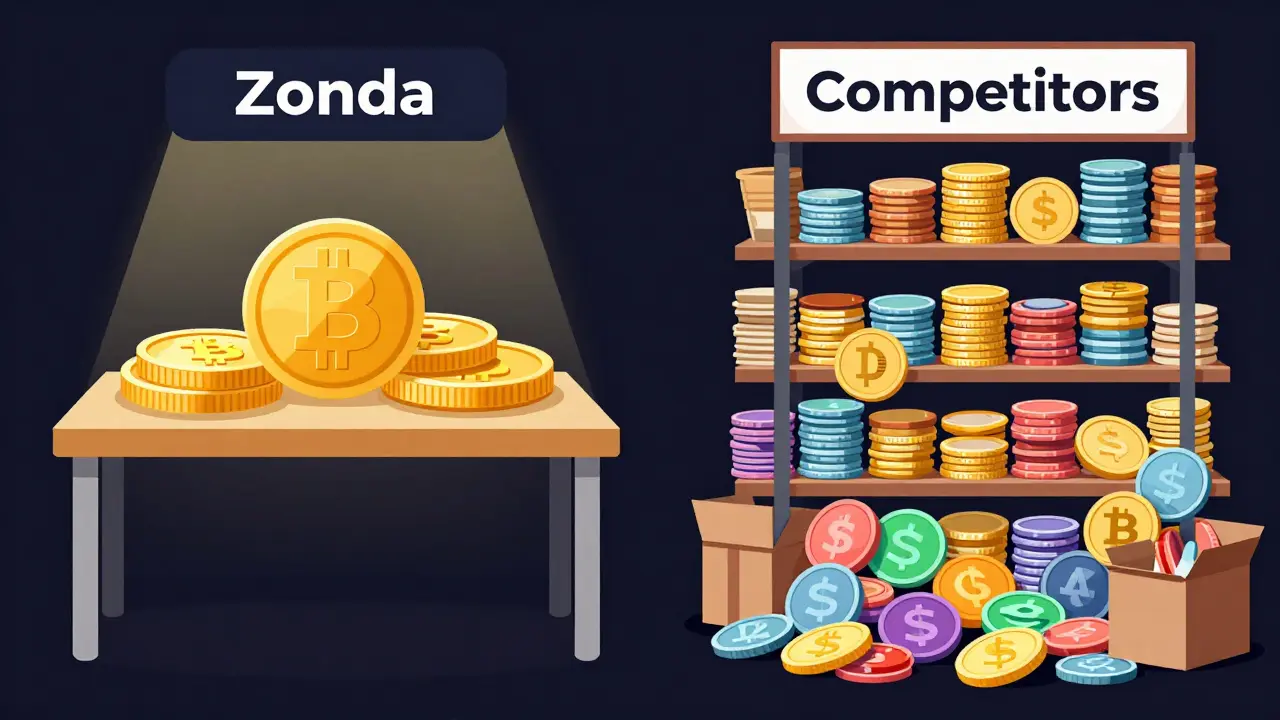
They process over 48 million USD in daily volume and handle more than 380,000 BTC annually. That’s serious liquidity for a mid-tier exchange. But here is the catch: they only support around 70 cryptocurrencies. Compare that to giants like OKX with 329 coins or Kraken with 278, and you’ll notice a gap. Zonda sticks to the top performers. You won’t find the next moon-shot meme coin here unless it breaks into the mainstream.
Fees and Trading Costs: What Will You Actually Pay?
Let’s talk money. Nobody likes paying fees, but every exchange needs them to survive. The confusion around Zonda’s pricing comes from different reporting sources, so I want to clear that up for you.
According to recent reviews from February 2026, the standard spot trading commission ranges between 0.3% and 0.5%. That sounds steep compared to Binance or Kraken, right? Here is where it gets interesting. BitCourier reported a more favorable structure for specific pairs. For example, there are no maker fees for BTC, ETH, or USDC trades. Taker fees can drop to 0.1% for BTC or USDC. If you are mostly providing liquidity (making orders) rather than taking it, your costs could be significantly lower than the headline numbers suggest.
Withdrawal fees are another area to watch. Cryptowisser noted a withdrawal fee of 0.0005 BTC, which is higher than Coinbase’s 0.000079. If you move large amounts frequently, these small percentages add up. Always check the current fee schedule on their site before moving significant capital, as these rates change.
| Feature | Zonda | Kraken | Coinbase |
|---|---|---|---|
| Supported Coins | ~70 | 278+ | 136+ |
| Maker Fee (BTC) | 0% - 0.3% | 0.16% | 0.25% - 2.00% |
| Taker Fee (BTC) | 0.1% - 0.5% | 0.26% | 0.25% - 2.00% |
| Futures/Derivatives | No | Yes | Limited |
| Demo Account | No | Yes | No |
Security and Regulation: Is Your Money Safe?
This is the big question. In crypto, trust is earned, not given. Zonda scores remarkably high here. Traders Union gave them a security rating of 9.75 out of 10 in February 2026. Why such a high score?
- Cold Storage: The vast majority of user funds are kept in cold wallets, meaning they are offline and inaccessible to hackers.
- Regulatory Compliance: As mentioned, they are licensed in Estonia and Italy. They are also preparing for DAC8 regulations, which will require stricter reporting of crypto transactions across Europe starting in 2026.
- No Major Hacks: Since their launch in 2021, there have been no successful breaches reported.
However, there are some quirks. Some reports mention SSL encryption and government regulation but note a lack of two-factor authentication (2FA) options in certain contexts. This seems contradictory, as most reputable exchanges mandate 2FA. If you sign up, ensure you enable every security layer available, including email verification and potentially hardware keys if supported. Also, note that they do not use facial recognition for security, which some users prefer for frictionless access, though others argue it adds unnecessary risk.
User Experience: Interface and Mobile App
If you hate cluttered screens with flashing red and green charts, Zonda will feel like a breath of fresh air. The interface is clean, intuitive, and designed for ease of use. You can buy crypto with Visa, Mastercard, or bank transfers with minimum deposits as low as €10 or $5. This makes it incredibly accessible for beginners who don’t want to deal with sending Bitcoin from one wallet to another.
For technical analysis, they integrate TradingView. This is a huge plus. TradingView is the industry standard for charting, so you get professional-grade tools without leaving the platform. However, there is no standalone desktop application. You have to use the web browser version. If you prefer dedicated software on your PC, this might annoy you.
The mobile app is another story. It holds a 3.9 rating on the iOS App Store. While functional, users report bugs and slower performance compared to competitors. It handles basic buying and selling fine, but if you rely heavily on your phone for active trading, you might find it lacking.
What Zonda Does NOT Offer
To give you a fair picture, I need to highlight what’s missing. Zonda is a spot-trading platform. That’s it. No fluff.
- No Leverage or Margin Trading: You cannot borrow funds to amplify your trades. If you want to go 10x long on Ethereum, you’ll need to look elsewhere.
- No Futures or Options: Derivatives trading is completely absent. This limits advanced hedging strategies.
- No Demo Account: There is no paper trading mode. You must use real money to learn the ropes. This is a downside for absolute beginners who want to practice risk-free.
- No Algorithmic Trading: If you run bots or API-driven strategies, Zonda’s limited API functionality will likely frustrate you.
These limitations aren’t necessarily bad. They reduce complexity and risk. But if you are an experienced trader used to the full suite of tools on OKX or Bybit, Zonda will feel restrictive.
Customer Support and Community Sentiment
When things go wrong, support is your lifeline. Zonda offers live chat and email support. Reviews from Trustpilot show a 4.1/5 average rating based on over 300 reviews. Users generally praise the responsiveness during European business hours. However, outside those hours, response times can drag.
On Reddit, opinions are mixed but realistic. One user noted, “Zonda's KYC process was surprisingly smooth compared to other EU exchanges.” Another complained, “Switched to Kraken after 3 months - needed futures trading that Zonda doesn't offer.” This reinforces the idea that Zonda is great for simple spot trading but leaves advanced users wanting more.
Withdrawal delays during periods of high market volatility have been cited as a complaint. This is common across many exchanges due to security checks, but it can be stressful if you’re trying to exit a position quickly.
Final Verdict: Should You Use Zonda in 2026?
Zonda is not trying to beat Binance at their own game. Instead, it carves out a niche as a safe, regulated, and easy-to-use exchange for Europeans. If you are in Poland, Italy, or nearby regions, and you want to buy Bitcoin or Ethereum with your local bank card without jumping through hoops, Zonda is an excellent choice.
It earns high marks for security and regulatory compliance. The integration of TradingView is a smart touch for technical traders. However, the limited coin selection, lack of derivatives, and mediocre mobile app are genuine drawbacks.
Use Zonda if you prioritize safety, simplicity, and fiat on-ramps. Avoid it if you need leverage, futures, or a massive variety of altcoins. For most retail investors in Europe looking for a straightforward way to enter the crypto market, it remains a reliable option in 2026.
Is Zonda crypto exchange safe?
Yes, Zonda is considered highly secure. It holds a 9.75/10 security rating from Traders Union (2026). It uses cold storage for funds, employs SSL encryption, and is regulated by financial authorities in Estonia and Italy. There have been no major hacks since its launch in 2021.
Does Zonda offer demo accounts?
No, Zonda does not offer a demo account or paper trading feature. All trading must be done with real funds. This makes it less ideal for complete beginners who want to practice without financial risk.
Can I trade futures on Zonda?
No, Zonda only supports spot trading. It does not offer futures, options, margin trading, or leverage. If you need derivatives, you should consider alternatives like Kraken or OKX.
What are the fees on Zonda?
Spot trading fees typically range from 0.3% to 0.5%. However, maker fees for major pairs like BTC and ETH can be 0%. Withdrawal fees vary by cryptocurrency but are generally competitive, though slightly higher than some global giants for Bitcoin withdrawals.
Is Zonda available in the United States?
Zonda primarily targets European markets and operates under EU regulations. It does not have specific US regulatory approvals (like SEC registration), so availability and compliance for US residents may be limited or non-existent. Check their official website for current geographic restrictions.
How many cryptocurrencies does Zonda support?
As of early 2026, Zonda supports approximately 70 cryptocurrencies. This is fewer than major competitors like Kraken (278+) or OKX (329+), focusing mainly on top-tier assets like Bitcoin, Ethereum, and stablecoins.
Jay Sharma
they say regulated but i know how these things work. its all about the data harvesting. they feed your info to the banks and then the banks decide if you can withdraw. cold storage is a lie for retail users, they just move it to hot wallets when the market pumps so they can rug pull or get hacked on purpose. dont trust any exchange that isnt fully decentralized. zonda is just another front for the fiat system to track every satoshi you touch.
Carl Hanzel
typical european mediocrity. why would anyone use this garbage when kraken exists? zero innovation, zero features, just a bunch of bureaucrats playing trader. absolute waste of time reading this.
Fiona Ellis
I actually tried signing up last week because I live in London and wanted something simple 🇬🇧 The interface is genuinely clean which I appreciate since I am not a day trader. However, the mobile app crashed twice while I was trying to verify my ID 😡 It was incredibly frustrating because I had prepared all my documents beforehand. I hope they fix the bugs soon otherwise it is useless for anyone who trades on the go.
John Curry
There is a profound irony in seeking safety within a digital asset class defined by its inherent volatility. Zonda attempts to bridge this gap by offering regulatory compliance, yet one must ask: does regulation truly protect the user, or merely the institution? The absence of derivatives is not a flaw, but perhaps a necessary restraint for those who do not understand the risks they are taking. We often mistake complexity for sophistication.
Rebecca Shoniker
The fee structure is an absolute nightmare for high-frequency traders!!! You cannot possibly compete with binance on liquidity without having deep order books!!!! The maker fees might be zero for btc but what about the slippage on smaller pairs??? It is completely unacceptable for a platform claiming to be professional to have such opaque pricing models!!!!
Melissa L
i like that they have tradingview built in. makes it easy to check charts without opening another tab. the app is kinda slow tho but works fine for buying stuff.
nancy jarecki
Only amateurs care about 'simplicity'. If you need hand-holding you should stick to mutual funds. The lack of API functionality renders this platform obsolete for any serious quantitative analysis. It is a toy store for retail investors who don't understand market microstructure. Pathetic.
Robert Hundley
Hey everyone! Just wanted to chime in because I've been using Zonda for a few months now and honestly it's pretty solid for what it is :) I'm not looking to trade futures or anything crazy, just want to buy some ETH and BTC safely. The fact that they are regulated in Estonia gives me peace of mind. Plus no hacks since 2021 is a great sign! Keep doing your research guys!
Sajjad Ghorbani Moghaddam
look man if you are new to crypto zonda is probably fine. dont overcomplicate it. just start small. learn the ropes. dont put all your money in at once. the fees arent the worst if you are just spot trading. take it from someone who has been around the block.
Nicole Woessner
as a us resident i cant even use most of these platforms properly due to sec regulations. seeing europeans have options like zonda makes me jealous. maybe we should lobby for clearer rules here instead of banning everything. it feels like we are left behind in the innovation game because of red tape.
Rob Morton
It is interesting to consider the psychological aspect of trading interfaces. A cluttered screen induces stress, which leads to poor decision-making. By stripping away the noise, Zonda forces the user to focus on price action rather than indicators. This minimalist approach could be beneficial for long-term holders who prefer a set-and-forget strategy. What do you think about the impact of UI design on trading performance?
Maurice Flynn
just chill and enjoy the ride. whether you use zonda or binance doesnt matter as much as your mindset. stay calm during dips. dont panic sell. the market will always bounce back eventually. keep learning and stay positive.
Jon Milton
Listen, I respect the regulatory stance but let's be real about the limitations. No futures means no hedging against bear markets. That is a massive oversight for risk management. I switched to Kraken specifically because I needed to short positions when the bubble burst last year. Zonda is fine for bulls but dangerous for bears who need tools to protect their capital. Don't sleep on the importance of derivatives.