You might have seen the headlines screaming that buying a single Bitcoin in Bangladesh could land you in jail for twelve years. It sounds like something out of a dystopian novel, doesn't it? But here is the twist: if you look at the actual court records and legal texts, you won't find anyone serving a decade behind bars just for trading crypto. So, what is actually going on? Is it a strict law, or is it a misunderstanding wrapped in regulatory fear?
The short answer is that while the threat exists on paper, the reality is much murkier. Bangladesh Bank, the country's central bank, has issued stern warnings since 2014. They state that cryptocurrency isn't legal tender and using it can violate existing financial laws. But did they actually create a specific "crypto crime" with a fixed 12-year penalty? Not exactly. Let’s break down where this number comes from, why the government is so cautious, and what happens if you get caught.
Where Did the 12-Year Number Come From?
To understand the panic, we need to look at the source. In September 2014, Bangladesh Bank released its first major cautionary notice regarding Bitcoin. Officials told media outlets, including AFP, that violations could lead to sentences of up to 12 years. This figure wasn't pulled out of thin air; it was an extrapolation from the Money Laundering Prevention Act 2012.
Here is the logic the regulators used:
- Section 9(1) of the Act: This section states that money laundering carries a rigorous imprisonment term of not less than one year but up to 10 years.
- Fines: The same section allows for fines up to 10 lakh taka (approximately $8,500 USD).
- The Extrapolation: By adding potential additional penalties or combining charges under different sections, officials suggested the total exposure could reach 12 years.
However, legal experts point out a critical flaw in this interpretation. The Act targets money laundering, not simple currency exchange. If you buy coffee with dollars in a country where dollars aren't legal tender, you aren't automatically a money launderer. You are just breaking a foreign exchange rule. Similarly, trading crypto doesn't inherently mean you are laundering money unless you are hiding the source of funds or moving them illicitly across borders.
The Legal Framework: Three Laws in One
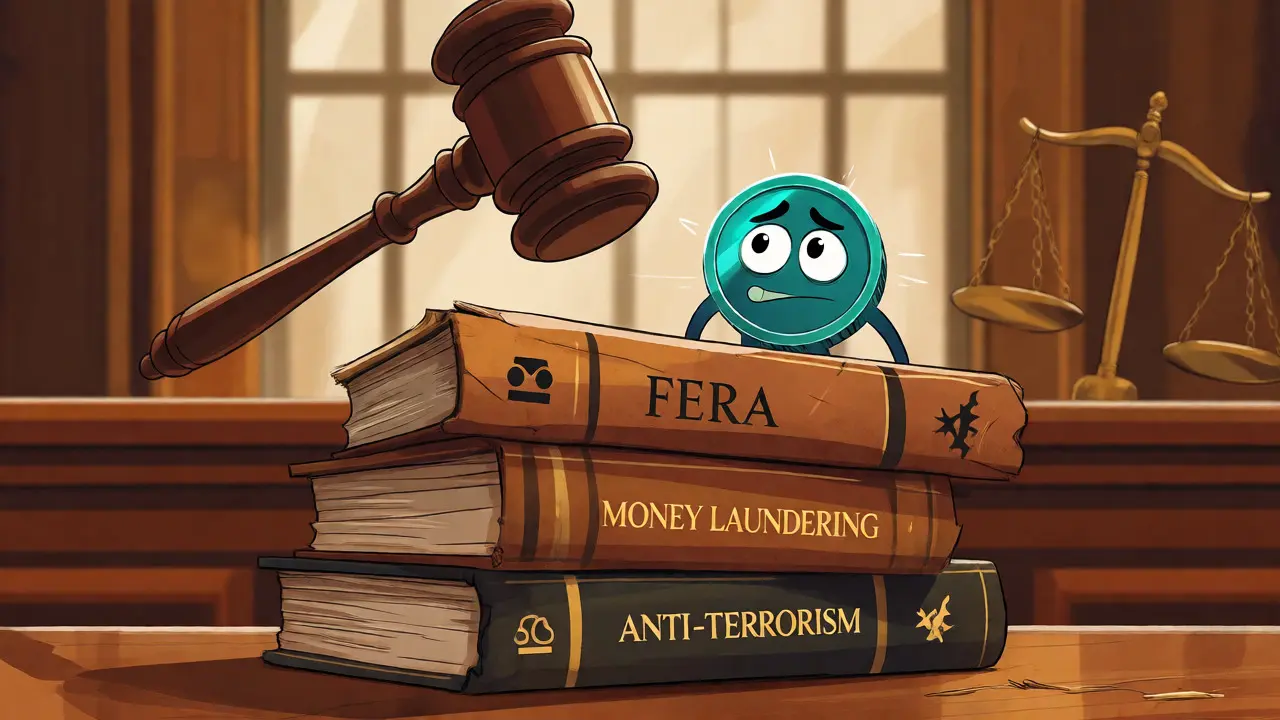
Bangladesh doesn't have a dedicated "Cryptocurrency Law." Instead, regulators rely on three older statutes to police digital assets. This patchwork approach creates confusion because these laws were written long before Bitcoin existed.
| Law Name | Year Enacted | Relevance to Crypto | Potential Penalty |
|---|---|---|---|
| Foreign Exchange Regulation Act (FERA) | 1947 | Regulates all foreign currency transactions. Crypto is treated as foreign currency. | Up to 5 years imprisonment for repeat offenses. |
| Money Laundering Prevention Act | 2012 (Amended 2015) | Targets illicit fund movements. Amended to include "virtual assets" in definitions. | Up to 10 years imprisonment + fines. |
| Anti-Terrorism Act | 2009 | Added in 2017 notices to cover funding risks via unregulated channels. | Varies based on terrorism financing charges. |
The most significant update came in 2015 when the Money Laundering Prevention Act was amended. Section 2(17) explicitly included "virtual assets" in its definition of property subject to anti-money laundering rules. This gave Bangladesh Bank more teeth. They argued that because crypto transactions often bypass traditional banks, they lack transparency. Therefore, any large-scale movement of crypto without proper documentation looks like money laundering.
Is It Actually Illegal to Own Bitcoin?
This is the million-dollar question-or rather, the billion-taka question. The consensus among legal scholars, such as those at Mahbub & Company, is that owning Bitcoin is not explicitly illegal. What is illegal is using it to violate other laws.
Think of it this way: If you use regular cash to bribe an official, you go to jail. If you use Bitcoin to pay for that same bribe, you also go to jail. The crime is the bribery, not the Bitcoin. However, because Bitcoin operates outside the banking system, proving the legitimacy of your funds becomes harder. If you can't show where your crypto came from, authorities assume the worst.
In December 2017, Bangladesh Bank issued a second cautionary notice. This time, they specifically named Bitcoin, Ethereum, Ripple, and Litecoin. They warned that transactions involving these currencies could violate FERA. Why? Because FERA requires all foreign exchange transactions to go through authorized dealers-basically, licensed banks. Since you can't buy Bitcoin directly from a Bangladeshi bank using Taka, every trade technically breaks this rule.
Enforcement Reality vs. Paper Threats
If the penalties are so severe, why aren't there mass arrests? The answer lies in enforcement priorities. As of 2025, there are no publicly documented cases of individuals receiving the full 12-year sentence solely for holding or trading small amounts of cryptocurrency.
According to the Anti-Money Laundering Department's 2022 annual report, only 37 cases related to "digital financial crimes" were filed nationwide. None of these resulted in maximum penalty sentences for simple trading. Most cases involve larger operations suspected of smuggling or tax evasion.
Here is what typically happens:
- Bank Freezes: If your local bank sees transfers to known crypto exchanges (like Binance or Huobi), they may freeze your account.
- Interrogation: Authorities may ask you to prove the source of funds.
- Fines: Small traders usually face fines rather than prison time.
- Confiscation: Large amounts of crypto involved in suspicious transactions may be seized.
A study by Chainalysis showed that despite the bans, cryptocurrency transaction volume in Bangladesh grew by 206% between July 2021 and June 2022. This suggests that people are still trading, likely through Peer-to-Peer (P2P) networks or offshore platforms, flying under the radar.
Why Is Bangladesh So Strict?
It’s easy to dismiss Bangladesh’s stance as backward, but their concerns are rooted in economic stability. The country has struggled with capital flight-money leaving the country faster than it enters. Cryptocurrency makes it incredibly easy to move wealth abroad without going through official channels.
For a developing nation trying to stabilize its currency, the Taka, unregulated crypto flows pose a real risk. If everyone starts buying Bitcoin instead of saving in Taka, the value of the local currency could drop. Additionally, there are fears about terrorism financing. The Financial Action Task Force (FATF) has noted inconsistent application of anti-money laundering standards in Bangladesh, which puts pressure on regulators to take a hard line.
Interestingly, the government isn't against blockchain technology itself. In 2020, they published a National Blockchain Strategy. They want to use blockchain for supply chains and record-keeping but remain wary of decentralized currencies that challenge the central bank's authority.

What Should You Do If You Live in Bangladesh?
If you are a resident or planning to do business there, tread carefully. The environment is described by analysts at Lightspark as "highly restrictive," even if it lacks specific legislation.
Here are some practical tips:
- Avoid Local Exchanges: There are no licensed domestic exchanges. Using international ones via P2P is common but risky.
- Keep Records: Document every transaction. If questioned, you need proof that your funds weren't involved in illegal activities.
- Small Amounts Are Safer: Enforcement focuses on large-scale operators. A few hundred dollars worth of crypto is unlikely to trigger a criminal investigation compared to millions.
- Don't Use Bank Transfers Directly: Many users avoid direct bank-to-exchange transfers to prevent automatic flags. Cash-based P2P trades are popular but carry their own risks.
Remember, the law is evolving. While the 12-year threat looms large in headlines, the actual practice is more nuanced. It’s a gray area where selective enforcement keeps traders nervous but active.
Comparing Bangladesh to Neighbors
How does Bangladesh stack up against its neighbors? China implemented a comprehensive ban in 2021, shutting down mining and trading entirely. India, on the other hand, moved from prohibition to taxation, recognizing crypto as an asset class. Bangladesh sits somewhere in between-a de facto ban driven by warnings rather than explicit prohibitive statutes.
This inconsistency creates challenges for consistent enforcement. The Bangladesh Securities and Exchange Commission acknowledged in 2023 that the absence of specific legislation makes it hard to apply rules uniformly. Until a clear crypto law is passed, the status quo will likely persist: high anxiety, low enforcement, and a thriving underground market.
Is cryptocurrency completely banned in Bangladesh?
Not explicitly. There is no specific law banning the ownership or trading of cryptocurrency. However, Bangladesh Bank warns that transactions may violate existing laws like the Foreign Exchange Regulation Act and the Money Laundering Prevention Act. Banks are prohibited from facilitating crypto transactions, making it difficult to enter or exit the market legally.
Can I really go to jail for 12 years for buying Bitcoin?
The 12-year figure is a theoretical maximum derived from interpreting money laundering laws strictly. In practice, no individual has been sentenced to 12 years solely for trading crypto. Most penalties involve fines or shorter prison terms if linked to serious financial crimes like fraud or large-scale smuggling.
Are P2P crypto trades legal in Bangladesh?
Peer-to-Peer (P2P) trading is common but exists in a legal gray area. While the trade itself isn't explicitly outlawed, using bank accounts to facilitate these trades can attract scrutiny from banks who monitor for unauthorized foreign exchange transactions. Cash-based P2P trades are less visible to regulators but carry security risks.
Does Bangladesh allow blockchain technology?
Yes. The government distinguishes between blockchain technology and cryptocurrencies. The National Blockchain Strategy 2020 encourages the use of blockchain for applications like supply chain management, healthcare, and public records, while remaining skeptical of decentralized digital currencies.
What happens if my bank freezes my account due to crypto?
If your bank suspects unauthorized foreign exchange activity, they may freeze your account pending an investigation. You will need to provide documentation proving the source of funds and the nature of the transactions. In many cases, accounts are unfrozen after clarification, but repeated issues can lead to account closure.

Nicoletta Milanesio
Wow, this is such a nuanced breakdown! 🤯 I always thought it was just a blanket ban like China's, but the distinction between owning vs. laundering is so important. The fear of capital flight makes total sense for their economy though. 🇧🇩💸 It’s wild how much anxiety exists over something that might not even be strictly illegal in practice. 😅
Daniel Pearson
It is frankly irresponsible to dismiss these regulations as mere "fear." Bangladesh has legitimate concerns about illicit financial flows and terrorism financing. If you cannot prove the source of your funds, you are essentially operating outside the law. Moral hazard is real here; people need to respect sovereign monetary policy instead of trying to bypass it with digital tokens.
Angel Bee
Hey, nice article! It really helps clear up the confusion. I think its great that theyre still using blockchain tech even if they hate the coins. Gives me hope that maybe other countries can find a middle ground too. Keep up the good work! 👍
Sandy Garg
The juxtaposition between the severe theoretical penalties and the lax enforcement creates a fascinating paradox regarding state authority and individual agency. One must consider whether the threat serves more as a deterrent against capital flight than a genuine intent to imprison traders. This regulatory ambiguity allows the state to maintain control without stifling the underground economy entirely, suggesting a pragmatic, albeit opaque, approach to modern finance.
Douglas Sorocco
While the analysis is adequate, it fails to address the geopolitical pressure from the FATF which dictates much of this policy. Without understanding the international compliance framework, one misses the root cause. Furthermore, comparing it to India ignores the distinct structural weaknesses in Bangladesh's banking infrastructure. :)
Joey Eden
The extrajudicial nature of the "virtual asset" classification under Section 2(17) is particularly troubling. By retrofitting anti-money laundering statutes onto decentralized ledgers, regulators create a chilling effect on innovation while failing to establish clear custodial responsibilities. The lack of licensed domestic exchanges exacerbates the opacity, forcing users into P2P channels where KYC/AML protocols are virtually non-existent. It is a classic case of regulatory arbitrage meeting institutional inertia.
Donald Underwood
You guys are missing the point. If it walks like a duck and quacks like a duck, it's a money launderer. Who cares about the legal technicalities? Just lock them up. Simple.
Genevieve LeMarchal
I love seeing how different cultures handle this! In my experience, when govs try to ban tech, it just goes underground. Its kinda sad but also cool that people find ways to trade anyway. Hope they figure out a fair system soon! 🌏✨
Sayantan Bhadury
Meh. Another country banning crypto because they don't understand it. Typical.
rose meechan
This is exactly why we need to stay informed! 💪 Knowledge is power. Even if the laws are strict, knowing the difference between holding and laundering changes everything. Let's keep pushing for clarity and fair treatment for all crypto enthusiasts! 🚀😊