Starting a cryptocurrency business used to mean navigating a legal gray area where regulations changed overnight. That era is over. In the United Arab Emirates, specifically within its specialized free zones, you now face one of the most structured-and strictly enforced-regulatory environments on the planet. If you are looking to launch an exchange, a wallet provider, or a token issuance platform in 2026, understanding which regulator holds the keys to your license is not just helpful; it is mandatory.
The UAE does not have a single "crypto law." Instead, it operates through a multi-layered framework involving federal authorities and specific free zone regulators. Getting this wrong can cost you months of delays and significant fees. This guide breaks down exactly how to set up your crypto business in UAE free zones, focusing on the two primary hubs for digital assets: VARA (Virtual Assets Regulatory Authority) in Dubai and ADGM (Abu Dhabi Global Market).
Understanding the Regulatory Landscape
Before you file any paperwork, you need to know who regulates what. The UAE’s approach is jurisdictional. Your choice of free zone dictates your regulator.
In Dubai, the VARA is the world's first dedicated virtual asset regulator. Established in 2022, VARA oversees all virtual asset activities across Dubai, including economic free zones like Dubai International Financial Centre (DIFC) exclusions aside. VARA’s mandate covers everything from exchanges and custody services to wallet provision and token issuance. It is designed for agility, allowing businesses to scale incrementally through a modular licensing system.
In Abu Dhabi, the game changes. The ADGM is an international financial free zone regulated by the Financial Services Regulatory Authority (FSRA). ADGM follows common law principles similar to the UK or US, making it attractive for institutional players, family offices, and traditional financial firms entering the crypto space. FSRA enforces stringent compliance standards that align with global financial benchmarks.
Then there is the federal level. The Securities and Commodities Authority (SCA) regulates crypto activities outside of free zones, primarily on the mainland. While relevant, most crypto startups prefer the tax benefits and streamlined processes of free zones, keeping them under VARA or ADGM rather than SCA jurisdiction.
Choosing Between VARA and ADGM
Your business model should dictate your location. There is no "better" regulator, only the right fit for your specific operations.
| Feature | VARA (Dubai) | ADGM (Abu Dhabi) |
|---|---|---|
| Regulatory Philosophy | Innovation-focused, modular licensing | Institutional-grade, strict compliance |
| Ideal For | Exchanges, wallets, DeFi protocols, startups | Custodians, fund managers, institutional brokers |
| Licensing Structure | Activity-specific (modular) | Comprehensive entity-level licenses |
| Capital Requirements | AED 100k - 1.5M (varies by activity) | Higher, often exceeding AED 1M+ |
| Legal Framework | Civil law based | Common law based |
If you are building a retail-facing exchange or a decentralized finance (DeFi) interface, VARA is likely your path. Its modular approach means you don’t need approval for every potential future service upfront. You apply for what you do today-say, fiat-to-virtual asset brokerage-and add custody later when you’re ready.
Conversely, if you are a hedge fund manager wanting to hold crypto assets, or a bank launching a digital asset custody service, ADGM provides the trust signal and legal certainty required by institutional clients. The barrier to entry is higher, but so is the credibility.
VARA Licensing Process and Costs
VARA’s process is transparent but demanding. Here is what you need to prepare for in 2026.
Step 1: Define Your Activity
VARA categorizes activities into specific modules. Common ones include:
- Exchange Services: Operating a platform for trading virtual assets.
- Broker Services: Acting as an intermediary between buyers and sellers.
- Custody: Holding private keys on behalf of clients.
- Wallet Provision: Issuing software or hardware wallets.
- Token Issuance: Creating and selling utility or security tokens.
Step 2: Meet Capital Requirements
You cannot operate without skin in the game. Paid-up capital requirements vary significantly based on risk. For lower-risk activities like advisory services, you might start with AED 100,000 ($27,000). For high-risk activities like running an exchange or providing custody, expect to lock up between AED 500,000 and AED 1.5 million ($135,000 to $408,000). These funds must be held in a local bank account.
Step 3: Submit Application and Fees
Application fees range from AED 40,000 to AED 100,000 depending on the complexity of the license. Once approved, you will pay annual supervision fees ranging from AED 80,000 to AED 200,000. Budget for these recurring costs early; they are non-negotiable.
Step 4: Compliance and Technology Audit
This is where most applications stall. VARA requires robust Anti-Money Laundering (AML) and Combating the Financing of Terrorism (CFT) frameworks. You need:
- A designated Money Laundering Reporting Officer (MLRO).
- Real-time transaction monitoring systems.
- Secure infrastructure audits (often requiring third-party cybersecurity firms).
- Clear data privacy policies compliant with UAE laws.

ADGM Licensing Overview
The ADGM process is less about modularity and more about holistic fitness. The FSRA evaluates your entire business plan, governance structure, and risk management capabilities.
Key differences include:
- Fit and Proper Tests: Every director, shareholder, and senior manager undergoes rigorous background checks.
- Business Plan Scrutiny: FSRA expects detailed projections, risk assessments, and contingency plans.
- Physical Presence: You must maintain a physical office in the ADGM free zone with staff present during working hours.
While ADGM doesn’t publish a fixed fee schedule like VARA, expect professional service fees for legal counsel and compliance consultants to run high. Institutional licenses here often cost upwards of AED 200,000 in initial setup costs, excluding capital reserves.
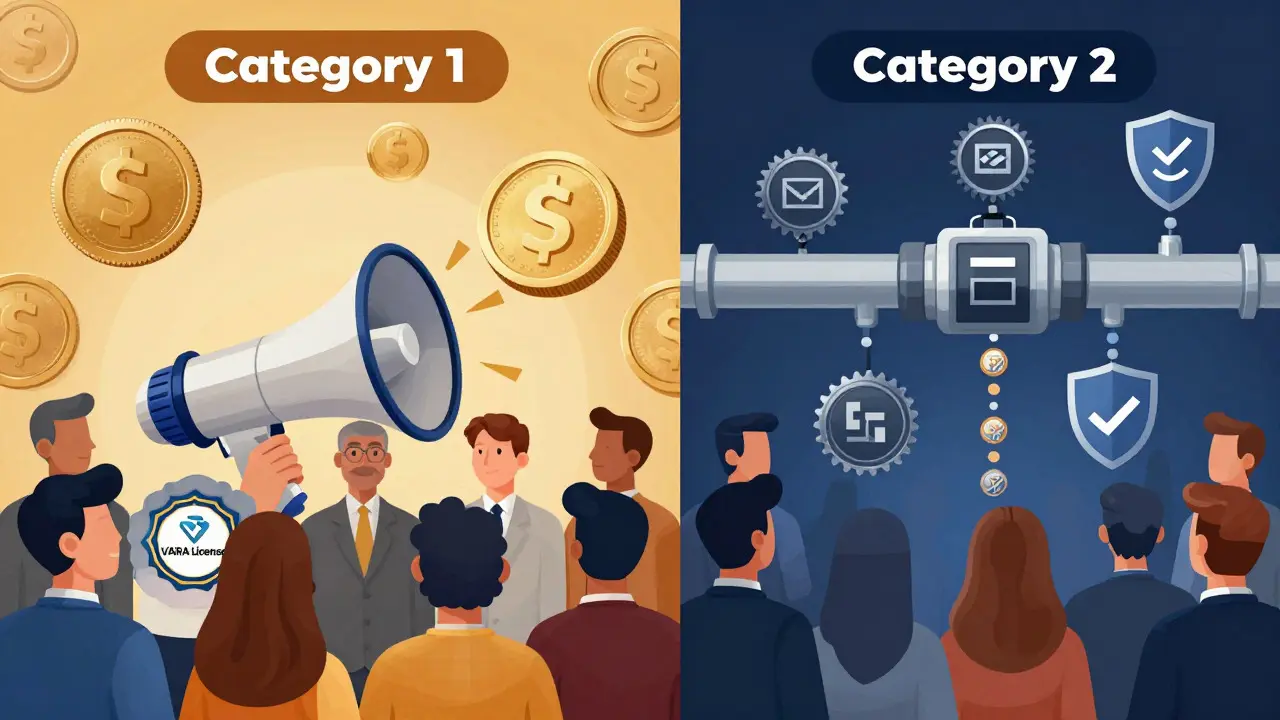
Token Issuance: Category 1 vs Category 2
If your business involves issuing tokens, VARA splits this into two categories. Understanding this distinction saves you from applying for the wrong license.
Category 1 Tokens are those issued directly to the public or a broad group of investors. These require a full VARA license plus specific project approval. Think Initial Coin Offerings (ICOs) or Security Token Offerings (STOs).
Category 2 Tokens are distributed through a licensed distributor. If you are a startup creating a utility token for your ecosystem, you might partner with a VARA-licensed exchange or broker to handle the distribution. This reduces your regulatory burden but ties you to a third party’s compliance standards.
Note: Closed-loop tokens (used only within a specific merchant’s ecosystem, like loyalty points) may be exempt from licensing but still fall under VARA’s oversight for consumer protection.
Common Pitfalls to Avoid
Even with clear rules, mistakes happen. Here are the most frequent issues I see entrepreneurs face:
- Assuming One License Covers All: Having an exchange license does not automatically allow you to offer custody services. You need separate approvals for each module.
- Underestimating Compliance Costs: Hiring a qualified MLRO and implementing KYC/AML software is expensive. Factor this into your burn rate.
- Ignoring Mainland Restrictions: If you operate in a free zone but market aggressively to mainland residents without proper cross-border permissions, you risk penalties. Stick to your licensed jurisdiction initially.
- Poor Documentation: VARA and FSRA reject applications with vague business plans. Be specific about your target market, technology stack, and revenue model.
Next Steps for Your Setup
Ready to move forward? Start by mapping your core activities. Are you trading? Storing? Issuing? Then, choose your hub based on your client base. Retail and tech-native projects lean toward VARA. Institutional and finance-heavy projects lean toward ADGM.
Engage a local legal consultant early. They can help you navigate the fit-and-proper tests and ensure your AML framework meets the exact specifications of your chosen regulator. Finally, secure your paid-up capital before submitting your application. Delays in funding verification are the easiest fix but cause the most frustration.
How long does it take to get a crypto license in UAE?
The timeline varies by regulator and complexity. With VARA, the process typically takes 3 to 6 months from initial application to final approval, assuming all documentation is complete. ADGM processes can take longer, often 6 to 9 months, due to their rigorous institutional review standards. Delays usually occur during the compliance audit phase if your AML/KYC systems need adjustment.
Can I hold a license in both VARA and ADGM?
Yes, it is possible to hold licenses in both jurisdictions if your business operates across both Dubai and Abu Dhabi. However, this doubles your compliance costs and administrative burden. Most companies choose one primary regulator and establish subsidiaries or partnerships if they need access to the other market.
What are the tax implications for crypto businesses in UAE free zones?
Free zones in the UAE offer significant tax advantages. Generally, there is 0% corporate tax on qualifying income within the free zone, provided you meet certain substance requirements. However, note that the UAE introduced a federal Corporate Tax of 9% on profits exceeding AED 375,000 in 2023. Free zone entities can often claim exemption if they conduct qualifying activities and maintain adequate economic substance. Always consult a tax advisor to ensure compliance with the latest Federal Tax Authority rules.
Do I need a physical office for my crypto license?
Yes. Both VARA and ADGM require you to have a physical presence in their respective free zones. This includes leasing office space and having staff physically present during business hours. Virtual offices or PO boxes are generally not accepted for regulated virtual asset activities due to the need for on-site inspections and operational substance.
Is it possible to operate a crypto business in UAE mainland?
Yes, but it is regulated by the Securities and Commodities Authority (SCA) rather than VARA or ADGM. Mainland setups are more common for companies targeting direct B2B relationships with mainland banks or government entities. However, the approval process is often slower, and the regulatory framework is less specialized for crypto compared to the free zones. Most pure-play crypto startups prefer free zones for speed and clarity.


Pernelia Wahkan
The modular licensing structure at VARA is a genuine game-changer for startups that need to pivot without drowning in red tape. Most jurisdictions treat every new feature as a brand new regulatory hurdle, but here you can just add the custody module later when your treasury actually needs it. It feels like they built the system for engineers who think in sprints rather than lawyers who think in centuries. The capital requirements are steep, sure, but knowing exactly where the money goes gives me more peace of mind than vague promises elsewhere.
Ed Mitchell
They call it structured regulation but I see nothing but a velvet trap designed to bleed dry anyone with actual innovation. The federal corporate tax introduction was just the opening salvo. Now they want physical offices and staff presence? It is clearly about creating jobs for local bureaucrats while suffocating the digital nomad spirit that crypto was supposed to champion. Do not trust the 'innovation' label; it is merely marketing for compliance industrial complexes.
Ed Wallace
One must ponder whether the strictness of ADGM creates a moat or a wall. On one hand, institutional players crave the common law certainty that mirrors London or New York, which makes sense for heavy capital flows. On the other hand, does this rigidity stifle the very disruptive nature of decentralized finance? It seems we are trading chaos for order, but perhaps we are losing the soul of the technology in the process of making it palatable for hedge funds.
Marcia Albert
I just sit back and watch these founders stress over AED limits while the real action happens on-chain regardless of where the server is hosted. The whole debate between VARA and ADGM feels like arguing over which luxury hotel has better valet parking when the car itself is driving off a cliff anyway. But hey, if you have the budget for a physical office in Dubai, go ahead and play the game. Just do not expect it to save you from market cycles.
Emma Smith
look at the token issuance categories again because most people miss the nuance there category 1 vs 2 is basically public vs private distribution logic wrapped in legal jargon. if you are doing an ico you are walking into a minefield unless you have deep pockets for the full license. partnering with a licensed distributor for cat 2 tokens is smarter but then you are beholden to their compliance standards which can be a nightmare. also dont forget the closed loop exemption for loyalty points its a huge loophole for retail apps
Carl Michaud
The narrative of 'structured environment' is a disingenuous facade masking the predatory nature of state-sanctioned financial extraction. By forcing entities into free zones, the UAE effectively creates captive markets where regulatory capture is inevitable. The so-called 'modular' approach is merely a mechanism to maximize fee generation per activity type. Furthermore, the reliance on third-party cybersecurity audits ensures that data sovereignty remains an illusion. We are witnessing the bureaucratization of liberty under the guise of security.
Rita Dutta
Actually the SCA mainland option is often overlooked by these tech bros who only care about free zones. If you are targeting B2B relationships with government entities on the mainland, the SCA license is non-negotiable despite the slower process. Also the 9% corporate tax applies to profits above AED 375k so dont assume zero tax forever. Free zone exemptions require substantial economic substance which means real employees not just virtual offices. Many startups fail because they ignore the substance requirements and get hit with penalties later.
Paul Smith
Love the detailed breakdown! 🇦🇪✨ The comparison table is super helpful for visualizing the differences. It really highlights how VARA is tailored for the agile startup scene while ADGM plays nice with the big institutional whales 🐋. Just remember that having a physical office is a must for both, so factor in those rent costs early on! Good luck to everyone navigating this space! 🚀💼
Rodmun Tarnowski
Indeed, the clarity provided by this guide is most welcome. It is imperative that entrepreneurs understand the distinct philosophical divergences between VARA and ADGM. One should not underestimate the rigor of the fit-and-proper tests in Abu Dhabi. Every director and shareholder will be scrutinized with microscopic precision. Therefore, ensure your governance structures are impeccable before submission. Delays are costly, and preparation is paramount. Well articulated piece!
Matthew Smith
the moral decay of finance is evident in how easily we accept these complex regulatory labyrinths. why must we choose between civil and common law frameworks when the underlying asset is code? it seems we are building cathedrals of bureaucracy on top of sand. yet here we are optimizing for compliance rather than truth. perhaps the real issue is our collective desire for permissioned systems in a permissionless world. we sanction our own chains
Prudence Flemming
the kycaml overhead is insane but necessary evil i guess. most projects die in the audit phase because they think software alone solves compliance. you need human oversight mlro designation is not just a title its a liability shield. varas modular approach lets you scale but adgm forces holistic fitness which scares away small players. ultimately its about risk appetite and client profile. retail wants speed institutions want trust
Matt Kay
too long didnt read but looks expensive. prob better to stay offshore until u have millions.
Dave Kjendal
Most people skip the part about cross-border permissions. You can be in a free zone but if you market to mainland residents without proper setup you get fined. Its a classic trap. Also the timeline of 3-6 months for VARA is optimistic if your docs are messy. Just pick a good lawyer and pay up. Life is short dont waste time on paperwork errors.
Joshua Hofford
This is a fantastic resource for anyone looking to legitimize their operations in the region. The cultural shift towards embracing regulated innovation in the UAE is truly inspiring. It shows a forward-thinking mindset that balances tradition with modernity. Whether you lean towards the agility of VARA or the stability of ADGM, the key is engagement and transparency. Let us continue to build bridges between traditional finance and the digital frontier. The future is bright for those who prepare wisely.
Erica Johnson
Everyone keeps talking about the benefits but nobody mentions the hidden costs of maintaining dual licenses if you expand. Holding both VARA and ADGM licenses doubles your administrative burden significantly. Most companies should stick to one primary regulator and use subsidiaries if needed. Also the MLRO salary expectations in Dubai have skyrocketed due to demand. Factor that into your burn rate or you will be scrambling within six months 😒
Michael Mostyn
The distinction between Category 1 and Category 2 tokens is particularly salient for project founders. It dictates not only the licensing pathway but also the strategic partnerships required for distribution. One might argue that the Category 2 route offers a pragmatic compromise for utility tokens, allowing startups to leverage existing infrastructure. However, this dependency introduces counterparty risk that must be meticulously managed. The regulatory landscape demands rigorous adherence to these classifications to avoid punitive measures.