Imagine filing your taxes without opening a single spreadsheet. You just check the numbers, sign, and done. That is exactly where automated crypto tax reporting is heading. By 2026, the days of manually tracking every swap on Uniswap or calculating cost basis for that one-off NFT sale are rapidly disappearing. Instead, global regulators and tech giants are building a system where your wallet talks directly to the tax authority. It sounds like science fiction, but it is already happening. The OECD’s Crypto-Asset Reporting Framework (CARF) and the EU’s DAC8 directive have turned this from a concept into a mandatory reality for millions of investors.
This shift isn't just about convenience; it is about closing a massive loophole. The International Monetary Fund estimated a $10 billion annual tax gap in crypto compliance before these systems went live. Now, with 112 tax administrations exchanging data automatically, that gap is shrinking fast. But what does this mean for you? Whether you are a casual Bitcoin holder or a DeFi power user, understanding how these automated systems work is no longer optional-it is essential for avoiding penalties and maximizing your after-tax returns.
The Regulatory Backbone: CARF, DAC8, and Form 1099-DA
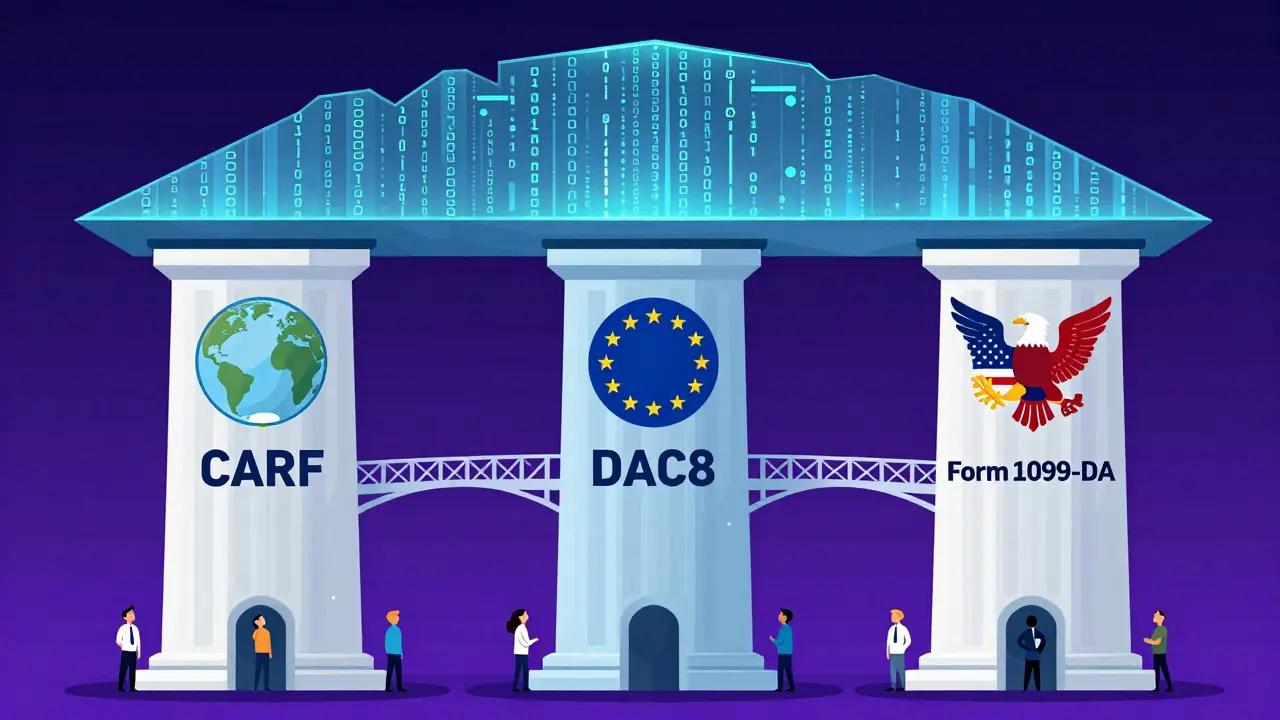
To understand the future, you have to look at the three pillars currently holding up the house. They operate differently but share the same goal: visibility. The most ambitious is the OECD’s Crypto-Asset Reporting Framework (CARF). Launched fully in 2025, CARF allows countries to exchange data on crypto transactions across borders. If you are a US citizen living in Germany, both countries can now see your trades. This multilateral approach has achieved a 92% cross-border data capture rate, far outpacing national-only systems.
In Europe, the DAC8 Directive took effect on January 1, 2025. Unlike CARF, which relies on international cooperation, DAC8 mandates that any platform serving EU citizens must report data, regardless of where the platform is based. This direct reporting model ensures that even offshore exchanges cannot hide their users' activities from European tax authorities. Meanwhile, the United States introduced Form 1099-DA via IRS Notice 2024-39. Effective for 2025 transactions (reported in 2026), this form requires US-based exchanges to send detailed transaction reports directly to the IRS and the taxpayer. While limited to US entities, it marks a significant departure from the old 1099-B forms that often lacked crucial cost basis details.
| Framework | Scope | Cross-Border Capture Rate | Key Strength | Main Limitation |
|---|---|---|---|---|
| CARF (OECD) | Multilateral (112 jurisdictions) | 92% | Global data exchange | Depends on bilateral treaties |
| DAC8 (EU) | EU residents (global platforms) | 84% | Jurisdiction-independent reporting | Complex asset classification |
| Form 1099-DA (US) | US taxpayers/exchanges | 76% | High accuracy for CEXs | Excludes self-custody/DeFi |
How the Technology Actually Works
You might wonder how a machine knows that you swapped ETH for SOL and calculated your profit correctly. The answer lies in a multi-layered technical architecture. At the core are blockchain analytics engines like Chainalysis Reactor and Elliptic Horizon. These tools don't just watch transactions; they attribute them. According to MIT’s Digital Currency Initiative, these systems achieve 98.7% transaction attribution accuracy. They process over 1.2 million transactions per second across 28 different blockchain networks, identifying not just who sent what, but why-distinguishing between a trade, a transfer, or a staking reward.
This data is then standardized using XML schemas defined by the OECD. The latest version, Schema 2.1, includes 37 mandatory fields. This means your wallet address, timestamp (down to the millisecond), and asset classification are all formatted uniformly so that any tax authority in the world can read it instantly. For centralized exchanges, this process is nearly seamless, with an average reporting latency of just 72 milliseconds. However, decentralized finance (DeFi) presents a tougher challenge. Here, latency jumps to 4.2 seconds, and only 63% of Uniswap v3 transactions are properly attributed due to the complexity of liquidity pools. As you dive deeper into DeFi, you will find that the automation is less perfect, requiring more manual oversight than simple spot trading.
The DeFi and NFT Blind Spots
While the system works brilliantly for buying Bitcoin on Coinbase, it struggles with the wild west of DeFi and NFTs. This is where many users get tripped up. A joint study by CoinGecko and TaxBit found that 31% of users with multi-chain activity face cost basis miscalculations. Why? Because bridging assets between Ethereum and Solana often breaks the audit trail. CertiK’s transparency report notes that 18.7% of bridge transactions remain untraceable, leaving tax algorithms guessing.
NFTs are another headache. Royalty payments are notoriously hard to track. NonFungible.com’s 2025 report shows that 47% of royalty payments remain unreported. For creators and collectors alike, this creates a risk of under-reporting income. Similarly, staking rewards are treated inconsistently. Only 31% of DeFi platforms correctly calculate taxable events for staking, according to CoinDesk. Until the OECD updates its standards further, you need to be extra careful here. The automation handles the easy stuff well, but the complex stuff still needs human eyes.
Privacy vs. Transparency: What Users Are Saying
Does all this monitoring feel like Big Brother watching your portfolio? Many people think so. A survey of 1,287 Reddit threads revealed that while 68% of users are happy with the reduced manual work, 74% express concern about privacy. One common sentiment from r/CryptoTax was that seeing wallet-to-wallet transfers reported to the IRS feels like overreach, even if those transfers aren't technically taxable events. This tension between compliance and privacy is driving innovation. The OECD is currently testing decentralized identity solutions that allow for privacy-preserving compliance, ensuring that tax authorities get the data they need without exposing every minor transaction to public view.
Despite the concerns, the benefits are tangible. Users report saving an average of 15 hours per year in manual tracking. Trustpilot reviews for major crypto tax software show a 4.1/5 rating, with high praise for automated exchange integration. The key takeaway is that while the system is intrusive, it is also efficient. It removes the guesswork and the risk of simple errors, which are far more common than intentional evasion.

Preparing Your Workflow for 2026
So, how do you prepare? First, clean up your digital footprint. The average crypto user maintains 3.7 distinct wallets. Consolidating where possible makes reconciliation easier. Second, ensure your API connections are active. Most platforms complete API integration within 48 hours, but delays happen. Start early. Third, invest in specialized software. The market for crypto tax software hit $5.04 billion in 2025, growing by 20% year-over-year. Tools like Koinly and CoinTracker now feature "Protocol Tax Engines" that maintain thousands of specific rules for different DeFi protocols. These tools update in real-time, handling the nuances that generic accounting software misses.
If you are a professional, note that the learning curve for these systems has dropped significantly. It used to take 80 hours to master; now it takes about 22. CPA firms are hiring dedicated blockchain tax specialists, with average salaries reaching $142,500. This signals that crypto tax is becoming a standard, specialized field rather than a niche hobby. Documentation quality varies, so rely on official handbooks. The EU’s DAC8 Implementation Handbook is rated highly for clarity, while US guidelines still have room for improvement. Always double-check your local jurisdiction's specific interpretation of global standards.
What Comes Next: AI and Harmonization
The next few years will bring even more sophistication. The IRS released DATS 2.0 in July 2025, introducing real-time monitoring with 94.2% accuracy for identifying taxable events. This means the lag between your trade and the tax authority knowing about it is shrinking to near zero. Looking ahead, Deloitte predicts that by 2027, crypto tax reporting will be fully embedded within standard financial statements. No more separate workflows. Crypto will just be another line item, handled by the same systems that manage your stocks and bonds.
Four critical evolution paths are emerging: AI-powered tax optimization engines, global harmonization of asset classification, decentralized identity for privacy, and quantum-resistant encryption. The World Economic Forum estimates that by 2030, this infrastructure will process 8.2 billion daily transactions, making it as fundamental to finance as SWIFT payments today. The future isn't just about reporting; it's about optimizing. As the systems mature, they won't just tell you what you owe-they will suggest how to structure your holdings to minimize that amount legally.
Is automated crypto tax reporting mandatory for everyone?
Yes, for most users in regulated jurisdictions. If you use a centralized exchange in the US, EU, or other CARF-participating countries, reporting is automatic. However, self-custody users and DeFi participants may still need to manually verify data if their protocols are not yet fully integrated with tax APIs.
How accurate are current blockchain analytics for DeFi?
Accuracy is high for standard swaps but lower for complex interactions. Around 63% of Uniswap v3 transactions are properly attributed automatically. Cross-chain bridges have an 18.7% untraceability rate. Always review DeFi-specific reports manually to catch errors.
What is the difference between CARF and Form 1099-DA?
CARF is a global framework allowing countries to exchange data. Form 1099-DA is a specific US document sent by exchanges to the IRS and the taxpayer. CARF enables cross-border visibility, while 1099-DA focuses on domestic compliance for US-based entities.
Do I need new software for 2026 reporting?
If you were using basic spreadsheets, yes. You should switch to dedicated crypto tax software that supports API integrations and protocol-specific tax rules. These tools handle the new XML schemas and automated data feeds much better than manual methods.
Will my private wallet transactions be tracked?
Indirectly, yes. If you move funds from a private wallet to an exchange, the exchange reports it. Analytics firms can often link wallet addresses to identities through past interactions. Pure off-chain cold storage is harder to track, but any on-chain movement leaves a trace.



Write a comment