You deploy your new decentralized application. The code looks clean. The tests pass. You launch it on the mainnet, and within three weeks, $8.2 million vanishes into a hacker’s wallet. This isn’t a hypothetical nightmare; it’s a documented reality in the blockchain world. In 2024, the average cost of a smart contract exploit hit $1.87 million, according to Immunefi’s annual report. For many projects, that single mistake is fatal.
This is why Blockchain Security Audits are systematic evaluations designed to identify vulnerabilities in blockchain networks and smart contracts before they go live. They are not just a checkbox for investors or a marketing badge. They are the primary defense mechanism against catastrophic financial loss. But how exactly do these audits work? Who performs them? And more importantly, can you actually trust the results?
The Anatomy of an Audit Process
When you hire a firm like CertiK or OpenZeppelin, you aren’t just paying for someone to read your code. You are entering a rigorous, multi-phase methodology that typically spans two to four weeks for medium-complexity projects. Let’s break down what happens behind the scenes.
Phase 1: Planning and Scoping (10-15% of time)
Before a single line of code is scanned, auditors sit down with your team to define boundaries. What is in scope? Is it just the core token contract, or does it include the staking mechanism and the oracle integration? According to the USCSI Institute’s 2024 framework, this phase is critical because scope creep-where new features are added mid-audit-is reported in 41% of cases, leading to rushed reviews and missed bugs.
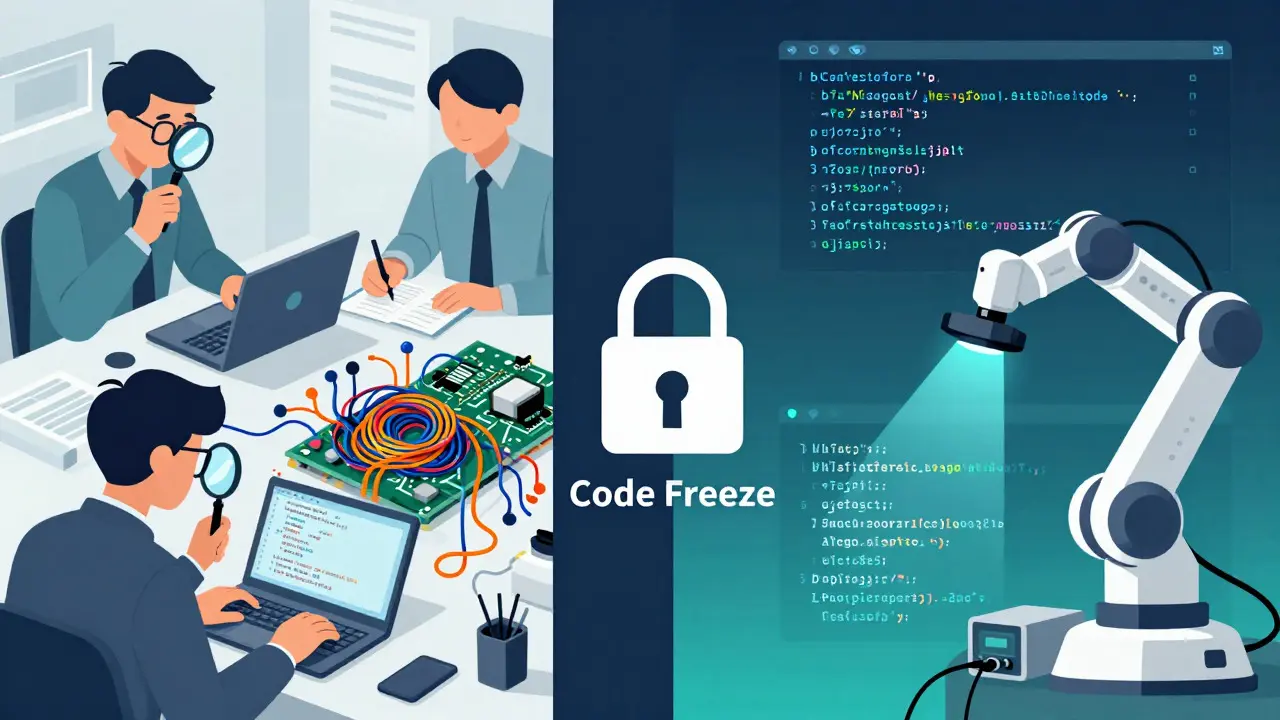
Phase 2: Documentation and Code Freeze (5-10% of time)
Your team must implement a strict code freeze. No more changes. You submit whitepapers, architectural diagrams, and the complete codebase. If the documentation doesn’t match the code, the audit fails before it begins. Chainstack reports this phase consumes about 5-10% of the total duration, but it sets the foundation for everything else.
Phase 3: Technical Examination (The Core Work)
This is where the magic-and the money-goes. Auditors use a hybrid approach:
- Automated Static Analysis: Tools like Slither and MythX scan 100% of code paths for common patterns. They are fast and exhaustive but prone to false positives.
- Manual Review: Human experts focus on the 20-30% of code that matters most-the critical logic. As Ledger Academy’s 2023 guide notes, humans catch the nuance that machines miss, such as complex economic incentive flaws.
- Dynamic Testing: Contracts are deployed on testnets to simulate real-world interactions. Penetration testing mimics attack vectors like flash loan exploits.
- Formal Verification: For high-stakes functions, tools like Certora Prover mathematically prove that specific properties hold true under all conditions.
Phase 4: Reporting and Remediation
The auditor delivers a detailed report listing every vulnerability found, categorized by severity (Critical, High, Medium, Low). Your developers then fix these issues. Crucially, 43% of audited projects require multiple rounds of re-auditing before achieving satisfactory security, per a 2024 Chainstack case study.
Types of Audits: Which One Do You Need?
Not all audits are created equal. Choosing the wrong type is like bringing a knife to a gunfight. Here is how the three main categories compare:
| Audit Type | Focus Area | Duration | Cost Range (2024) | Best For |
|---|---|---|---|---|
| Smart Contract Audit | Application-layer code (reentrancy, access control) | 2-4 Weeks | $15,000 - $50,000 | DeFi protocols, NFT projects, dApps |
| Protocol-Level Audit | Consensus mechanisms, network architecture, game theory | 4-8 Weeks | $50,000 - $200,000 | Layer 1 blockchains, new consensus models |
| Infrastructure Audit | Oracles, storage solutions, cross-chain bridges | 3-6 Weeks | $20,000 - $80,000 | Cross-chain apps, data-dependent systems |
Smart contract audits make up 78% of all blockchain audits, according to Chainlink’s 2024 statistics. They excel at catching improper access controls-a flaw found in 32% of unaudited contracts per OpenZeppelin’s database. However, they often miss systemic network-level weaknesses. If you are building a new Layer 1 chain, a simple smart contract audit is insufficient. You need a protocol-level audit that examines incentive structures, something Dr. Emin Gün Sirer of Ava Labs emphasized in a 2024 interview.
The Limitations: Why Audits Aren't Silver Bullets
Here is the hard truth: An audit is not a guarantee of security. It is a risk reduction tool. Dr. Christian Reitwiessner, creator of Solidity, stated clearly in 2023: "No audit can provide 100% security guarantees; they can only reduce risk to acceptable levels through thorough examination."
Why are they imperfect?
- Complex Logic Flaws: Professor Andrew Miller of the University of Illinois published findings in IEEE Security & Privacy (March 2024) showing that while audits catch 85-90% of common vulnerabilities, they miss 62% of complex logic flaws. These require specialized formal verification, which is expensive and time-consuming.
- False Sense of Security: Dr. Ari Juels noted in Communications of the ACM that current practices often focus on known vulnerabilities while novel attack vectors emerge weekly. Projects see the "Audited by" badge and relax their vigilance.
- Implementation Gaps: Immunefi’s 2024 breach report revealed that 27% of exploited projects had undergone at least one audit but failed to implement all recommended fixes. The audit was done; the action wasn’t.
Furthermore, there is a growing concern about "audit shopping," where projects seek multiple firms until they receive favorable results. Chainalysis’ 2024 security trends analysis documented this behavior in 18% of projects. Always check if a project has implemented the fixes from previous audits, not just if they have a badge.
Choosing an Auditor: Market Leaders and Costs
The blockchain audit industry is valued at $315 million in 2024, with significant consolidation. The top five firms-CertiK, OpenZeppelin, Trail of Bits, Quantstamp, and PeckShield-control 68% of the market. But who should you choose?
CertiK holds a 22% market share and is known for its Skynet monitoring platform, which provides continuous post-audit surveillance. Users praise their detailed documentation (mentioned in 73% of positive Trustpilot reviews) but criticize high costs for small projects.
OpenZeppelin (18% market share) is renowned for its Defender suite for runtime protection and its open-source community contributions. Their audit checklist was downloaded over 12,000 times in Q3 2024 alone, indicating strong developer trust.
Trail of Bits (12% market share) specializes in formal verification and deep technical analysis, making them a top choice for complex protocol-level audits.
For smaller projects, the cost barrier is real. A standard smart contract audit costing $15,000-$50,000 can be prohibitive. This is why the Ethereum Foundation announced a $5 million grant program in September 2024 to subsidize audits for community projects under $500,000 in valuation. If you are a startup, look for these grants or consider bounty-based models, like the one OpenZeppelin introduced in October 2024.
Practical Steps for Developers
If you are preparing for an audit, here is how to ensure it goes smoothly:
- Prepare Early: Start documenting your architecture months in advance. Use standardized vulnerability classification systems like the SWC Registry.
- Freeze Code Strictly: Implement a code freeze 3-5 days before the audit starts. Any changes during the audit reset the clock and increase costs.
- Allocate Time for Remediation: Don’t expect to fix everything in a day. A Chainlink Education Hub survey found that development teams need 40-60 hours of study to fully comprehend technical findings.
- Communicate Clearly: Communication gaps between developers and auditors are cited in 33% of challenges. Schedule regular triage sessions to discuss findings immediately.
- Plan for Post-Audit Monitoring: The audit ends when the report is delivered, but security doesn’t. Consider services like CertiK’s Skynet or OpenZeppelin’s Defender for ongoing protection.
The Future of Blockchain Auditing
The landscape is evolving rapidly. The Blockchain Security Alliance released Version 2.1 of its Audit Standard Framework in August 2024, introducing mandatory testing for economic attack vectors. By Q2 2025, quantum-resistant cryptography assessments will become part of standard protocols.
Regulatory pressure is also driving change. The SEC’s 2024 Crypto Audit Framework requires proof of third-party audits for token offerings above $5 million, and the EU’s MiCA regulations mandate regular security audits for crypto asset service providers. Gartner predicts that by 2026, 80% of audit firms will adopt the Baselining Audit Maturity Model, standardizing quality across the industry.
As Forrester noted in November 2024, blockchain audits are becoming mandatory infrastructure, similar to financial statement audits in traditional finance. The market is projected to reach $850 million by 2027. For developers, this means audits are no longer optional-they are a prerequisite for survival.
How much does a blockchain security audit cost?
Costs vary significantly based on complexity. A standard smart contract audit typically ranges from $15,000 to $50,000 for 5,000-10,000 lines of code. Protocol-level audits for Layer 1 chains can cost between $50,000 and $200,000. Prices scale linearly with code complexity and the depth of analysis required, such as formal verification.
How long does a blockchain audit take?
A medium-complexity smart contract audit usually takes 2-4 weeks. Protocol-level audits can take 4-8 weeks. This timeline includes planning, automated scanning, manual review, and reporting. However, 43% of projects require multiple audit rounds, extending the total time to production readiness.
Can an audit guarantee my smart contract is secure?
No audit can provide a 100% security guarantee. Audits reduce risk by identifying known vulnerabilities and logical flaws, but they may miss complex economic incentives or novel attack vectors. Dr. Christian Reitwiessner emphasizes that audits only reduce risk to acceptable levels. Continuous monitoring and bug bounties are essential complements to audits.
What is the difference between static and dynamic analysis in audits?
Static analysis uses automated tools like Slither to scan code without executing it, checking for syntax errors and common patterns across 100% of code paths. Dynamic analysis involves deploying the contract on a testnet and interacting with it to simulate real-world attacks, revealing runtime bugs that static tools might miss.
Which audit firms are considered the best in 2024?
The top firms include CertiK (known for Skynet monitoring), OpenZeppelin (renowned for community tools and Defender), and Trail of Bits (specialized in formal verification). Other notable players are Quantstamp and PeckShield. Choice depends on your specific needs: CertiK for comprehensive monitoring, OpenZeppelin for DeFi standards, and Trail of Bits for complex protocol architecture.

Dina Lazarova
One must acknowledge that the reliance on such superficial 'audits' is merely a placebo for the uninitiated masses who lack the technical acumen to understand true cryptographic security. It is rather tedious to watch projects pat themselves on the back for hiring CertiK, as if that badge confers any actual invulnerability against sophisticated state-level actors or novel exploit vectors. The article correctly identifies the limitation of static analysis, yet it fails to emphasize how deeply entrenched the culture of performative security has become in the industry.
alex fordy
I really appreciate this breakdown because it highlights the human element so clearly 🧠✨. It’s easy to forget that behind every line of code there are people making decisions under pressure. The part about communication gaps resonates with me personally since I’ve seen teams struggle when they treat auditors like vending machines instead of partners. We need more empathy in tech, especially when millions are on the line 😊🤝.
Nia Franklin
Oh my gosh!! This is SUCH a crucial topic!!! I mean, seriously, who would have thought that freezing your code could be so dramatic?!? But yes, the scope creep thing is wild!! Like, imagine starting a project and then adding features mid-audit... it’s chaos!!! I love how you explained the different types of audits though!!! It makes me feel smarter just reading it!!! 🌈💖
Mohamed Shoaeb
pretty solid overview overall. i think the point about remediation time is often overlooked by founders who want to launch yesterday. taking 40-60 hours to truly understand findings isn't laziness its respect for the craft. most devs rush this step and end up patching one bug while creating two others. chill approach works better here than panic mode
SHIV SHANKAR KANTA
The moral decay of the industry is palpable. Auditors sell their souls for fees while developers feign ignorance. It is a theater of cruelty where the innocent users bear the brunt of greed. You speak of 'risk reduction' but ignore the spiritual void left by broken trust. The numbers do not lie but they also do not weep for the victims of these digital heists.
Daniel Brown
You mention OpenZeppelin's Defender suite but fail to disclose whether you hold tokens in their ecosystem. Transparency is key in an article about security. If you are recommending specific tools based on market share without disclosing potential conflicts of interest, you are undermining the very principle of trust you claim to uphold. Readers deserve to know if this is genuine advice or sponsored content disguised as education.
Uday N M
Western firms dominate this narrative again. Indian developers build robust systems daily without needing these expensive audits. Our engineering talent is superior and cost-effective. The global standard should reflect our contributions not just the US-centric view of security.
Hicham Mounir
Hey everyone! 👋 Let's keep this conversation respectful and helpful. Dina raises a valid point about performative security, and Alex reminds us of the human side. For those new to this, remember that audits are just one layer. Think of it like wearing a seatbelt-it doesn't prevent accidents, but it saves lives when they happen. Don't let the complexity scare you off; start small, document well, and seek mentorship. We're all learning together! 🚀💙
Ami Elizabeth
i mean its cool but honestly most peeps just copy paste code from github anyway so why bother auditing?? just ship it lol
michelle aguilar
How utterly quaint to assume that 'copy-pasting' is a viable strategy for anyone with even a shred of professional ambition!!! One simply cannot afford to be so casual with other people's life savings!!! The pretension of thinking that informal practices yield formal results is laughable!!! Please, do try to take this seriously!!! 💅✨