Imagine a country where the government doesn’t just regulate cryptocurrency mining-it runs it. In Iran, a nation facing severe international economic sanctions, crypto mining has become more than a side hustle; it is a strategic tool for survival and profit. But this isn’t your typical decentralized network of home miners in basements. Here, massive industrial farms are controlled by powerful state entities, primarily the Islamic Revolutionary Guard Corps (IRGC), using subsidized electricity that costs pennies compared to global rates.
This setup creates a bizarre paradox. On one hand, Iran claims to be regulating the industry to protect its grid. On the other, its most powerful military and political factions operate semi-secretly, draining national power supplies to mine Bitcoin and generate hard currency outside the reach of Western banks. If you’re trying to understand how state-controlled crypto mining in Iran functions, you need to look past the official laws and into the shadowy infrastructure built on military bases and sports complexes.
The Rise of the Crypto Cartel
To understand why the Iranian state entered the mining business, you have to look at the timeline. Before 2018, crypto was largely ignored or viewed with suspicion. However, as U.S. sanctions tightened, cutting off access to the SWIFT banking system, Tehran needed a way to move money across borders. In July 2018, President Hassan Rouhani’s administration officially recognized mining as a legal industry. The goal? To monitor operations and create a backdoor for international transactions.
But legalization didn’t mean equal opportunity. By 2019, the real players arrived. The IRGC and organizations linked to Supreme Leader Ali Khamenei began establishing massive mining facilities. They didn’t do it alone; they partnered with Chinese companies who were eager to exploit Iran’s incredibly cheap energy. One prime example is the 175-megawatt Bitcoin farm in Rafsanjan, Kerman province. This joint venture between an IRGC-linked enterprise and Chinese investors consumes enough power to supply hundreds of thousands of homes, yet it operates with minimal oversight.
| Factor | Iran (State-Affiliated) | Global Commercial Average |
|---|---|---|
| Electricity Cost | ~$0.004 per kWh | ~$0.05 - $0.10 per kWh |
| Regulatory Scrutiny | Minimal / Exempted | High / Strict Compliance |
| Hardware Access | Government-approved or smuggled ASICs | Open market purchase |
| Primary Goal | Sanctions evasion & Profit | Profit & Market Share |
The cost advantage is staggering. While commercial miners elsewhere pay five to ten cents per kilowatt-hour, state-affiliated operators in Iran often pay less than half a cent. This margin allows them to remain profitable even when global hash rates spike or Bitcoin prices dip. It also means they can absorb losses that would bankrupt private competitors.
Hidden Infrastructure and Public Outrage
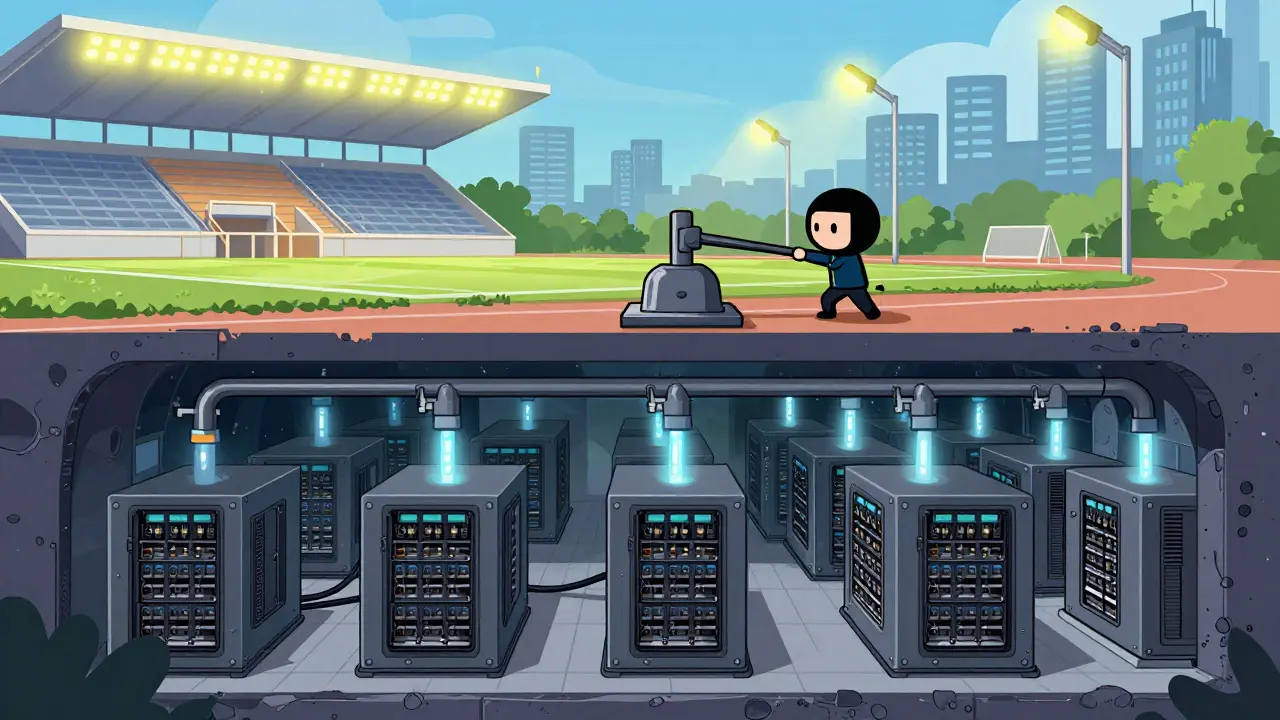
You might expect these farms to be located in industrial zones. Sometimes they are. But often, they are hidden in plain sight. Investigative reports from NCR-Iran revealed a shocking discovery in Ahvaz: a large-scale mining operation running inside the Shahid Ghorbani Sports Complex. Miners had dug tunnels beneath the cycling track and installed servers in service rooms. For over two years, this facility operated undetected, drawing power meant for public services.
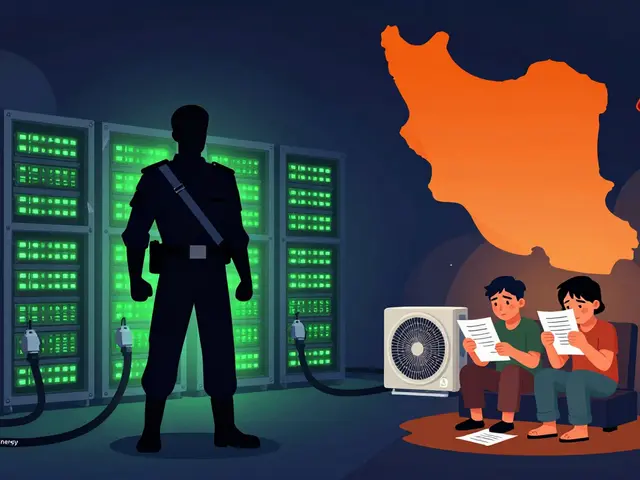
This secrecy fuels public anger. Iranians live through frequent blackouts, especially during summer heatwaves when temperatures soar above 45°C (113°F). Citizens take to social media, posting videos of dark streets and failed air conditioners, while hashtags like #IranEnergyCrisis trend. The frustration is palpable: factories shut down due to rationing, hospitals struggle with backup generators, and ordinary people suffer-while IRGC-linked farms keep humming uninterrupted.
The contradiction is stark. The Ministry of Industry, Mine and Trade issues licenses for legal miners, requiring them to use specific hardware and pay higher tariffs (reportedly around 7 cents per kWh). Yet, enforcement is selective. Legal miners face strict power cuts during peak demand, while state-affiliated entities enjoy "dedicated power feeds" that bypass these restrictions. This double standard has led many to describe the sector as a "crypto cartel" that prioritizes regime profits over national stability.
Navigating Sanctions and Financial Controls
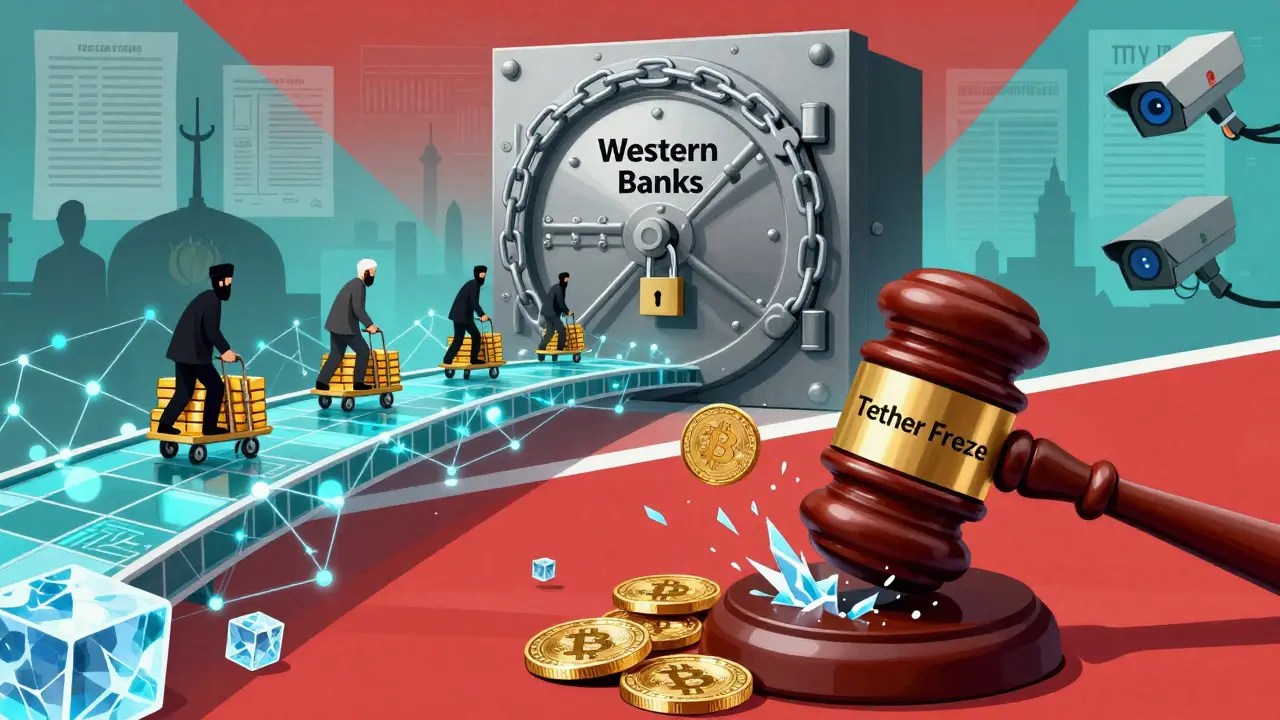
Crypto mining in Iran isn’t just about energy; it’s about financial warfare. The mined Bitcoin and other cryptocurrencies serve as a lifeline for circumventing sanctions. The Central Bank of Iran (CBI) has attempted to tighten control, introducing measures that oscillate between suppression and regulation. In early 2025, the CBI ordered the closure of rial payment gateways for crypto exchanges, citing lack of transparency and unpaid taxes. Later, they partially reversed this, but only after demanding API access that gave authorities full visibility into user data.
International pressure continues to mount. In July 2025, Tether executed its largest-ever freeze of Iranian-linked funds, blocking 42 addresses connected to Nobitex, Iran’s largest domestic exchange, and wallets flagged by counter-terrorism agencies. This move disrupted established transaction patterns. In response, Iranian authorities urged users to shift from USDT to DAI via the Polygon network, demonstrating a rapid adaptation to preserve liquidity despite global crackdowns.
The introduction of the "Law on Taxation of Speculation and Profiteering" in August 2025 marked another shift. For the first time, capital gains tax was imposed on cryptocurrency trading, placing digital assets alongside gold and real estate. This signals Tehran’s intent to capture revenue from a sector that once flew under the radar. However, the effectiveness of this tax remains questionable given the opacity of state-affiliated operations.
Technical Realities and Hardware Constraints
Running a mining operation in Iran requires navigating technical hurdles beyond politics. Most facilities rely on ASIC miners, specialized computers designed solely for hashing algorithms like SHA-256. These machines generate immense heat and consume vast amounts of electricity. In a country with an aging power grid, cooling these units is a major challenge. Many farms use passive cooling methods or are located in cooler regions, though this adds logistical complexity.
Legal miners face additional constraints. They must use government-approved hardware, which investigative sources suggest is often older or less efficient than top-tier models available globally. This reduces mining efficiency by 15-20%, putting licensed operators at a disadvantage compared to their state-backed counterparts who may import newer equipment through informal channels. The learning curve for new entrants is steep, not just technically, but politically. Success often depends less on engineering skill and more on having connections within the IRGC or religious foundations like Astan Quds Razavi.
The Future of State-Controlled Mining
Where does this leave Iran’s crypto sector? It sits at a precarious intersection of economic necessity and systemic instability. On one side, the regime needs crypto to bypass sanctions and generate foreign currency. On the other, the energy crisis threatens to undermine basic societal functions, leading to unrest. Experts note that tensions persist between regulatory ambitions and the reality of unchecked exploitation by powerful elites.
As international scrutiny increases, expect more freezes and restrictions from entities like Tether and blockchain analytics firms. Domestically, the push for taxation and surveillance will likely intensify. The government wants to control the narrative and the profits, creating a tightly monitored ecosystem where dissent is difficult and exit strategies are limited. For now, the lights stay on in the mining farms, even if the rest of the country goes dark.
Is cryptocurrency mining legal in Iran?
Yes, mining is technically legal but heavily regulated. Operators must obtain licenses from the Ministry of Industry, Mine and Trade, use approved hardware, and pay specific electricity tariffs. However, enforcement is inconsistent, and state-affiliated entities often operate outside these rules with impunity.
Who controls the majority of crypto mining in Iran?
The Islamic Revolutionary Guard Corps (IRGC) and organizations linked to Supreme Leader Ali Khamenei control significant portions of the sector. They operate large-scale farms, often in partnership with foreign investors, benefiting from subsidized energy and minimal regulatory oversight.
How does crypto mining affect Iran's power grid?
Mining consumes a substantial amount of national electricity, contributing to frequent blackouts and power rationing, especially during summer peaks. While legal miners face strict cuts, state-affiliated operations often continue running, exacerbating public frustration and energy shortages.
Why did Tether freeze Iranian-linked funds in 2025?
Tether froze 42 addresses linked to Iran’s largest exchange, Nobitex, and IRGC-affiliated wallets, citing compliance with international sanctions and counter-terrorism financing regulations. This was part of a broader effort to restrict illicit financial flows involving stablecoins.
What are the electricity costs for miners in Iran?
State-affiliated miners often pay extremely low rates, estimated at around $0.004 per kWh. Legal miners face higher tariffs, reportedly around 7 cents per kWh, though enforcement varies. These costs are significantly lower than global averages, providing a competitive advantage.

Write a comment