Most people jump into liquidity providing thinking it's a "set it and forget it" passive income stream. They deposit some tokens, see a juicy APY, and walk away. Then, a few weeks later, they check their dashboard only to find their portfolio is worth less than if they had just held the tokens in a wallet. This is the harsh reality of Managing Liquidity Pool Positions: if you aren't active, the market will likely eat your profits.
To make this work, you have to stop thinking like a passive investor and start thinking like a fund manager. Whether you're using a simple 50/50 pool or a complex concentrated range, your goal is to balance fee collection against the risk of asset divergence. If you can master the art of rebalancing and range setting, you can turn a losing position into a consistent revenue stream.
Quick Start: The Basics of LP Positions
Before getting into the weeds, let's define what we're actually doing. A Liquidity Pool is a crowdsourced pool of cryptocurrencies locked in a smart contract that facilitates trading on a decentralized exchange (DEX). When you provide assets to this pool, you become a Liquidity Provider (LP).
In the early days, this was simple. You put in equal values of two tokens, and you earned a slice of every trade. But as the market matured, the tools got more complex. Today, the big players are Uniswap, Curve Finance, and Balancer. Each handles your money differently, and choosing the wrong one for your risk tolerance can be a costly mistake.
Key Takeaways for Beginners:
- Fee Tiers: Volatile pairs (like ETH/USDC) usually have higher fees (0.3% or 1%) to compensate for risk, while stablecoin pairs are much lower (0.01% to 0.05%).
- Asset Ratios: Most standard pools require a strict 50/50 ratio. If you're off, you'll hit slippage costs that can eat 0.5% to 1.2% of your initial deposit immediately.
- The Trade-off: Stablecoin pools offer lower returns (typically 2-4% APY) but almost zero risk of major loss. Volatile pairs can hit 15% or more, but the risk is significantly higher.
Solving the Impermanent Loss Puzzle
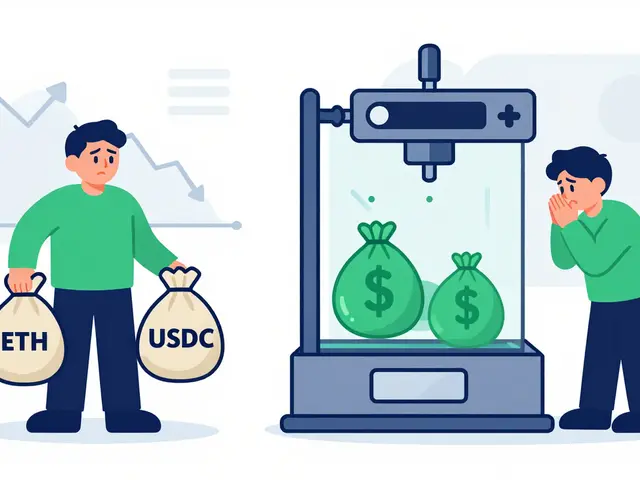
You can't talk about liquidity without mentioning Impermanent Loss. It's the "ghost in the machine" of DeFi. Impermanent loss occurs when the price of your deposited assets changes compared to when you deposited them. The AMM automatically rebalances your holdings, meaning you end up with more of the underperforming asset and less of the winning one.
Think of it this way: if ETH price skyrockets, the pool sells your ETH for USDC to keep the ratio balanced. You still have profit, but you have *less* profit than if you had just held the ETH in your cold wallet. If the price drops, you're left holding a larger bag of a crashing asset.
How do you manage this? The pros use a few specific rules of thumb:
- Stay Close to Price: Keeping your range within 15% of the current market price can reduce loss exposure by up to 60-70%.
- Pair Matching: Pair assets that move together (correlated assets). For example, pairing two different liquid staking derivatives (like stETH and ETH) minimizes divergence.
- Fee Buffer: Your position is only "profitable" when the accumulated trading fees exceed the amount lost to impermanent loss. If the volume is low, you're just gambling on price action.
Mastering Concentrated Liquidity (Uniswap V3)
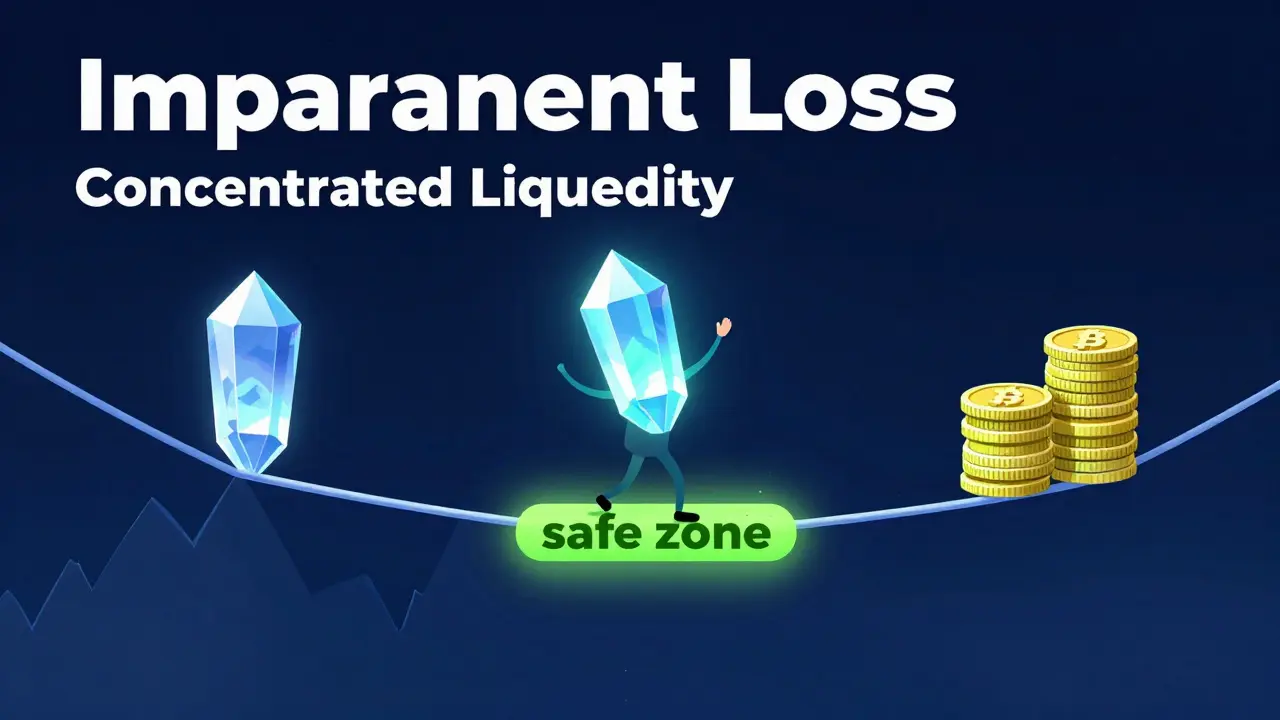
If you've used Uniswap V3, you know about Concentrated Liquidity. Instead of providing liquidity across the entire price curve from zero to infinity, you pick a specific price range. For instance, if ETH is at $2,000, you might set your range from $1,800 to $2,200.
This is a game-changer for capital efficiency. You can earn the same amount of fees with a fraction of the capital. In some cases, this increases efficiency by up to 4,000x compared to old-school pools. However, there's a catch: if the price moves outside your chosen range, your position becomes "inactive." You stop earning fees entirely, and you're left holding 100% of the cheaper asset.
| Strategy | Management Level | Capital Efficiency | Risk Profile | Typical Yield |
|---|---|---|---|---|
| Full Range (V2 style) | Low (Passive) | Low | Moderate IL | Lower (5-10%) |
| Concentrated (V3) | High (Active) | Very High | High IL / Range Risk | Higher (15-30%+) |
| Stablecoin Pools | Low | Moderate | Very Low | Low (2-4%) |
To manage these positions, you can't just check them once a month. Successful LPs often spend 15-20 hours a month monitoring charts. If a token moves 15-20% in either direction, it's usually time to rebalance your range to keep capturing those fees.
The Professional's Workflow: 7 Steps to Success
If you want to treat this as a financial operation rather than a hobby, follow this structured process. This is the same logic used by institutional-grade providers to keep their drawdowns low.
- Security Audit: Don't trust a pool just because the APY is 1,000%. Check if the protocol has at least two independent audits and a multi-year uptime record.
- Volume Analysis: Use DefiLlama to check the Total Value Locked (TVL). Look for pools with at least $10 million in TVL and $1 million in daily trading volume. High TVL with low volume means you're fighting for crumbs.
- Price Modeling: Use a position simulator to see how much you'll make if the price goes up 10% versus down 10%. Determine your breakeven point.
- Precision Swapping: Swap your assets to the exact ratio required by the pool. Avoid fat-finger mistakes that lead to unnecessary slippage.
- Tight Approvals: When interacting with the smart contract, specify the exact amount of tokens you're approving. Never give "unlimited allowance" if you can avoid it; this is how most drain-wallet exploits happen.
- Weekly Health Checks: Check your composition every week. Are you too heavy in one asset? Is your range still valid?
- Tranche Exits: When you decide to close the position, do it in tranches during low-volatility periods to avoid getting hit by massive slippage.
Diversification and Risk Mitigation
Putting all your capital into one ETH/USDC pool is a recipe for stress. Even the best protocols can have a bug. A smarter approach is to diversify across at least three different protocols to hedge against smart contract failure.
A balanced, risk-adjusted portfolio often looks like this:
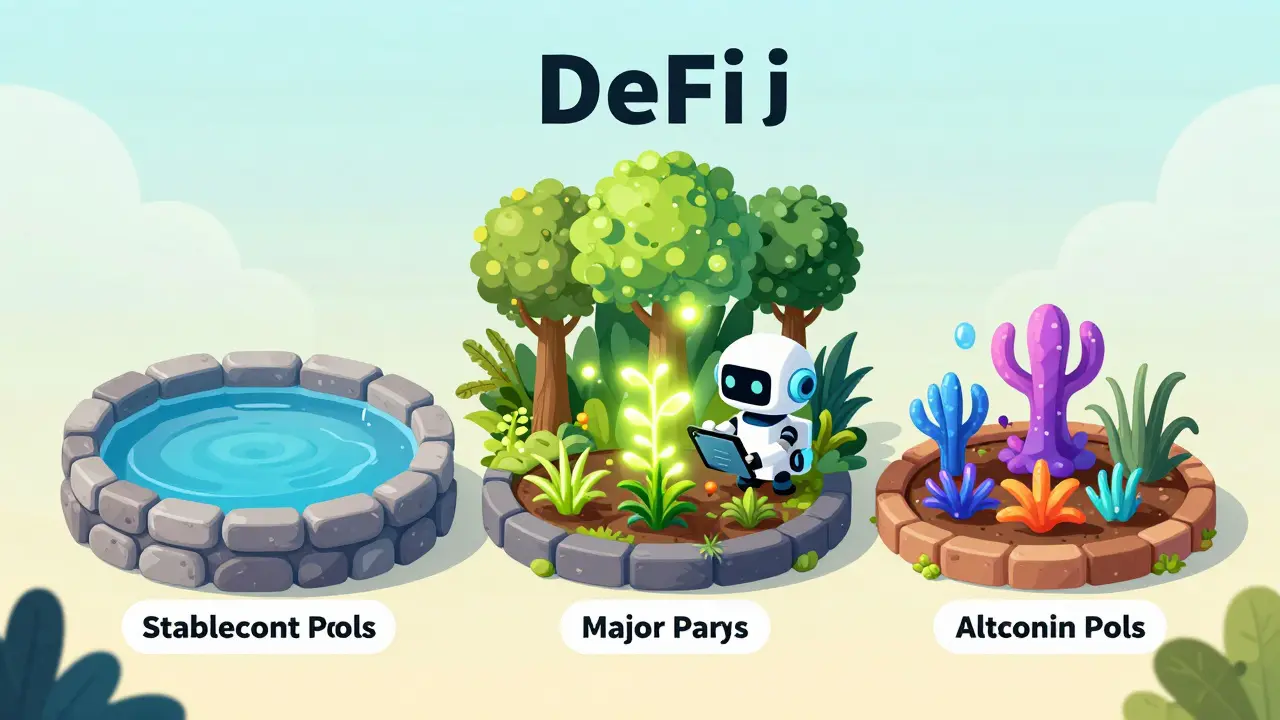
- 40% in Stablecoin Pools: (e.g., USDC/DAI on Curve) This is your "safe haven" that provides a baseline return.
- 35% in Major Pairs: (e.g., ETH/USDC on Uniswap) This is where you capture the bulk of the trading volume.
- 25% in Altcoin/Custom Weights: (e.g., using Balancer's 80/20 pools) This allows you to hold a diversified basket of tokens while still earning fees.
This strategy is particularly effective during market crashes. Data shows that diversified LPs experience significantly lower drawdowns because the stability of the stablecoin pools offsets the volatility of the altcoin positions.
Automation and the Future of LPing
The manual grind of adjusting ranges is slowly being replaced by automation. Tools like Uniswap's Position Manager and SWAAP's Autopilot use machine learning to shift price ranges automatically. These tools can reduce your management time by over 60% while potentially increasing net returns by 12-18% by reacting to price swings faster than a human can.
We're also seeing a shift toward institutional-grade liquidity. With the introduction of permissioned pools, big firms can now provide liquidity while meeting KYC/AML requirements. For the average user, this means deeper liquidity, lower slippage, and more stable pools, though it might mean the era of 100% "anonymous" yield farming is winding down.
Is liquidity providing actually "passive income"?
Not really. While it's marketed that way, successful LPing requires active management, especially with concentrated liquidity. If you ignore your position and the price moves out of range, you stop earning fees and may suffer significant impermanent loss. It is more of a dynamic financial operation than a passive investment.
How do I know if I'm losing money to impermanent loss?
Compare the current value of your LP position (including accrued fees) to what the value would be if you had simply held the original assets in your wallet (HODL value). If the HODL value is higher, you've experienced impermanent loss. Analytics tools like Zapper.fi can help calculate this in real-time.
What is the safest way to start?
Start with a small amount-around 0.1 to 0.5 ETH equivalent. Begin with stablecoin pools on Curve or Uniswap to get a feel for how the interface works without worrying about price crashes. Once you understand the mechanics, move into a volatile pair but use a wide price range to minimize the need for constant rebalancing.
Do gas fees matter when managing positions?
Absolutely. On the Ethereum mainnet, a single range adjustment can cost anywhere from $1.50 to $50 depending on congestion. If your position is small, a few rebalances a month could wipe out all your earned fees. Always check a gas tracker like Etherscan before making a move.
What is a "safe" TVL for a pool?
While there is no magic number, a minimum of $10 million in Total Value Locked (TVL) generally indicates a healthy pool with enough depth to prevent extreme slippage. More importantly, look for consistent daily trading volume of at least $1 million to ensure there are enough trades to generate meaningful fees.
Next Steps and Troubleshooting
If you're just starting, don't throw all your capital in at once. Spend a few hours using a position simulator to see how different price ranges affect your returns. If you find your transactions are failing during high volatility, it's likely due to gas spikes; try increasing your priority fee or waiting for a quieter window.
For those already in positions: if you notice a significant token imbalance during withdrawal, don't panic. This is a normal result of the AMM rebalancing. Use partial withdrawals and strategic swaps to return your portfolio to your desired allocation. As you grow, look into automated range managers to reclaim your time while keeping your yield optimized.

Write a comment