You put your crypto into a decentralized exchange to earn fees. You watch the dashboard turn green for a few days. Then, the market shifts. Suddenly, your portfolio looks worse than if you had just held the tokens in your wallet. This isn’t bad luck; it is how liquidity pools work.
Liquidity pools are the engine of DeFi (Decentralized Finance). They replace human market makers with code. But that code introduces specific, often misunderstood dangers. If you treat providing liquidity like parking money in a savings account, you will likely lose value. The difference between profit and loss usually comes down to understanding three main threats: impermanent loss, smart contract failure, and malicious project owners.
The Mechanics of Impermanent Loss
Impermanent loss is the most common risk for new providers. It happens when the price of the tokens in your pool changes compared to their price outside the pool. Let’s look at why this occurs.
When you deposit assets into an Automated Market Maker (AMM), such as those on Uniswap or PancakeSwap, you provide two tokens in equal value. Say you deposit $1,000 worth of ETH and $1,000 worth of USDC. The AMM algorithm keeps the ratio balanced. If someone buys ETH from the pool, they pay with USDC. The pool now has less ETH and more USDC. To keep the math working, the price of ETH inside the pool goes up slightly.
Here is where the risk kicks in. If the real-world price of ETH skyrockets, traders will buy all the cheap ETH from your pool. Your pool ends up holding mostly USDC and very little ETH. When you withdraw, you have fewer ETH tokens than you started with. Even though the total dollar value might be higher than your initial deposit, it is lower than what you would have earned by simply holding the original ETH and USDC in your wallet.
This loss is called "impermanent" because it only exists while your funds are in the pool. If prices return to equilibrium, the loss disappears. However, if you withdraw during a divergence, that loss becomes permanent. The greater the price swing between the two tokens, the larger the impermanent loss.
- Stablecoin Pairs: Pairing two stablecoins (like USDC and DAI) minimizes impermanent loss because their values stay pegged to each other.
- Volatile Pairs: Pairing a volatile token (like a meme coin) with a major asset (like ETH) creates high impermanent loss risk.
- Single-Sided Liquidity: Some newer protocols allow single-sided deposits, which can mitigate certain types of IL but introduce different risks.
Smart Contract Vulnerabilities: Code Is Law, Until It Isn't
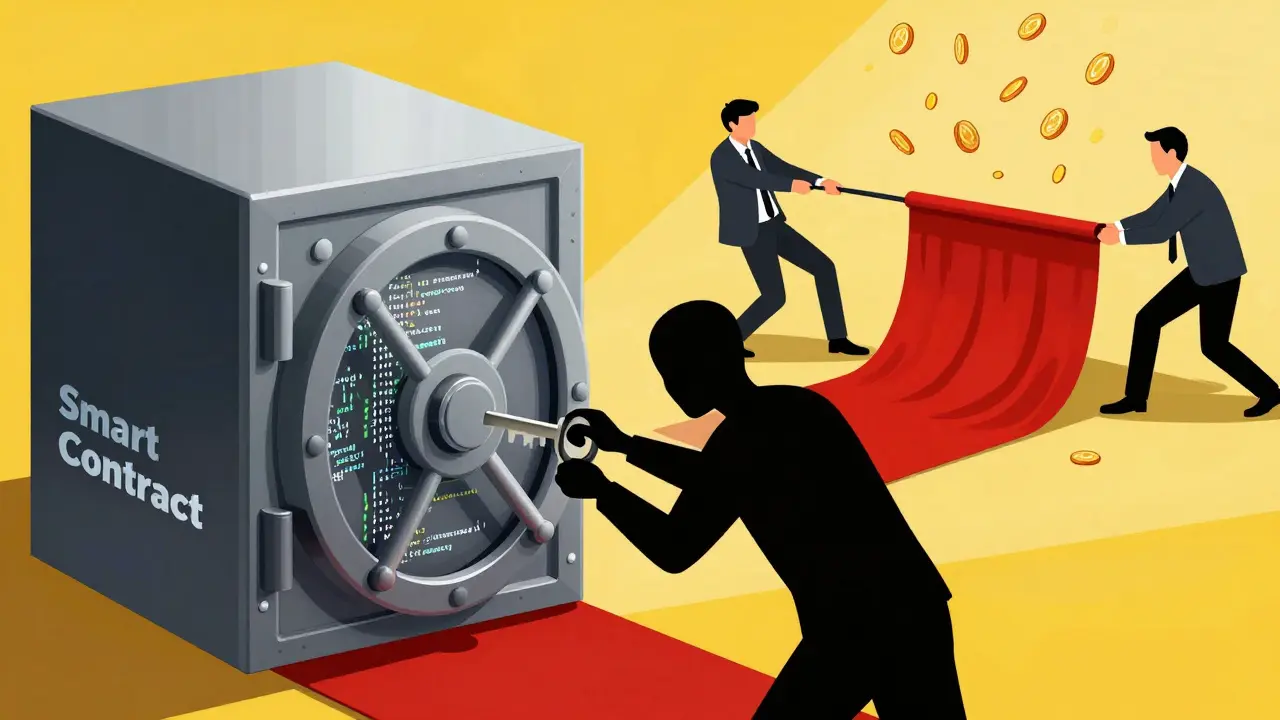
In traditional finance, if a bank makes a mistake, regulators step in. In DeFi, there is no customer service line. Your assets sit in a smart contract-a self-executing program on the blockchain. If that code has a bug, hackers can exploit it.
Smart contract risks fall into two categories: unintentional bugs and intentional exploits. Unintentional bugs happen when developers make logical errors. For example, a rounding error in the fee calculation could allow a user to drain the pool slowly over time. Intentional exploits occur when attackers find a vulnerability and use it to steal funds instantly.
History shows us this is not theoretical. In 2022, the Ronin Network bridge was exploited for nearly $600 million due to a compromise in the validator keys. While bridges are distinct from standard pools, they highlight the fragility of code-controlled custody. More commonly, smaller pools suffer from reentrancy attacks or flash loan attacks, where a hacker borrows millions, manipulates the pool's price artificially, drains the value, and repays the loan-all in one transaction block.
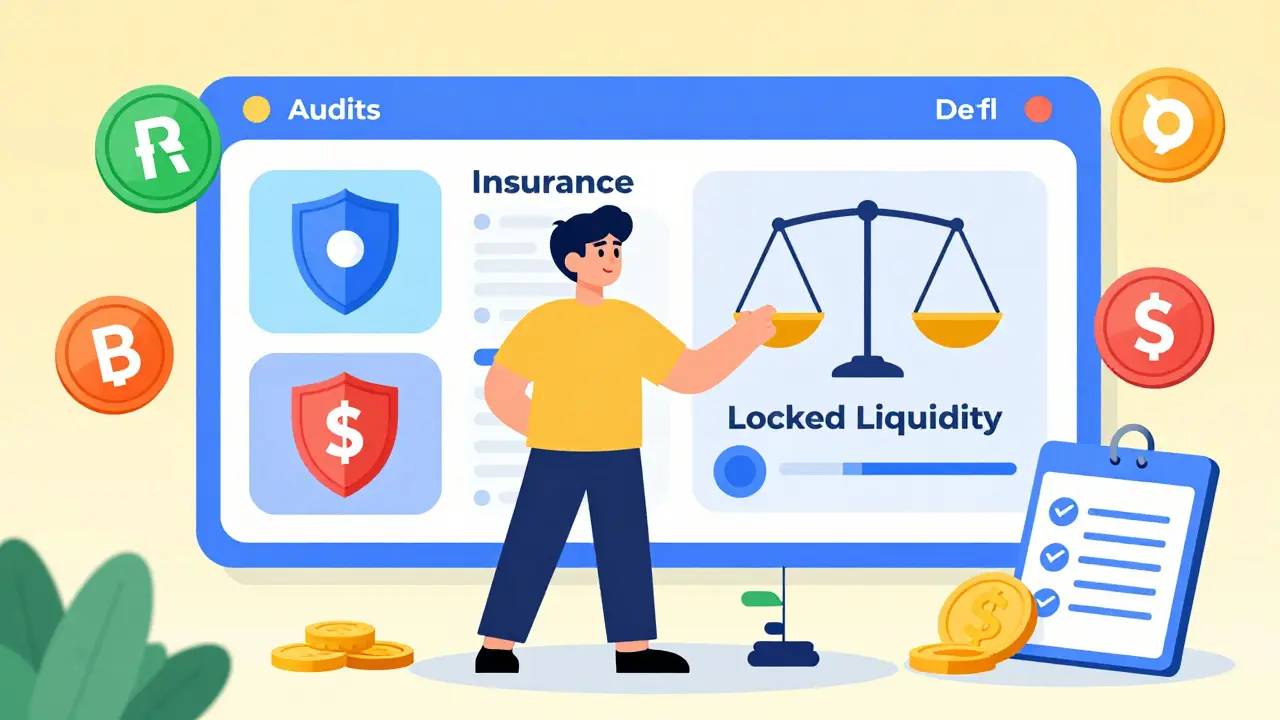
To protect yourself, never trust a protocol just because it has a sleek website. Look for these security indicators:
- Audits: Has the code been audited by reputable firms like CertiK, OpenZeppelin, or Trail of Bits?
- Bug Bounties: Does the project offer rewards for finding bugs? This incentivizes white-hat hackers to help rather than hurt.
- Open Source: Can you view the source code on GitHub? If the code is closed-source, you cannot verify its safety.
- Time on Chain: Older contracts have survived more attack vectors. New launches are higher risk.
Rug Pulls and Governance Risks
Not all losses come from market movements or code bugs. Sometimes, the people behind the project decide to take the money. This is known as a rug pull.
A classic rug pull works like this: Developers create a new token, pair it with ETH in a liquidity pool, and hype the project on social media. Investors buy the token, adding more ETH to the pool. Once the liquidity is high enough, the developers sell all their native tokens into the pool. This crashes the token price to zero and fills the pool with worthless tokens while draining all the valuable ETH. The developers then remove the liquidity and disappear.
A subtler version involves governance control. In many DeFi protocols, decisions are made via token votes. If the development team holds a majority of the governance tokens, they can vote to change the protocol’s parameters. They might increase fees, pause withdrawals, or redirect funds to their own wallets. This is sometimes called a "slow rug."
How do you spot these risks before investing?
- Check Liquidity Locks: Use tools like Unicrypt or Team Finance to see if the liquidity provider tokens (LP tokens) are locked. If LP tokens are locked for a set period (e.g., 1 year), the developer cannot pull the liquidity immediately.
- Review Ownership: Check if the contract ownership is renounced. If ownership is still active, the owner can potentially blacklist addresses or modify taxes.
- Analyze Holder Distribution: If one wallet holds 50% of the supply, they can crash the market whenever they want.
Concentrated Liquidity and Out-of-Range Risk
Newer versions of exchanges, like Uniswap V3, introduced concentrated liquidity. Instead of spreading your capital across the entire price range ($0 to infinity), you specify a narrow range where you want to provide liquidity. This increases your capital efficiency and potential fees.
However, it introduces a new headache: out-of-range risk. If the market price moves outside your selected range, your position stops earning fees entirely. One side of your pair converts completely to the other. For example, if you provided liquidity for ETH/USDC in the range of $3,000-$3,500, and ETH drops to $2,900, your position converts entirely to ETH. You are now just holding ETH, earning no trading fees.
To resume earning, you must rebalance your position by moving the range. This requires paying gas fees. On Ethereum mainnet, frequent rebalancing can eat into your profits significantly. This turns passive investing into active management. You need to monitor charts daily or use automated bots, which themselves carry risks and costs.
| Pool Type | Impermanent Loss Risk | Management Effort | Primary Danger |
|---|---|---|---|
| Stablecoin Pair (USDC/DAI) | Very Low | Low | Depegging events |
| Major Pair (ETH/USDC) | Moderate | Medium | Market volatility |
| Volatile Pair (Altcoin/ETH) | High | High | Severe impermanent loss |
| Concentrated Liquidity (Uniswap V3) | Variable (High if out-of-range) | Very High | Out-of-range positions, Gas costs |
Mitigation Strategies for Providers
You don’t have to avoid liquidity pools entirely to stay safe. You just need to adjust your strategy based on your risk tolerance. Here are practical steps to reduce exposure.
1. Favor Stable Pairs for Passive Income
If you want steady returns without watching charts, stick to stablecoin pairs. The impermanent loss is minimal unless a stablecoin depegs (loses its $1 value). Even then, the loss is usually recoverable if the peg restores.
2. Calculate Fee Yield vs. IL Risk
Before entering a volatile pool, calculate the annual percentage yield (APY) from fees. Compare this to the potential impermanent loss. If the APY is 50%, but a moderate price swing causes 20% IL, the trade-off might not be worth it. Many online calculators can simulate IL based on historical volatility.
3. Diversify Across Protocols
Don’t put all your funds into one smart contract. Spread your liquidity across established platforms like Uniswap, Curve, and Balancer. Each has different security profiles and audit histories.
4. Use Insurance
Some DeFi insurance protocols, like Nexus Mutual, allow you to buy coverage against smart contract failures. While expensive, it acts as a hedge against catastrophic code bugs.
5. Monitor Governance Proposals
If you hold governance tokens, participate in votes. Watch for proposals that seem to benefit insiders disproportionately. Silence in governance forums can be a red flag.
Conclusion: Treat Liquidity Provision as Active Work
Liquidity pools are powerful tools for generating yield in a decentralized world. But they are not passive investments. They require constant attention, technical literacy, and risk management. Whether you are dealing with the mathematical inevitability of impermanent loss or the existential threat of a smart contract hack, ignorance is expensive.
Start small. Test with amounts you can afford to lose. Learn how the AMM mechanics work before committing significant capital. Remember, in DeFi, you are your own bank-and your own security guard.
What is impermanent loss in simple terms?
Impermanent loss occurs when the value of your deposited tokens in a liquidity pool decreases relative to just holding those same tokens in your wallet. This happens because the automated market maker adjusts the ratio of tokens in the pool as trades occur, often leaving you with more of the depreciating asset and less of the appreciating one.
Can impermanent loss become permanent?
Yes. The loss is only "impermanent" while your funds remain in the pool. If you withdraw your liquidity while the price divergence exists, you realize the loss. If the prices eventually converge back to their original ratio, the loss disappears, but this is not guaranteed.
How do I avoid rug pulls when providing liquidity?
To avoid rug pulls, check if the liquidity is locked using tools like Unicrypt. Verify that the contract ownership is renounced or multi-sig controlled. Analyze the holder distribution to ensure no single wallet controls a majority of the supply. Finally, research the team behind the project; anonymous teams pose a higher risk.
Are smart contract audits enough to guarantee safety?
No. Audits identify known vulnerabilities but cannot catch every potential bug. Additionally, audits do not protect against logic flaws or future exploits discovered after the audit. Always combine audits with other safety measures like bug bounties, open-source code verification, and diversification.
What is out-of-range risk in Uniswap V3?
Out-of-range risk occurs when the market price moves outside the specific price range you selected for your concentrated liquidity position. When this happens, your position stops earning trading fees and converts entirely into one of the two assets. You must manually rebalance the position to resume earning, which incurs additional gas fees.

Write a comment