Imagine buying a digital asset in London, holding it in a wallet based in Singapore, and selling it to a buyer in New York. Who’s actually watching the transaction? For years, the answer was "nobody," or worse, "everyone but differently." This regulatory patchwork created chaos for investors and headaches for businesses trying to scale globally. But as of late 2025 and into 2026, the landscape is shifting. We are witnessing a serious push toward international coordination on crypto regulation, moving from fragmented local rules to a more unified global standard.
If you’re an investor, developer, or just someone curious about where your money sits legally, understanding this shift is critical. It’s no longer just about whether Bitcoin is legal; it’s about how regulators across borders talk to each other. Let’s break down who is driving this change, what frameworks are emerging, and why it matters for your portfolio.
The Financial Stability Board Sets the Baseline
At the heart of global coordination sits the Financial Stability Board (FSB). This isn’t some obscure think tank; it’s the body that monitors the global financial system. In July 2023, they issued comprehensive recommendations for crypto-assets and stablecoins. Their core principle is simple but powerful: "same activity, same risk, same regulation." If you’re doing something risky with traditional finance, you should face similar scrutiny when doing it with crypto.
By October 2024, the impact was measurable. About 93% of FSB members had plans to develop new or revised frameworks for crypto-assets. Even more telling, 88% had specific frameworks for stablecoins. The goal? To have most jurisdictions aligned with the FSB framework by 2025. While we are now in 2026, the ripple effects of those initial guidelines are still being felt as countries tweak their domestic laws to fit this international mold.
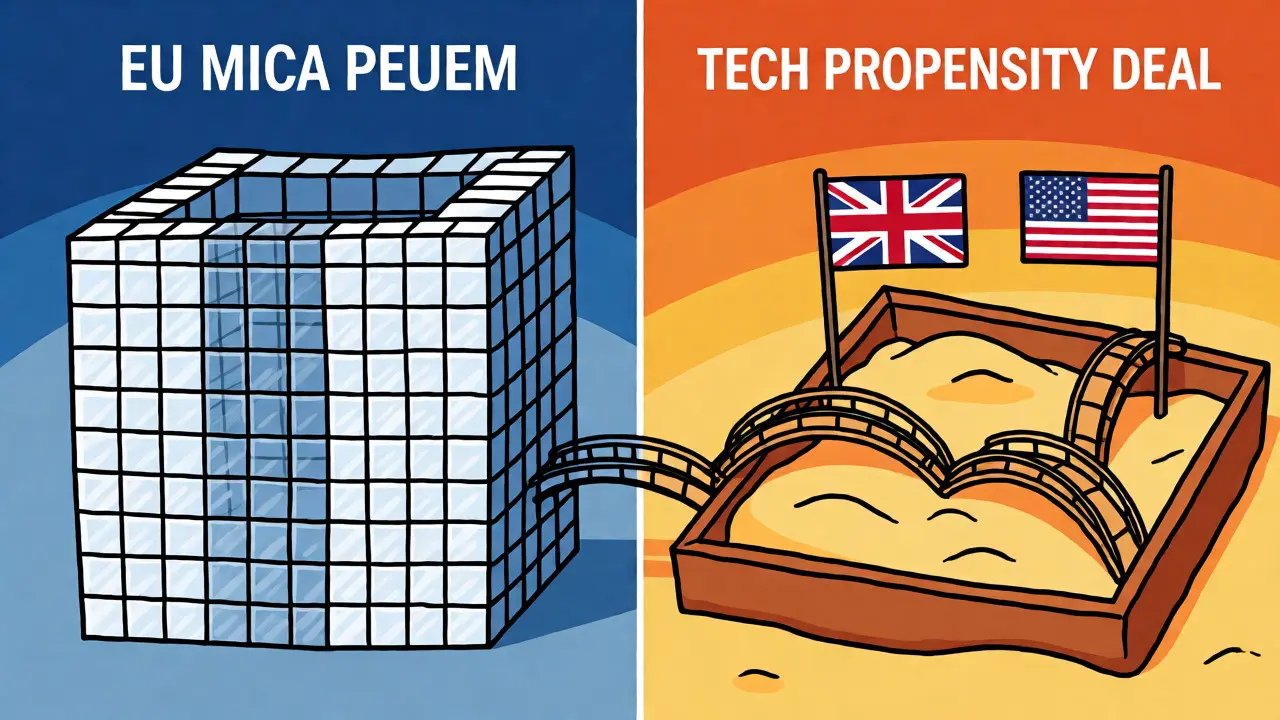
The UK-US Tech Propensity Deal: A Transatlantic Shift
While multilateral bodies like the FSB set broad principles, real-world momentum often comes from bilateral agreements. The biggest recent example is the Tech Propensity Deal announced on September 18, 2025, between the United Kingdom and the United States. This wasn’t just a handshake; it established a formal framework for transatlantic cooperation in digital asset regulation.
Why does this matter? Because the UK and US hold deep capital markets and significant legal expertise. By aligning their approaches, they create a template that other nations might follow. It’s a strategic move to shape global financial rules rather than react to them. China and the EU have their own paths, but the UK-US partnership signals a desire to lead the conversation on innovation-friendly yet regulated environments.
EU’s MiCA vs. Anglo-American Approaches
On the other side of the Atlantic, the European Union has been executing its own massive experiment: the Markets in Crypto-Assets (MiCA) regulation. MiCA is comprehensive, detailed, and notably risk-averse. It emphasizes consumer protection and market integrity through stringent compliance requirements.
This creates a distinct contrast with the UK-US approach. While MiCA provides a clear, albeit strict, rulebook for the entire EU bloc, the UK-US deal focuses more on harmonization and flexibility. The EU continues to monitor the UK-US task force, aware that their divergent paths could lead to a multi-polar regulatory environment. For businesses, this means choosing where to operate isn’t just about taxes anymore; it’s about which regulatory philosophy fits your business model best.
| Framework/Initiative | Primary Focus | Key Characteristic | Status in 2026 |
|---|---|---|---|
| FSB Recommendations | Global Systemic Risk | "Same activity, same risk" principle | Adopted by >90% of member jurisdictions |
| MiCA (EU) | Consumer Protection | Comprehensive, prescriptive rules | Fully implemented across EU states |
| UK-US Tech Propensity Deal | Innovation & Harmonization | Bilateral cooperation sandbox | Active pilot programs underway |
| IOSCO Principles | Market Integrity | 18 policy recommendations for CASPs | Integrated into national securities laws |
US Domestic Harmony: SEC and CFTC Alignment
Inside the United States, the story of 2025 was about ending turf wars. For years, the Securities and Exchange Commission (SEC) and the Commodity Futures Trading Commission (CFTC) fought over jurisdiction. Did a token count as a security or a commodity? The ambiguity paralyzed exchanges.
Things changed rapidly in August 2025 when both agencies issued joint statements clarifying boundaries. They confirmed that exchanges regulated by either commission could offer certain spot commodity products. By September 2025, they held roundtables on regulatory harmonization, tackling issues like perpetual contracts, shared portfolio margining, and decentralized finance (DeFi) exemptions. This internal alignment made the US a more predictable partner for international negotiations, directly supporting the broader goal of global coordination.
The Role of IOSCO and FATF in Standardizing Rules
Beyond the big economic powers, technical standard-setters play a crucial role. The International Organization of Securities Commissions (IOSCO) adopted eighteen policy recommendations in November 2023. These aren’t just suggestions; they apply global securities market standards to Crypto Asset Service Providers (CASPs). Essentially, if you want to run a major exchange, you need to meet these benchmarks for market integrity and investor protection.
Meanwhile, the Financial Action Task Force (FATF) focuses on crime. Their Recommendation 15 addresses anti-money laundering (AML) and counter-terrorism financing. As of mid-2025, FATF continued monitoring implementation, particularly in emerging economies. Their work ensures that while regulations differ on investment rules, the baseline for preventing illicit flows remains consistent worldwide. This dual focus-market integrity via IOSCO and crime prevention via FATF-creates a safety net that supports legitimate growth.
Cross-Border Challenges and Stablecoin Risks
Despite all this progress, friction remains. Many issuers still operate in offshore jurisdictions with weak oversight. Cross-border activities originating from these places pose elevated risks because enforcement doesn’t always travel well. Stablecoins, in particular, require tight attention. They are vulnerable to sudden confidence loss, leading to "runs" on issuers. If a stablecoin fails in one country, the contagion can spread quickly due to the interconnected nature of DeFi protocols.
The US GENIUS Act represents a domestic attempt to address stablecoin reserves, but its international implications are still unfolding. Without coordinated reserve audits, a stablecoin deemed safe in New York might be viewed skeptically in Frankfurt. This lack of mutual recognition is the next big hurdle for regulators to clear.
What This Means for You
So, why should you care about bureaucratic meetings in Basel or Washington? Because regulatory clarity reduces volatility. When investors know the rules, they stay invested longer. When businesses know they won’t get shut down overnight due to a foreign regulator’s surprise, they build better products.
We are moving toward a world where digital assets are treated less like exotic curiosities and more like standard financial instruments. The era of "wild west" arbitrage-where you’d buy cheap in a lax jurisdiction and sell high in a strict one-is fading. Instead, value will increasingly derive from utility, adoption, and technology, not just regulatory loopholes.
Keep an eye on the UK-US sandbox pilots. If they succeed, they could become the blueprint for future trade deals involving digital assets. Conversely, watch the EU’s MiCA enforcement actions. They will show us how strictly "consumer protection" is interpreted in practice. Both tracks will define the next decade of crypto economics.
What is the main goal of international crypto regulation coordination?
The primary goal is to prevent regulatory arbitrage, where companies exploit differences between countries' rules. By harmonizing standards, regulators aim to ensure that the same activity carries the same risks and requires the same level of oversight regardless of location, thereby protecting consumers and maintaining financial stability.
How does the FSB framework influence local laws?
The Financial Stability Board (FSB) issues non-binding recommendations that serve as global best practices. Member jurisdictions, including G20 countries, use these guidelines to draft or revise their domestic legislation. As of 2024-2025, over 90% of FSB members were developing frameworks aligned with these principles, effectively creating a soft-law standard that drives hard-law changes nationally.
What is the difference between MiCA and the UK-US approach?
MiCA (Markets in Crypto-Assets) is a comprehensive EU regulation focused heavily on consumer protection and strict compliance. The UK-US approach, exemplified by the Tech Propensity Deal, emphasizes harmonization, innovation, and flexible sandboxes. MiCA is prescriptive and uniform across the EU, while the UK-US strategy is collaborative and aims to balance oversight with technological agility.
Why are stablecoins a priority for global regulators?
Stablecoins bridge traditional fiat currencies and digital assets, making them critical infrastructure for trading and lending. They are prone to "bank runs" if users lose confidence in their reserves. Regulators prioritize them because a failure in a major stablecoin could trigger systemic risk across the broader financial system, requiring coordinated reserve requirements and audit standards.
How do IOSCO recommendations affect crypto exchanges?
IOSCO (International Organization of Securities Commissions) developed 18 policy recommendations specifically for Crypto Asset Service Providers (CASPs). These cover conflicts of interest, custody arrangements, and market manipulation. Exchanges seeking global legitimacy must adhere to these standards, which help institutional investors feel safer entering the crypto market.



Write a comment