Imagine you want to buy Bitcoin while sitting in Mumbai or New Delhi. Can you do it without fear of the police knocking on your door? The short answer is yes, you can buy and hold crypto in India, but you cannot treat it like cash. As of March 2026, the landscape has shifted significantly from the outright bans of the past to a heavy, structured tax regime. The government isn't chasing traders off the internet anymore; instead, they are ensuring every rupee earned gets tracked.
The situation often feels confusing because people ask two different things at once: is it legal, and how much will I pay? Legally, cryptocurrencies operate in a specific 'legal grey area.' They aren't legal tender-you cannot buy bread at a bakery with Ethereum-but they are defined as property under tax law. This distinction matters more than you might realize. You aren't breaking the law by owning a token, but you are legally obligated to report every transaction to the authorities. The rules have tightened considerably over the last few years, moving from uncertainty to a strict compliance framework known as the Virtual Digital Asset (VDA) regime.
If you've been following Indian financial news, you know the journey hasn't been smooth. We went from a total banking blockade in 2018 to a Supreme Court victory in 2020, followed by aggressive taxation policies starting in 2022. By 2025, the Income Tax (No. 2) Billlegislation formally established the taxation framework for digital assets received presidential assent, cementing these rules into long-term policy. Today, if you're trading on platforms in India, you need to understand exactly what the government sees when you click 'sell'. Here is everything you need to know to stay compliant and avoid trouble.
What Defines a Digital Asset in India?
To understand the regulations, you first need to know what falls under the umbrella of 'crypto' according to Indian law. In 2022, the government expanded the definition beyond just Bitcoin. Under Section 2(47A) of the Income Tax Act, 1961, anything created through cryptography that exists digitally counts as a Virtual Digital Asset (VDA).
This definition is broad. It doesn't just cover popular coins like Bitcoin (BTC) or Ethereum (ETH). It includes tokens, non-fungible tokens (NFTs), and other digital representations of value. Crucially, this definition explicitly excludes fiat currencies like the Indian Rupee. So, when the law talks about VDA, it is talking specifically about crypto assets. This means your hobby of collecting NFTs is taxed the same way as trading volatile altcoins.
The key takeaway here is scope. If you hold any digital asset that uses cryptographic technology, it is subject to Indian monitoring. There is no separate 'license' required for you as an individual to hold these assets. However, the platforms you use to trade them must register with the Financial Intelligence Unit India (FIU-IND). If you use an exchange that hasn't registered with FIU-IND, you might find yourself stuck in a platform that freezes withdrawals due to regulatory scrutiny. Always check if your preferred exchange is compliant before depositing funds.
The Tax Burden: 30% and Beyond
This is where most Indian investors get surprised. The tax regime for crypto is distinct from the rest of your income. When you make a profit selling a virtual asset, you face a flat 30% tax rate on the gains. Unlike your salary or business profits, you cannot offset these gains against losses. If you lose money on one coin and make money on another, the losses don't cancel out.
Furthermore, there is a mechanism designed to catch those who try to evade taxes: Tax Deducted at Source, or TDS. For every purchase or sale transaction, the exchange deducts 1% of the transaction value and hands it over to the government directly. While you can claim this back during your annual filing if your overall taxable income is low, it ties up your capital immediately. Imagine buying $10,000 worth of Bitcoin; $100 goes straight to the government before you even own the asset.
| Feature | Stocks/Equities | Cryptocurrency (VDA) |
|---|---|---|
| Tax on Profit | Varies (Long term 10-20%) | Flat 30% |
| Loss Set-off | Allowed | Not Allowed |
| Expense Deductions | Allowed | None |
| TDS Requirement | N/A for standard equity trades | 1% on all transactions |
| Holding Period Impact | Yes (LTCG vs STCG) | No (Always short term) |
This rigidity is intentional. The government is treating crypto income as high-risk speculation rather than traditional investment. The lack of loss set-offs means that a volatile year where you end the month flat could still result in a massive tax bill if you traded frequently. You pay tax on every winning trade, regardless of whether your portfolio actually grew by year-end. This effectively penalizes day traders more than long-term holders.
Who Watches the Watchmen? The Regulators
You might assume one agency handles everything, but the oversight in India is a shared responsibility. The Reserve Bank of India (RBI) takes the lead on monetary stability. Their stance has historically been cautious. They view decentralized currencies as potential threats to financial security because they fall outside their control. While they don't set tax policy, they dictate how banks handle these relationships.
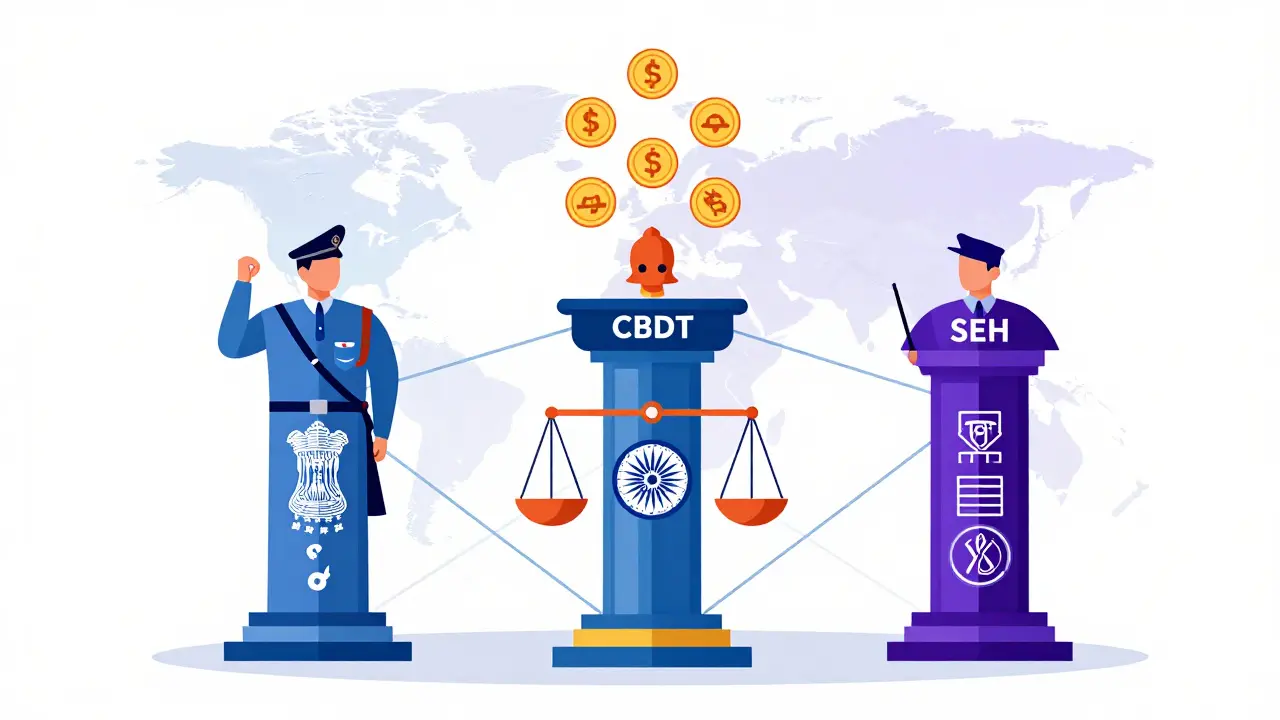
The Ministry of Finance, through the Central Board of Direct Taxes (CBDT), sets the actual tax rules and collection methods. They focus on compliance. Then you have the Securities and Exchange Board of India (SEBI). SEBI has shown a willingness to potentially regulate crypto markets similarly to securities, though as of 2026, this remains a proposal rather than finalized law. Some experts believe SEBI regulation would add clarity, defining which tokens count as securities and requiring listing standards similar to IPOs.
Don't forget the enforcement side. The Financial Crime Investigation Division of the Income Tax Department actively tracks wallets. With international cooperation frameworks in place, cross-border transactions are increasingly visible. If you move large amounts of stablecoins to offshore wallets, Indian authorities can flag discrepancies between your bank deposits and declared income.

A Brief History of the Rollercoaster
Understanding the current rules requires looking at why they exist. In 2013, the RBI issued warnings about risks associated with Bitcoin. By 2018, the situation deteriorated into a banking ban. Banks were instructed to cut off services to crypto businesses. This effectively killed the domestic industry; exchanges shut down or moved operations overseas.
On March 4, 2020, the Supreme Court of India delivered a landmark judgment in *Internet and Mobile Association of India v Reserve Bank of India*. They struck down the banking ban, ruling that the RBI had overstepped its powers. Crypto activity bounced back immediately. However, the government was already drafting new laws. The 2022 Union Budget announced the current tax regime, and later in 2025, the legislation formalizing it passed Parliament. This history explains why there is no grand 'Crypto Law' bill yet; the approach has been piecemeal regulation-tax first, licensing later.
Global Standards and the G20 Influence
India isn't acting alone. At the 2023 G20 summit, India championed a unified global approach to digital asset regulation. They pushed for the implementation of the Crypto-Asset Reporting Framework (CARF). This allows countries to automatically share tax information about crypto holdings, just as they do for bank accounts through the Common Reporting Standards (CRS).
Why does this matter to you? It means hiding crypto assets in foreign jurisdictions offers less protection than it did five years ago. The goal is to eliminate 'regulatory arbitrage,' where users simply shop around for jurisdictions with zero reporting requirements. With CARF gaining traction globally, the Indian tax net is becoming wider and more automatic. By 2026, major crypto firms are expected to comply with these reporting standards, feeding data directly to local tax authorities.
Paying with Crypto: Still Off Limits
A common question is whether you can use crypto to pay for goods or services. Even though you can hold the assets, the Legal Tender definition in India strictly prohibits using crypto for payments. Businesses cannot accept Bitcoin as currency for sales. Doing so would technically violate FEMA (Foreign Exchange Management Act) guidelines depending on the nature of the transaction.
This distinction protects consumers but limits utility. You cannot go buy a car or a house paying in USDT. You have to sell the crypto for INR (Rupees) first, then use the Rupees to pay the seller. This converts the transaction into a taxable event twice: once for the sale of the crypto, and again for the capital movement. Consequently, P2P (Peer-to-Peer) trading platforms where individuals swap crypto for cash are under heavy surveillance. Authorities often crack down on unregistered payment gateways attempting to facilitate these conversions.
Frequently Asked Questions
Is cryptocurrency trading illegal in India?
No, trading cryptocurrency is not illegal in India as of 2026. While there are restrictions on how it is used (e.g., not as legal tender), buying, holding, and selling digital assets is permitted, provided you comply with tax and KYC (Know Your Customer) norms.
Do I need to pay tax on crypto gifts or inheritances?
Gifts of VDAs to specified relatives are generally exempt, but receiving virtual assets as gifts from non-relatives is treated as income and taxed at 30%. Inheritance rules follow standard succession laws, but the value is still subject to valuation for tax purposes.
Can I buy crypto using credit cards in India?
Major exchanges and the RBI discourage or block such transactions due to risk concerns. Most Indian exchanges require debit card or UPI transfers. Using a credit card may result in rejection by the merchant acquiring system.
Is there a limit on how much crypto I can hold?
There is no specific limit on the quantity of crypto an individual can hold. However, high-value transactions trigger reporting requirements to FIU-IND, which monitors flows above certain thresholds for anti-money laundering purposes.
What happens if I forget to declare my crypto income?
The Income Tax Department matches data from registered exchanges with taxpayer filings. Missing declarations can lead to notices, penalties, and back-taxes with interest. It is safer to voluntarily disclose during rectification proceedings if you notice an omission.
Will India introduce a ban on private crypto in the future?
While a draft banning bill was discussed in 2019, it has not been reintroduced as of 2026. Current momentum favors regulation and taxation over prohibition, focusing on consumer protection and financial stability rather than criminalization.
Are Non-Fungible Tokens (NFTs) taxed differently?
No. Under the current framework, NFTs are classified as Virtual Digital Assets and are taxed identically to fungible cryptocurrencies like Bitcoin. The 30% tax rate applies to gains from buying or selling NFTs.
Does TDS apply to staking rewards?
Yes, staking rewards received in crypto are considered income. While TDS usually applies to the sale transaction, the value of the reward is added to your taxable income for the year. You must calculate the fair market value of the token received.
Which regulator should I contact for complaints?
For exchange-related disputes, start with the exchange itself. If unresolved, you can approach the Consumer Council or the Department for Promotion of Industry and Internal Trade (DIPP). SEBI is currently reviewing jurisdiction over specific DeFi activities.
Navigating the crypto landscape in India requires diligence. It is no longer the Wild West. With the Income Tax (No. 2) Bill fully in effect and international cooperation tightening, the era of anonymity is largely over. By understanding the 30% tax rule, the 1% TDS deduction, and the roles of agencies like RBI and SEBI, you can participate safely. Keep your records, report your gains, and stay updated as the framework continues to evolve alongside global standards.


Elizabeth Akers
honestly this change is good for the market stabilty even if it feels tight financially
Shubham Maurya
Finally the clarity we needed 🙌🇮🇳 The tax part hurts but atleast its legal now 💸 Dont forget the TDS guys ⚠️
Tiffany Selchow
Of course the government wants a slice of everything now that it exists legally 😂 They dont care about innovation they just want revenue streams
Alex Lo
I agrre with you about the revnue streams but thier is more too it then jusst money they want to controll the floew of capotal and stop ppl from going offshore with untracked funds this is a big deal for everyone who invests in decentrlized tech becouse it removes anoymity completely and makes every trade visable to the state which is scary for privicy advocates who liked the idea of finacial freedome back in 2020 when we thought crypto would save us from banks
Justin Garcia
The 30 percent tax rate kills any chance of real returns.
Alex Kuzmenko
I reallly hate how much goverment takes from us now with this new bill it shoudlnt be this hard to trade online
Addy Stearns
It really feels like the world is changing faster than we can keep up with when it comes to financial freedom and how governments view value. We used to think that digital money was the great equalizer that would bypass borders and bureaucracy completely. Now we see nations like India stepping in with structured frameworks to ensure compliance rather than total prohibition. This shift from banning to taxing shows a maturity in policy making that many analysts predicted years ago. It implies that the regulators understand the asset class cannot simply be wished away through bans alone. They realize that suppressing the demand only pushes activity into darker corners that they cannot monitor effectively anymore. Taxation brings visibility which allows for better oversight of where funds are actually moving globally. It also sends a clear message to investors that there are rules and consequences for non-compliance within this new regime. We must consider whether this heavy taxation stifles innovation or merely filters out speculative gamblers. High rates discourage casual flipping while potentially encouraging those truly committed to the technology's utility. History often suggests that regulatory friction eventually weeds out the weak hands leaving behind serious players. Perhaps this era of strict reporting is just the growing pains of a new global financial standard evolving organically. The involvement of international bodies like the G20 confirms that data sharing is becoming unavoidable for significant assets. Ultimately we are witnessing the transition of crypto from a wild frontier to an integrated component of traditional finance. The question remains open about how much privacy individuals will sacrifice for the sake of security and stability in the long run.
Ashley Stump
They are tracking every wallet and sharing data with other countries so hide nothing.
Matt Bridger
While your assertions regarding surveillance infrastructure hold theoretical weight, one must acknowledge the established legal frameworks governing digital asset ownership within sovereign territories.
Katrina Tate
Your argument lacks empirical data and ignores the reality of cross border enforcement actions we see daily in financial crime division reports.
Jay Starr
The uncertainty in previous years caused enough damage that current strictness is a relief honestly though it costs us more money.
Disha Patil
I am so stressed about filling out the forms correctly what if I mess up the tax part and they come to my house 😭😭
Beverly Menezes
You dont need to worry too much if you keep records straight and use a registered exchange most people do fine.
athalia georgina
i hope they dont add more rules soon i cant handel more changes this yr it feels like chaos out thera
joshua kutcher
If anyone needs help understanding the filing process I suggest joining a local investor group where people share templates for reporting income.
Ronald Siggy
You need to stay proactive about your compliance or you will face penalties later down the line.
Liam Robertson
The G20 agreement ensures that standards are consistent across borders so we can move towards better transparency together.
Jamie Riddell
we should focus on the positev aspects of regulaton instead of fear
Joy Crawford
why does positivity matter when they take our money :( it feels like betrayal by the system we trusted :cry:
Leah Lara
Its a boring topic but people keep asking about it so here we are again.