Imagine walking into a grocery store that only sells four types of apples. You might find the perfect red delicious, but if you need oranges, rice, or even just a different variety of fruit, you’re out of luck. That is exactly what using KaiaSwap, a decentralized exchange on the Kaia blockchain (formerly Klaytn), feels like right now.
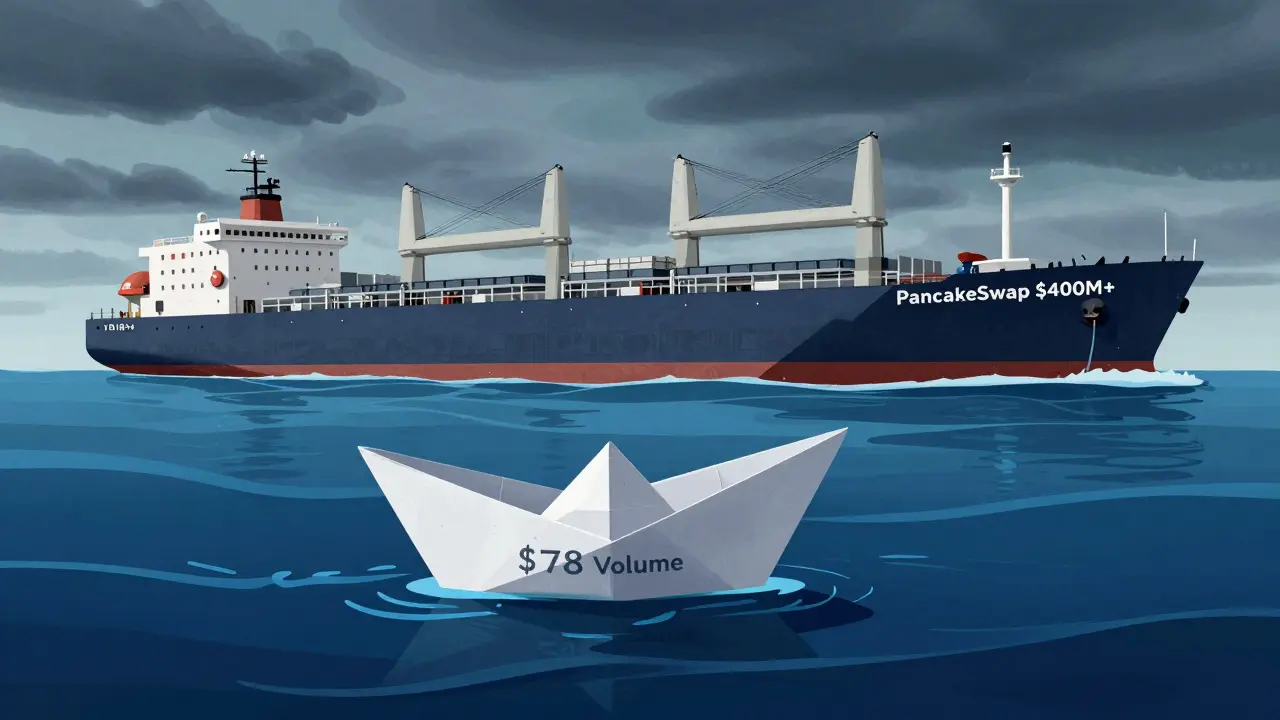
If you clicked this title hoping to find a robust platform for day trading, arbitrage, or swapping obscure altcoins, you are going to be disappointed fast. KaiaSwap is not a major player in the crypto space. It is a niche, micro-sized automated market maker (AMM) with virtually no liquidity and almost zero user activity. As of late 2025 data, its 24-hour trading volume sits at a staggering $78.73. To put that in perspective, Uniswap processes over $1 billion daily. KaiaSwap processes less than the cost of a single lunch in New York City.
The Hard Numbers: Volume and Liquidity Crisis
Let’s look at the raw data because it tells the whole story. According to CoinGecko metrics from December 2025, KaiaSwap supports only four coins and four trading pairs. The most active pair is STKAIA/WKLAY (Staked KAIA vs. Wrapped KLAY), which accounts for about $55 of that total $78 daily volume. The other notable pair is PING/WKLAY.
Here is why this matters to you. In decentralized finance (DeFi), liquidity is king. Low liquidity means two things: high slippage and wide spreads. When you try to swap tokens on KaiaSwap, you are likely to face an average bid-ask spread of 0.75%. On established exchanges like Uniswap or PancakeSwap, spreads for major pairs are often fractions of a percent. On KaiaSwap, you are paying nearly 1% just to execute a trade, effectively losing money before you even start.
| Feature | KaiaSwap | Uniswap v3 | PancakeSwap |
|---|---|---|---|
| 24h Trading Volume | $78.73 | $1.24 Billion | $487 Million |
| Trading Pairs | 4 | 15,000+ | 1,200+ |
| Average Spread | 0.75% | <0.05% (Major Pairs) | <0.1% (Major Pairs) |
| Liquidity Depth ($45 range) | $45 - $107 | Millions | Millions |
| Mobile App | No | Yes (Web-based) | Yes (Native) |
Notice the liquidity depth column? KaiaSwap has roughly $45 to $107 of depth within a 2% price movement. If you try to sell $500 worth of tokens here, you will crash the price significantly, resulting in massive losses due to slippage. This is not a bug; it is a fundamental limitation of its current state.
What Can You Actually Trade?
KaiaSwap is built exclusively for the Kaia Blockchain, a Layer 1 network formerly known as Klaytn, originally developed by South Korean tech giant Softbank. This limits your options severely. You cannot trade Bitcoin, Ethereum, Solana, or even stablecoins like USDT or USDC directly unless they are bridged specifically to this ecosystem and listed on this specific DEX (which they currently are not in any meaningful way).
The available assets are:
- STKAIA: Staked KAIA, used for yield farming within the ecosystem.
- WKLAY: Wrapped KLAY, the native token of the chain used as a quote currency.
- PING: A utility token within the Kaia ecosystem.
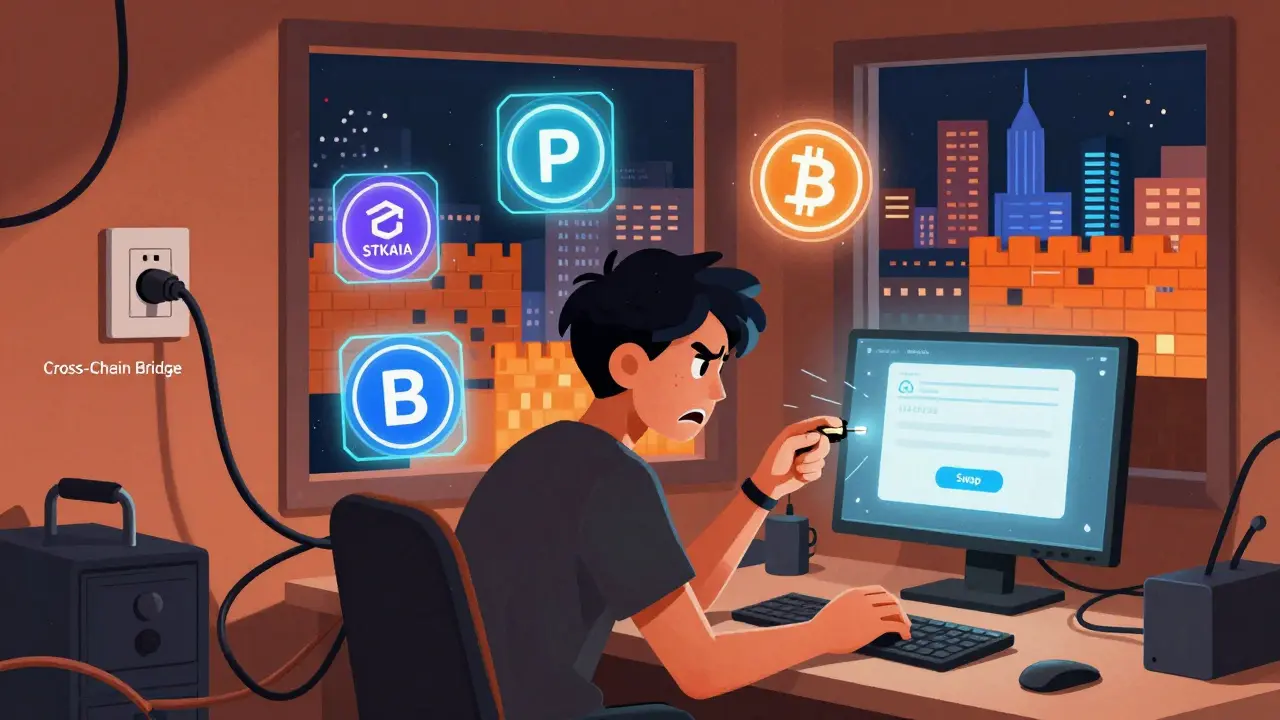
If you do not hold these specific tokens, KaiaSwap is useless to you. There is no cross-chain functionality. You cannot bridge assets from Ethereum or BNB Chain easily into this pool without going through complex, risky manual steps first. For the average crypto user who wants to diversify, this is a dead end.
User Experience and Technical Limitations
Using KaiaSwap requires a Web3 wallet compatible with the Kaia network, such as Kaikas or MetaMask configured with Kaia network settings. The interface itself is basic. It lacks advanced features like limit orders, stop-losses, or margin trading. It is a simple "swap" button.
For beginners, this simplicity can be misleading. It looks easy, but the lack of educational resources is a hurdle. Unlike Uniswap, which has hundreds of documentation pages and tutorials, KaiaSwap relies on general Kaia blockchain guides. There is no dedicated customer support team. If something goes wrong-and with low liquidity, slippage errors are common-you are on your own. There are no reviews on Trustpilot, Reddit, or CryptoSlate. The silence is deafening.
Furthermore, there is no mobile app. In 2026, expecting users to trade solely via desktop browsers is a significant barrier. Competitors like PancakeSwap offer native iOS and Android apps, making trading accessible anywhere. KaiaSwap forces you to use a computer, which limits impulse trading and convenience.
Safety and Security: Should You Trust It?
Security in DeFi is paramount. KaiaSwap operates on the Kaia blockchain, which has a solid reputation thanks to its corporate backing in South Korea (partnerships with LG Electronics, Shinhan Bank, etc.). However, the security of the underlying chain does not automatically guarantee the security of the dApp (decentralized application).
As of early 2026, there is no public audit report widely cited for KaiaSwap’s smart contracts. While the code may be open-source, the lack of independent verification from firms like CertiK or Trail of Bits is a red flag. More importantly, the risk isn’t necessarily a hack; it’s insolvency of liquidity. If the few liquidity providers pull their funds, the pool becomes empty instantly. You could have tokens in your wallet but no one to buy them from.
Regulatory clarity is also missing. The Kaia Foundation has not published explicit compliance frameworks for its DEXs. In contrast, platforms like dYdX implemented geo-blocking in 2025 to comply with US regulations. KaiaSwap appears to operate in a gray area, which adds legal uncertainty for users in restricted jurisdictions.
Who Is KaiaSwap For? (And Who Should Avoid It)
Let’s be brutally honest. KaiaSwap is not for traders. It is not for investors looking for exposure to major cryptocurrencies. It is not for those seeking high yields or low fees.
It is only for a very specific group: developers and testers working strictly within the Kaia ecosystem who need to move small amounts of STKAIA or PING tokens for testing purposes or minor portfolio adjustments. Even then, the high spreads make it inefficient.
If you are a regular crypto holder, stick to established aggregators like 1inch or Matcha, which route trades across multiple DEXs to find the best price. These platforms will either route you away from KaiaSwap due to poor prices or show you that the cost of trading there is prohibitive.
The Future Outlook: A Niche Struggling to Survive
Industry analysts at Messari noted in late 2025 that 78% of new DEX launches on emerging chains fail to reach $100k daily volume within six months. KaiaSwap, with $78 daily volume, is well below this survival threshold. Delphi Digital researchers stated that without substantial liquidity mining incentives (minimum $5 million allocation), single-chain DEXs face near-impossible odds.
There are no announcements of major partnerships, token launches, or liquidity injections for KaiaSwap as of mid-2026. Its fate is tied entirely to the growth of the Kaia blockchain itself. While Kaia sees moderate growth in daily active addresses (up 21.5% in 2025), this hasn’t translated to exchange activity. Until KaiaSwap expands its pairs, deepens its liquidity pools, or integrates with broader cross-chain protocols, it will remain a microscopic footnote in the DeFi world.
Is KaiaSwap safe to use?
While the Kaia blockchain itself is secure, KaiaSwap lacks public smart contract audits and has extremely low liquidity. The primary risk is not hacking, but financial loss due to high slippage and wide spreads when trading. Always verify contract addresses and start with tiny amounts if you must use it.
Can I trade Bitcoin or Ethereum on KaiaSwap?
No. KaiaSwap only supports tokens native to the Kaia ecosystem, primarily STKAIA, WKLAY, and PING. It does not support BTC, ETH, SOL, or major stablecoins like USDT/USDC directly.
Why is the trading volume so low?
KaiaSwap is a niche DEX launched in 2024 with limited marketing and no significant liquidity mining incentives. Most users prefer larger, more liquid exchanges like Uniswap or PancakeSwap, leaving KaiaSwap with minimal activity.
Does KaiaSwap have a mobile app?
No, KaiaSwap does not have a dedicated iOS or Android app. You must access it via a web browser on a desktop or mobile device, connecting through a Web3 wallet like MetaMask or Kaikas.
What is the best alternative to KaiaSwap?
For general trading, use Uniswap or PancakeSwap. If you specifically need to trade Kaia-native tokens, check if larger aggregators like 1inch support the Kaia network, or consider centralized exchanges that list KAIA tokens for better liquidity and lower fees.


Write a comment