Every year, over 100 million Indians hold cryptocurrency-but moving it overseas isn’t as simple as sending a wire. If you’re thinking about transferring Bitcoin, Ethereum, or any other digital asset out of India, you’re stepping into one of the strictest crypto regulatory environments in the world. There’s no ban on owning crypto. But moving it abroad? That’s where things get complicated, expensive, and risky.
What’s Legal? What’s Not?
Cryptocurrencies are legal to own and trade in India, but they’re not legal tender. The government calls them Virtual Digital Assets (VDAs), and they’re treated like property-not money-for tax and foreign exchange purposes. That distinction changes everything. You can buy crypto on Indian exchanges like WazirX, CoinDCX, or ZebPay. You can hold it. You can even sell it. But when you try to send it to a wallet or exchange outside India, you trigger multiple layers of regulation: tax, foreign exchange, anti-money laundering, and cybersecurity rules-all at once.The Tax Trap: 30% + 1% + 18% = Over 50% in Costs
The biggest surprise for most people? You pay tax on every crypto transfer-even if you’re just moving it to your own wallet abroad. - 30% capital gains tax: You pay this on any profit you made from buying crypto, no matter how long you held it. No loss offsetting. If you bought Bitcoin at ₹30 lakh and now it’s worth ₹40 lakh, you owe ₹3 lakh in tax on the ₹10 lakh gain-even if you’re just moving it overseas. - 1% TDS (Tax Deducted at Source): Every time you transfer crypto (buy, sell, swap, or send), the exchange withholds 1% of the transaction value if it’s over ₹50,000 in a financial year. That’s on top of the 30%. So sending ₹5 lakh worth of ETH? ₹5,000 gets taken before you even hit send. - 18% GST: Applied to every crypto transaction on Indian platforms-including withdrawals. That means if you’re moving crypto out of WazirX or CoinSwitch, you’re paying GST on the transfer itself. This isn’t a one-time fee. It’s charged every time. Add those up, and for a ₹10 lakh transfer, you could be paying over ₹5.3 lakh in taxes and fees before you even get the crypto out of India. That’s not a cost of doing business. That’s a penalty for trying to move assets legally.FEMA Rules: The Foreign Exchange Minefield
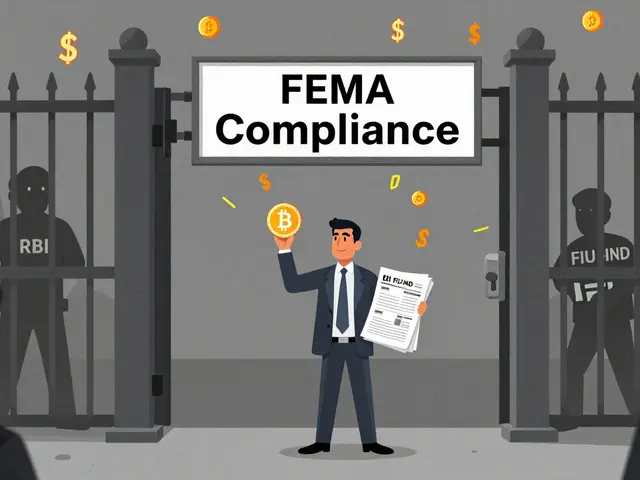
The Reserve Bank of India (RBI) controls all cross-border money flows under the Foreign Exchange Management Act (FEMA). And since 2025, VDAs are officially classified as intangible movable property under FEMA. That means: - You need prior approval from an authorized dealer bank (like SBI or HDFC) if you’re sending more than $250,000 worth of crypto per year. No exceptions. No loopholes. - You must prove the source of funds. If you bought crypto with rupees from your salary, you need bank statements. If you earned it through mining or staking, you need proof of income. The RBI doesn’t accept “I mined it on my laptop” as valid. - You must file Schedule VDA in your income tax return. If you hold crypto overseas, you must declare it. Failure to disclose? You could face a 60% penalty on the undisclosed value, plus criminal charges under Section 158B of the Income Tax Act. Most people don’t realize this: even if you’re sending crypto to your own wallet in the U.S. or Singapore, the Indian government still treats it as a foreign asset transfer. You’re not just moving data. You’re moving value across borders-and the system is watching.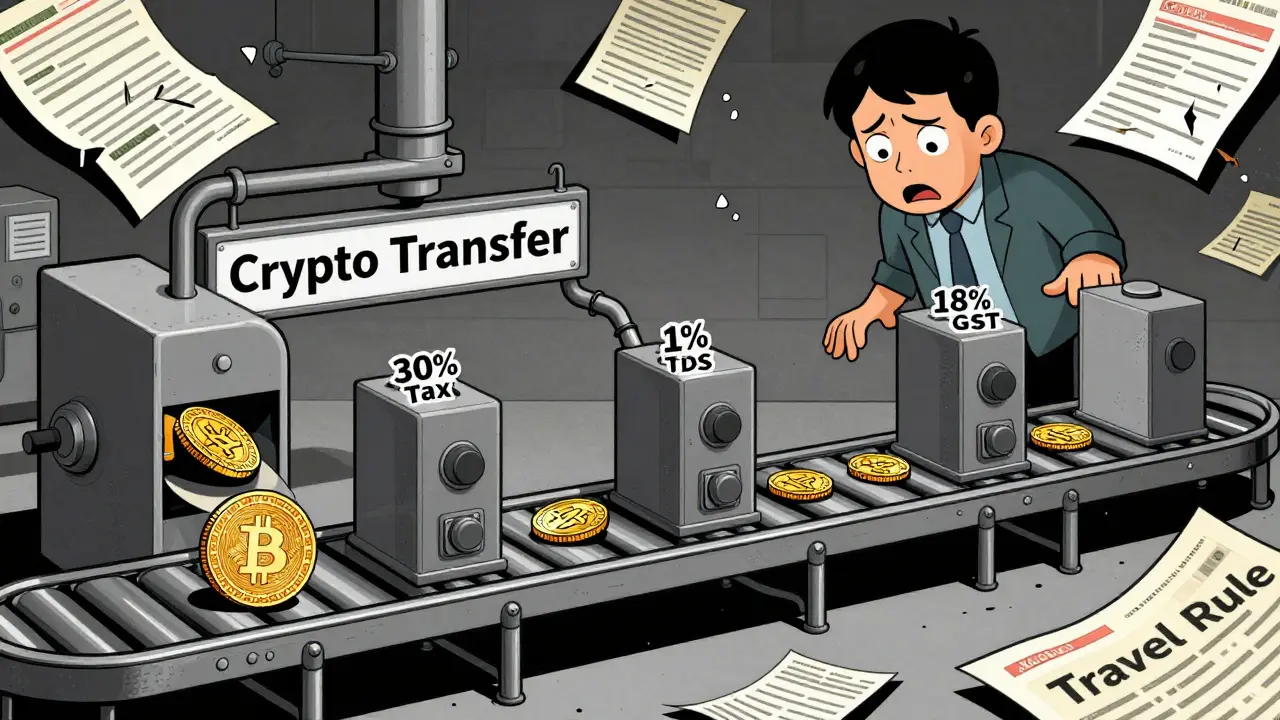
The Travel Rule: Every Transaction Is Tracked
India is one of the only countries in the world that applies the FATF Travel Rule to every crypto transaction, no matter how small. That means: - Every time you send crypto abroad, your exchange must collect and send your full name, address, PAN, Aadhaar number, and wallet address to the recipient’s platform. - The recipient platform must verify your identity before accepting the transfer. - If the foreign exchange doesn’t comply (like KuCoin or Bybit), Indian exchanges are required to block the transfer. This isn’t just about anti-money laundering. It’s about control. The government wants to know exactly where your crypto goes-and who gets it. That’s why platforms like WazirX and CoinDCX now freeze accounts if you try to send crypto to unregistered foreign wallets. A Reddit user in Mumbai reported in August 2025 that WazirX froze his account after he tried to send 2 BTC to Coinbase Pro. He was given 72 hours to submit FEMA compliance documents-or lose access to his entire portfolio. He didn’t have them. He lost the funds.What Happens If You Don’t Comply?
The Enforcement Directorate (ED) isn’t just sending warnings. They’re making arrests. In June 2025, the ED issued notices to 25 offshore exchanges-including Binance, KuCoin, and Bybit-demanding they comply with Indian KYC rules for Indian users. Non-compliant platforms were threatened with blocking. Some already are. If you try to bypass the system: - You could be flagged for money laundering. - Your bank account could be frozen. - Your crypto could be seized. - You could face criminal prosecution. Even if you use P2P platforms like LocalBitcoins or Paxful, the FIU-IND (Financial Intelligence Unit) monitors those transactions. Any transfer over ₹10 lakh ($12,000) must be reported within 24 hours. That’s not a suggestion. It’s the law.Real People, Real Problems
A CryptoWire survey of 1,247 Indian crypto users in July 2025 found: - 68% had their cross-border transfers frozen or delayed. - 42% waited more than 7 days for approval. - 57% couldn’t get bank certification for FEMA compliance. - 49% struggled to value their crypto for tax purposes because exchange rates changed during the transfer window. One user from Bangalore tried to send $50,000 worth of ETH to a Swiss wallet. He spent three weeks gathering documents: bank statements, tax filings, PAN-Aadhaar links, and a letter from his bank. He submitted everything. The transfer was blocked anyway because the receiving wallet hadn’t registered with FIU-IND.
What Are Your Options?
There’s no easy way out. But here’s what works:- Use only RBI-approved Indian exchanges that have partnered with authorized dealer banks. These platforms handle FEMA compliance for you.
- Keep records of every transaction: buy price, sell price, date, wallet addresses, and exchange rates. Use a crypto tax tool like Koinly or CoinTracker with Indian tax rules enabled.
- Don’t send to unregistered wallets. Even if it’s your own, if it’s on an unregistered platform, it’s a red flag.
- Stay under $250,000/year to avoid the need for prior approval.
- Declare everything. If you don’t, the government will find it anyway-through blockchain analytics, bank reports, or international tax sharing (CARF/CRS).

Clark Dilworth
From a regulatory architecture standpoint, the Indian VDA framework represents a textbook case of regulatory overreach masquerading as financial sovereignty. The conflation of property transfer with capital gains taxation at 30%-without loss carryforwards-is economically irrational and violates the principle of neutrality in digital asset treatment. Add the 1% TDS on every transaction, GST on withdrawals, and FATF Travel Rule enforcement at the exchange level, and you’ve engineered a de facto capital control regime under the guise of tax compliance. This isn’t crypto regulation-it’s financial surveillance with a compliance veneer.
The FEMA classification of VDAs as ‘intangible movable property’ is a legal fiction designed to bypass constitutional limitations on capital flight restrictions. No other asset class is subjected to this level of pre-emptive documentation burden. The requirement to submit PAN-Aadhaar links for every outbound wallet transfer is a privacy nightmare and sets a dangerous global precedent.
What’s more alarming is the Enforcement Directorate’s extraterritorial reach: demanding foreign exchanges comply with Indian KYC or face blocking. This is extrajudicial regulation at scale. The global crypto ecosystem cannot and will not comply with 190+ jurisdictional KYC mandates. The result? Fragmentation, liquidity death spirals, and a black market for unregulated P2P bridges.
The 2026 CARF implementation will make this even worse. Automatic data exchange means your entire crypto transaction history will be fed into India’s centralized ledger. Welcome to the digital financial panopticon.
Brenda Platt
Okay but like… why is everyone acting like this is unexpected? 😅
India’s been crystal clear since 2018: ‘We don’t ban crypto, but we’ll tax you into oblivion and track every satoshi.’ This isn’t a trap-it’s a feature. They want you to pay, report, and stay compliant. If you’re mad about the 30% tax, maybe don’t buy Bitcoin when it’s at ₹80L and sell at ₹1.2Cr? 🤷♀️
Also, if you’re sending crypto overseas, you’re already doing something that requires paperwork. It’s not like you’re mailing a postcard. You’re moving value across borders. Of course they’re gonna ask for proof. I get that it’s annoying, but blaming the government for having rules is like blaming the DMV for requiring a driver’s license.
Use Koinly. Keep receipts. Stay under $250K. Declare it. Done. No drama. 🌍💸
Arnaud Landry
Let me be the first to say this: this entire system is a psyop.
The government doesn’t care about taxes. They care about control. Every rule, every TDS, every Travel Rule mandate-it’s all designed to make you surrender your keys. Why? So they can freeze your assets on a whim. Look at what happened to the guy in Mumbai. One click. Account frozen. Funds gone. No trial. No appeal.
And don’t tell me ‘just use compliant exchanges.’ WazirX and CoinDCX are government-approved fronts. They’re not your friends. They’re data collectors with API keys.
They’re building the infrastructure now so that when they finally ban crypto outright in 2027, they already have your wallet addresses, your transaction history, and your PAN number. This isn’t regulation. It’s pre-emptive confiscation.
And the worst part? You’re all just complying like good little sheep. 😔
Mark Estareja
The 1% TDS on every crypto transaction is a brilliant (if brutal) fiscal innovation. It’s effectively a friction tax designed to disincentivize speculative behavior while generating steady revenue. The fact that people are shocked by it reveals a fundamental misunderstanding of how sovereign states treat non-fiat assets.
India isn’t unique here. The EU’s MiCA framework, the US’s IRS guidance, and Singapore’s MAS rules all impose similar burdens on cross-border crypto flows. The difference? India is the only country with the political will to enforce them at scale.
Also, the Travel Rule enforcement is technically compliant with FATF Recommendation 16. If you’re using unhosted wallets, you’re already in violation of global standards. The issue isn’t India being draconian-it’s that global crypto culture has been operating in a regulatory gray zone for a decade. Now the gray is being painted black.
Stop whining. Adapt. Or get left behind.
Sara Delgado Rivero
People keep saying ‘just pay the tax’ like it’s no big deal but you’re literally paying over 50% to move your own money and you’re not even selling it
That’s not tax that’s theft
And the government has no right to know where your crypto goes if you’re not selling it
They’re treating digital assets like cash but they’re not cash they’re code
And if you’re using your own wallet you’re not laundering anything
Why is everyone so okay with this
It’s not legal it’s authoritarian
Athena Mantle
Okay but imagine if you could just… teleport your crypto? Like, poof, it’s in your Coinbase wallet in Austin and no one cares? 🤔
But nooo, we have to submit 17 forms, get bank stamps, prove we didn’t mine it on a toaster, and then still get blocked because some Swiss exchange didn’t register with FIU-IND like it’s a TikTok account 😭
I just want to send my ETH to my friend’s wallet in Lisbon and have it be as easy as Venmo. Is that too much to ask? 🥺
Meanwhile, the Indian government is building the world’s most advanced crypto surveillance state and we’re all just… nodding along like ‘yes sir, here’s my Aadhaar, please take my 5.3 lakh’
Can we please just… be free? 🌈✨
carol johnson
I just… I just can’t believe this is real.
I mean, I’ve been holding BTC since 2021 and I thought I was being smart. I thought I was part of the future. But now? Now I feel like I’m living in a dystopian novel written by a bureaucrat who hates freedom.
They want me to declare my crypto? Okay. Fine. But they also want to know every single wallet I’ve ever touched? Even the ones I used to test a 0.001 BTC faucet in 2019?
And if I send 1 BTC to my sister in Canada… I need a letter from my bank? A notarized affidavit? A blood oath?
Why does it feel like the government is trying to make crypto so painful that people just give up and sell everything to a broker in Delhi at a 40% discount?
I’m not mad. I’m just… heartbroken. 💔
Steve Fennell
Thank you for writing this with such clarity. The level of detail here is rare in public discourse.
For anyone considering moving crypto out of India, I want to emphasize one thing: this isn’t about trust. It’s about transparency. The government doesn’t trust you because you’re a criminal. They don’t trust you because you’re a citizen with rights. They don’t trust you because you’re an individual with autonomy.
They don’t trust you because you’re a user of a decentralized system they cannot control.
So the rules aren’t designed to protect the system. They’re designed to break the spirit of decentralization.
That said-compliance isn’t surrender. It’s strategy. Use Koinly. Keep backups. Use only RBI-approved platforms. Declare everything. Pay what’s owed. And keep your records for 10 years.
Because in 2026, the only thing more dangerous than breaking the rules is not having proof you followed them.
Stay safe. Stay compliant. Stay informed.
Catherine Hays
Why are we even talking about this like it’s a problem?
India has 1.4 billion people. Most of them are poor. Crypto is a luxury. And luxury should be taxed. And tracked. And controlled.
Let rich people in Mumbai buy Bitcoin. Fine. But if they want to send it overseas? They pay. They report. They wait. They follow the rules.
This isn’t oppression. This is responsibility.
Other countries let their citizens move money freely? Great. But they also have weak economies and high inflation. India is building stability. We don’t need crypto to be free. We need it to be orderly.
Stop crying about your 30% tax. Get a job. Save. Pay your dues. Then you can move your money.
And if you can’t? Then maybe you shouldn’t have bought it in the first place.
Roshmi Chatterjee
As someone who’s lived through this, I can say: it’s brutal but not impossible.
I sent $200k worth of ETH to my wallet in Singapore last year. Took 47 days. Had to submit 12 documents. Got called by my bank twice. Had to get a notary to certify my mining income (yes, I mined ETH on a used RTX 3080).
But I did it. And I’m glad I did.
Don’t try to bypass it. Don’t use P2P. Don’t use unregistered wallets. The risk isn’t worth it. The government will find you. They always do.
Use CoinDCX’s official outbound portal. It’s slow. It’s expensive. But it works.
And yes, the 30% tax hurts. But if you’re holding crypto long-term, you’re probably already in the top 1% of earners in India. Pay your share.
This isn’t the end of crypto here. It’s the beginning of maturity.
Brenda Platt
Actually, I just checked my Koinly report and realized I paid over 50% in taxes on a transfer last month… and I’m okay with it now. 😅
Turns out, I didn’t need to move it overseas at all. I just wanted to feel ‘global.’ But my crypto is still mine. I can still use it. I just can’t move it like cash.
Maybe the real lesson here isn’t about rules.
It’s about letting go of the idea that crypto = freedom.
It’s just… a new kind of asset. With paperwork. 💼