Bitcoin doesn’t mine itself. Every ten minutes, a new block is added to the blockchain - not by magic, but by machines racing to solve a math puzzle. At the heart of that puzzle is a tiny number: the nonce. It’s a 32-bit field in the block header, and it only has 4.29 billion possible values. That’s it. No more. No less. And yet, today’s Bitcoin network is grinding through that entire range - every few milliseconds.
What Is a Nonce, Really?
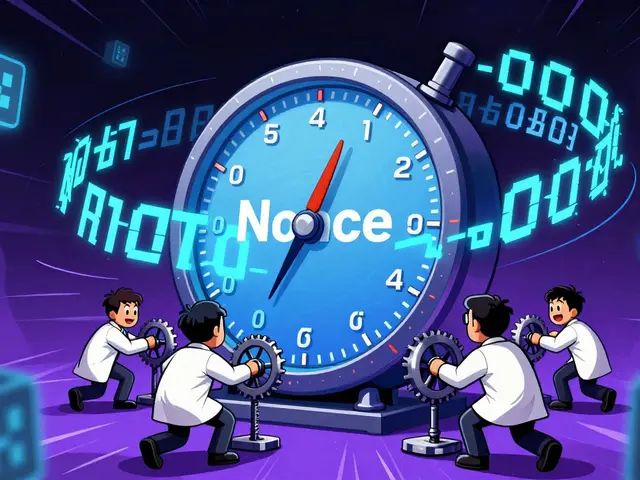
A nonce stands for "number only used once." In Bitcoin, it’s the one variable miners change over and over to try and get a block hash that’s low enough to meet the network’s difficulty target. Think of it like turning a dial on a lock. Each number you try gives you a different hash. You keep turning until the hash starts with enough zeros. That’s the goal.
The block header includes other data too: the previous block’s hash, the Merkle root of all transactions, the timestamp, and the difficulty target. But only the nonce is meant to be changed freely. The rest are mostly fixed for a given block template. Miners take that template, flip the nonce from 0 to 4,294,967,295, and hash it each time. If none of those values work - and they almost never do anymore - they have to change something else. That’s where things get messy.
Why 32 Bits? Why Not More?
Satoshi Nakamoto didn’t pick 32 bits by accident. It was intentional. A smaller range means miners have to rebuild the block header more often. That’s not a bug - it’s a feature. Every time the nonce runs out, miners must update the Merkle root (because they changed the transaction order or added new ones) or adjust the timestamp. Each rebuild adds a tiny bit of extra work. That extra work makes it harder for anyone to precompute hashes ahead of time. It’s a security layer.
Compare that to newer blockchains. Kaspa uses a 64-bit nonce - that’s over 18 quintillion possible values. Ethereum used to use a 32-bit nonce too, but it ditched mining entirely in 2022. Bitcoin stuck with the original design. And for over 14 years, it worked. Until it didn’t.
The Difficulty Problem
Bitcoin adjusts its mining difficulty every 2,016 blocks - roughly every two weeks. The goal? Keep block times at 10 minutes, no matter how many miners join or leave the network. If hash rate goes up, difficulty goes up. If miners shut off their rigs (like after China’s 2021 ban), difficulty drops.
As of late 2023, the difficulty hit 63.26 billion. That means the target hash has to be below 0x00000000000000000003e1c6d000000000000000000000000000000000000000. To put that in perspective: if you hashed every possible value in the nonce range, you’d need to do it over 63 billion times to find a winning hash - on average. That’s why you need ASICs. A consumer CPU? Forget it. A top-end i9-13900K would take over 3,800 years to find a single block solo.
What Happens When the Nonce Runs Out?
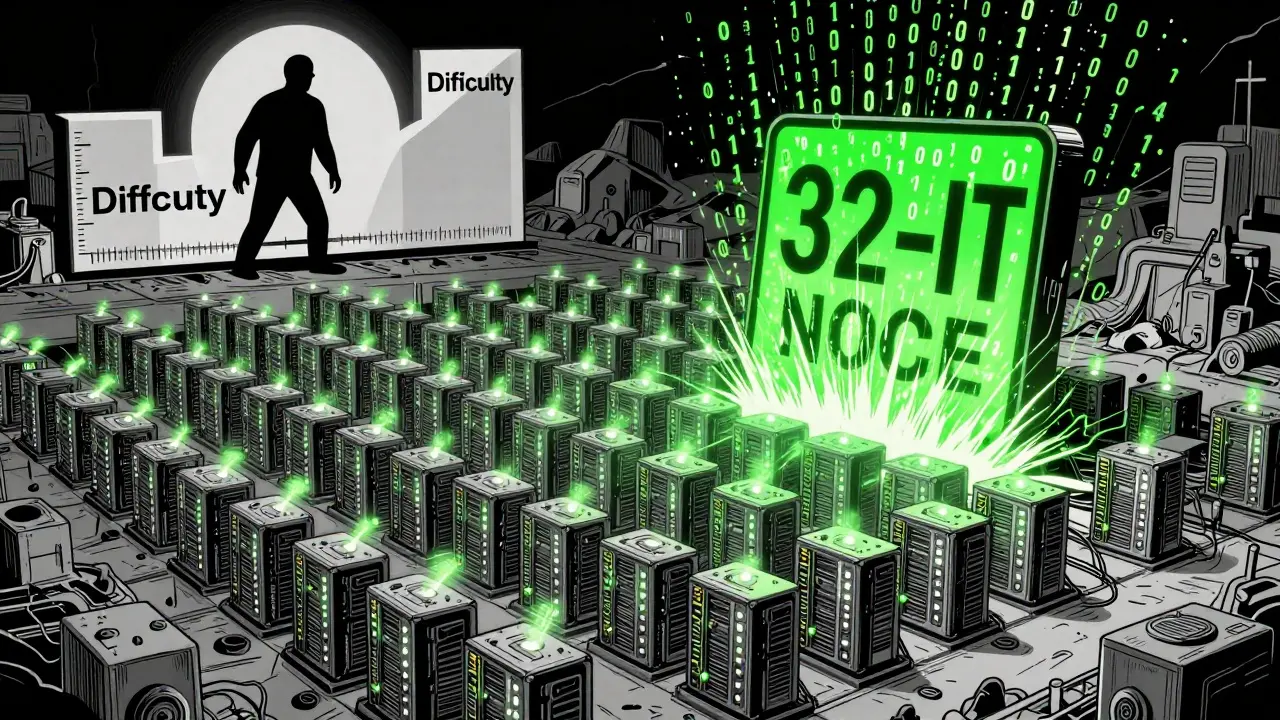
Here’s the real issue: at today’s hash rate - over 600 exahashes per second - miners burn through all 4.29 billion nonces in under 30 milliseconds. So what do they do? They use the extra nonce.
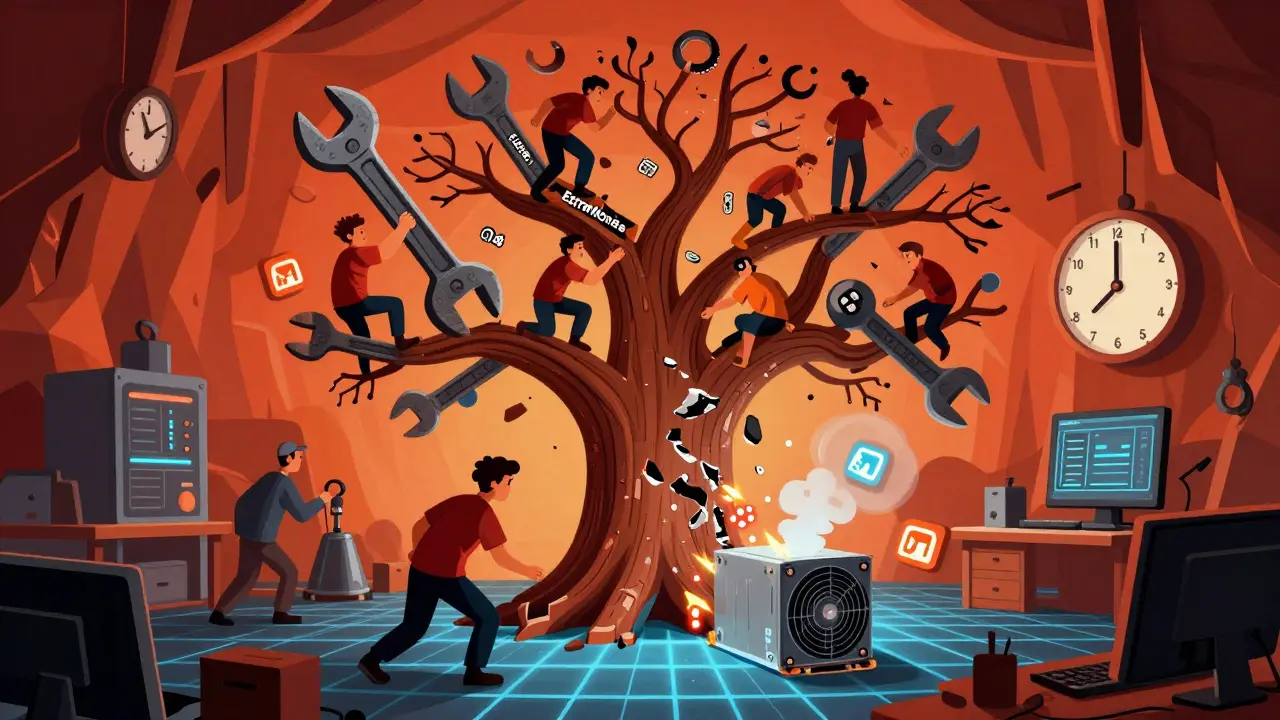
The extra nonce isn’t in the block header. It’s hidden inside the coinbase transaction - the first transaction in every block that pays out the block reward. It’s variable-length, so it can be as big as needed. When the primary nonce space is exhausted, miners tweak the extra nonce, which changes the Merkle root, which gives them a brand-new block template to try again.
But here’s the catch: changing the Merkle root means recalculating the entire tree. That takes time. Each rebuild adds 0.8 to 1.2 milliseconds of delay. At 600 EH/s, that’s not much. But for a mining pool running thousands of ASICs, even a 1-millisecond lag means lost hashes. F2Pool reported that 18% of rejected shares come from miners failing to update the extra nonce properly.
Professional mining farms use custom firmware to precompute Merkle roots and optimize transaction ordering. They can squeeze out 99.87% efficiency. But a hobbyist with a second-hand S19? They’re lucky to hit 80%. That’s hundreds of kilowatts wasted per day.
How Miners Are Adapting (and Failing)
Most beginners don’t realize how fast the nonce gets used up. Hashrate Index found that 68% of new miners waste over 20% of their hash rate in the first month because they don’t manage nonces correctly. They think more power = more luck. It’s not. It’s about how fast you can generate new block templates.
Reddit users in r/BitcoinMining report their S19s cycling through the entire nonce range 32,500 times per second. That’s not a typo. 32.5k times. Every second. And that’s just the primary nonce. The extra nonce kicks in constantly. The system is designed to handle this - but it’s not elegant. It’s brute force, with layers of complexity piled on top.
And it’s getting worse. The network hash rate is projected to hit 1,000 EH/s by mid-2024. At that point, the primary nonce will be exhausted in under 20 milliseconds. Miners will be rebuilding Merkle roots so often that the overhead could start eating into profitability. Some experts, like Dr. Aggelos Kiayias from Cardano, warn this could become a scaling bottleneck by 2030.
Is Bitcoin’s Nonce System Broken?
No - but it’s strained. The 32-bit nonce was never meant to handle 600 EH/s. It was meant to be simple, secure, and slow enough to keep mining accessible. That’s why Bitcoin’s security is so strong: the work isn’t just about hashing. It’s about constantly rebuilding the puzzle. That’s what makes pre-attacked blocks impossible.
But the cost is energy. NIST’s 2022 report called Bitcoin’s nonce mechanism "cryptographically sound but increasingly inefficient." Every time a miner rebuilds a Merkle tree to get a new nonce range, they’re burning electricity for something that doesn’t directly contribute to finding the hash. It’s overhead. And as difficulty climbs, that overhead grows.
Some proposals, like BIP-320, suggest adding auxiliary proof-of-work mechanisms to reduce the pressure. Others think Bitcoin will need a hard fork to expand the nonce field - but that’s politically impossible. The community values stability over speed. So for now, the extra nonce keeps things alive.
What This Means for You
If you’re a miner: your hardware is only half the story. Your software matters just as much. Use firmware that handles extra nonce rotation automatically. Don’t rely on default settings. Monitor rejected shares - if they’re above 10%, you’re losing money.
If you’re a casual observer: understand that Bitcoin’s security isn’t just about how much power is being used. It’s about how that power is being applied. The nonce system forces miners to work harder, not just faster. That’s why it’s still secure - even with quantum computers on the horizon. Even a future quantum machine would need 1.9 billion qubits to crack it efficiently. We’re nowhere near that.
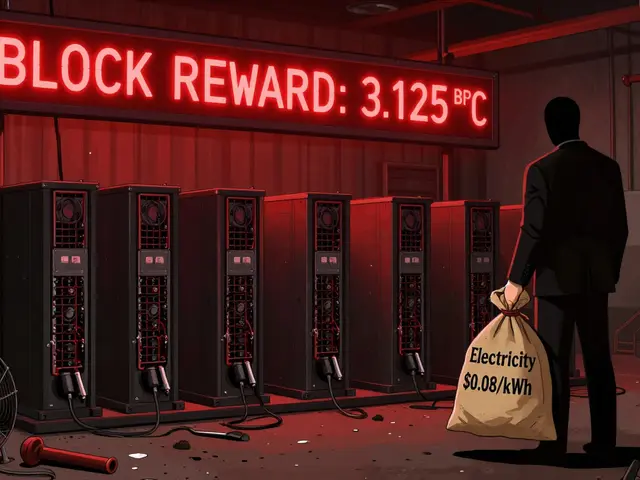
If you’re wondering why mining is so centralized: it’s because the nonce system favors scale. Only big farms can afford the engineering to optimize every millisecond. Solo mining? It’s dead. The math doesn’t lie.
The Future of Nonces
Bitcoin won’t change its nonce size. Not now. Not in five years. The protocol is too entrenched. But the mining industry will keep adapting. ASIC manufacturers will keep pushing for faster nonce iteration. Mining pools will get smarter at managing extra nonces. Energy efficiency will become the new battleground.
One thing’s certain: as long as Bitcoin uses proof-of-work, the nonce will remain its most overlooked hero. It’s small. It’s simple. And it’s holding up a $4.2 billion industry.
Danica Cheney
so the nonce is just a dial you turn until the hash works? kinda wild that we're still using this 2009 tech to secure billions
Kyle Pearce-O'Brien
Let’s be real - the 32-bit nonce is a cryptographic artifact of a pre-ASIC era. It’s not just inefficient, it’s *aesthetic* inefficiency. Satoshi designed it as a *slow burn* to enforce decentralization, but now we’re drowning in entropy. The extra nonce isn’t a patch - it’s a duct tape over a nuclear reactor. And don’t get me started on how Merkle root recalculations are just computational noise. We’re not mining Bitcoin - we’re performing ritualistic hash ballet to appease an algorithm that no longer cares if we win. 🤖⚡
Matthew Ryan
Interesting breakdown. I’ve always wondered how pools handle nonce exhaustion. The 0.8–1.2ms delay per rebuild adds up fast when you’re running 10,000 ASICs. Makes sense why firmware optimization matters more than raw hash rate.
Nathaniel Okubule
If you're mining Bitcoin, please make sure your software is updated. Many new miners don’t realize that rejected shares cost money. Even small inefficiencies add up over time. Stay informed.
Shruti Sharma
lol u think this is hard? in india we mine with rice cookers and chai machines. ur asics are just fancy heaters. also ur mom uses more power than ur rig
Robin Ødis
Everyone talks about nonce exhaustion like it’s some new problem, but the truth is Bitcoin was designed to be unsustainable. The entire system is a Ponzi scheme disguised as decentralization. The fact that we’re still clinging to a 32-bit field from 2009 proves how broken this whole thing is. They keep saying ‘security’ but it’s just energy waste wrapped in ideology. And don’t even get me started on how mining pools are just centralized oligarchies with fancy names. This isn’t innovation - it’s institutionalized insanity. And you people keep defending it like it’s some sacred text. Wake up.
Brittany Novak
Did you know the NSA helped design the original SHA-256 algorithm? The nonce limit isn’t a technical constraint - it’s a backdoor. They knew we’d hit this wall. They wanted mining to become centralized so they could monitor every hash. The extra nonce? That’s the real trap. Every time you rebuild a Merkle root, you’re sending metadata to the pool operator. And guess who owns the biggest pools? Hint: their HQs are in places with no privacy laws.
Joshua Herder
Okay but what if the entire premise is wrong? What if the nonce isn’t the bottleneck - what if the real problem is that we’re using proof-of-work at all? Why are we still pretending this is ‘mining’ like it’s gold? It’s not. It’s a glorified electricity auction. And the fact that we’re still clinging to this 14-year-old design because ‘it’s secure’ is just intellectual cowardice. We’re not preserving decentralization - we’re preserving the illusion of it. And every time someone says ‘Bitcoin is unchangeable,’ they’re really saying ‘I’m too scared to imagine something better.’
Brittany Coleman
It’s kind of beautiful how something so simple - a 32-bit number - can hold up an entire global financial system. Not because it’s perfect, but because it’s stubborn. Like a quiet old man who refuses to upgrade his phone but still knows everyone’s secrets. The nonce doesn’t need to be fancy. It just needs to be consistent. And that’s why it works.
laura mundy
So let me get this straight - we’re burning coal and gas to spin a dial that has 4 billion positions? And you call this innovation? The whole thing is a grotesque joke. We’re living in a world where a teenager in Ohio can buy a $5k ASIC and think they’re part of the future. Meanwhile, the entire system is held together by a single line of code that was written before smartphones existed. This isn’t blockchain. It’s a fossil.
Jacque Istok
68% of new miners waste 20% of their hash rate? Wow. So basically, most people are paying to run a space heater that occasionally flashes a green light. Congrats, you just turned your garage into a crypto sauna. At least your dog gets warm. 🐶❄️
Mendy H
The nonce system is a relic. The fact that we’re still using it proves Bitcoin’s community is more obsessed with dogma than progress. The extra nonce isn’t a solution - it’s a hack. And hacks become liabilities. This isn’t engineering. It’s archaeology with electricity.
Molly Andrejko
It’s okay if you’re new to mining. Everyone starts somewhere. Just remember: efficiency matters more than power. Check your rejected shares, update your firmware, and don’t compare yourself to big farms. You’re not behind - you’re learning. Keep going. 💪
sabeer ibrahim
Bitcoin is American imperialism wrapped in blockchain. Why do you think they chose 32-bit? Because US engineers in 2009 thought they were gods. Now we’re stuck with their arrogance. In India we build solar-powered rigs. We don’t worship silicon idols. Your nonce is your problem, not ours.
David Bain
The nonce’s 32-bit constraint is not a flaw - it is a necessary condition for the Byzantine fault tolerance of the system. By forcing block header reconstruction, it introduces a non-deterministic entropy injection mechanism that prevents precomputation attacks. This is not inefficiency - it is cryptographic resilience. The extra nonce is not a workaround; it is an emergent property of the protocol’s compositional design. To conflate computational overhead with systemic fragility is to misunderstand the nature of distributed consensus.
Deeksha Sharma
I love how Bitcoin keeps going even when everyone says it’s dead. The nonce might be small, but the community is huge. Keep building, keep learning, keep mining - even if it’s just one rig in your basement. You’re part of something real.
Freddie Palmer
Just curious - do mining pools ever use the coinbase transaction’s scriptSig to store extra nonce data? Or is it always the coinbase input? And how does that affect the Merkle tree depth? I’ve been reading the code but I’m not sure I get the exact flow.
Taybah Jacobs
While the nonce mechanism may appear archaic, its continued functionality speaks to the robustness of Bitcoin’s foundational architecture. It is not the most efficient system, but it is the most auditable. For those engaged in mining, adherence to protocol integrity remains paramount. Please ensure your operations comply with local regulations and environmental standards.
Alisha Arora
Wow so you're telling me people are spending thousands on machines just to flip a number? That's so dumb. Why not just print money? At least that's easier. And why are you all so obsessed with this? It's not even real money.