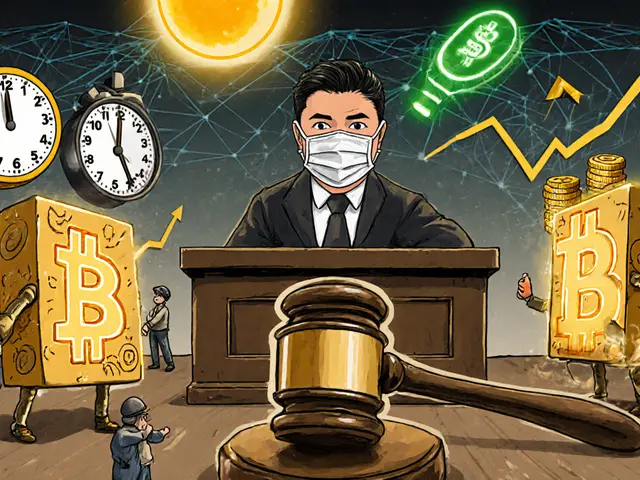
When Bitcoin’s block reward cuts in half, it’s not just a technical update-it’s an economic earthquake for miners. The April 2024 halving slashed rewards from 6.25 BTC to 3.125 BTC per block. For many miners, that meant overnight losses. Some shut down. Others scrambled to upgrade. And the network? It got stronger.
What Miner Capitulation Actually Means
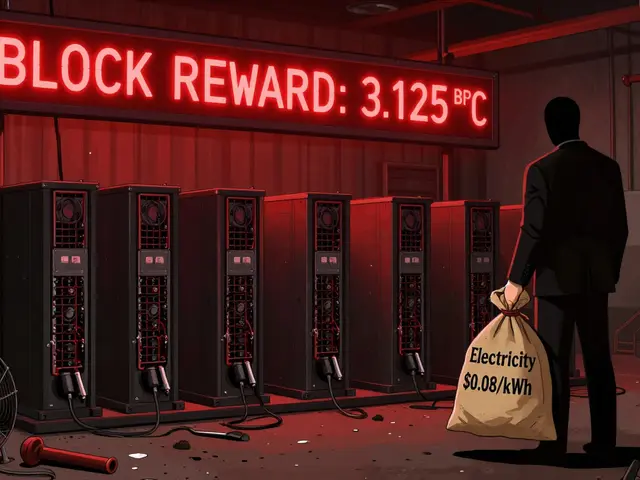
Miner capitulation isn’t a crash. It’s a purge. When the halving hits, mining revenue drops by 50%. But electricity bills, cooling costs, and hardware maintenance don’t. If you’re running old ASICs on expensive power, you’re now losing money every hour. No profit. No cash flow. Just red ink.This isn’t theoretical. After the 2024 halving, tens of thousands of mining rigs went dark. Smaller operations-those paying more than $0.08 per kWh or using pre-2021 hardware-couldn’t survive. On Reddit, miners posted photos of their rigs unplugged. One user from Texas wrote: "I ran a 100-TH farm on retail power. After halving, I lost $1,200 in two weeks. I sold the machines for parts."
It’s not about greed. It’s about math. At $54,000 per Bitcoin, only miners with efficiency under 30 TH/s per 3,000W and electricity under $0.05/kWh break even. Anything worse? You’re digging your own grave.
Who Survives-and Who Gets Crushed
Not all miners are the same. The winners have three things: cheap power, modern hardware, and cash reserves.Companies like Marathon Digital, Bitdeer, and Riot Platforms reported 20-30% drops in Bitcoin production right after the halving. But they didn’t shut down. Why? They locked in power deals at $0.03-$0.04/kWh. They bought the latest Bitmain S21s and MicroBT M50s. They kept 8-12 months of operating costs in reserve.
Meanwhile, independent miners using Antminer S17s or older models, especially those on grid power above $0.07/kWh, vanished. Mining pools saw hash rate drop 15-20% in the first 90 days. That’s not a glitch-it’s the system working.
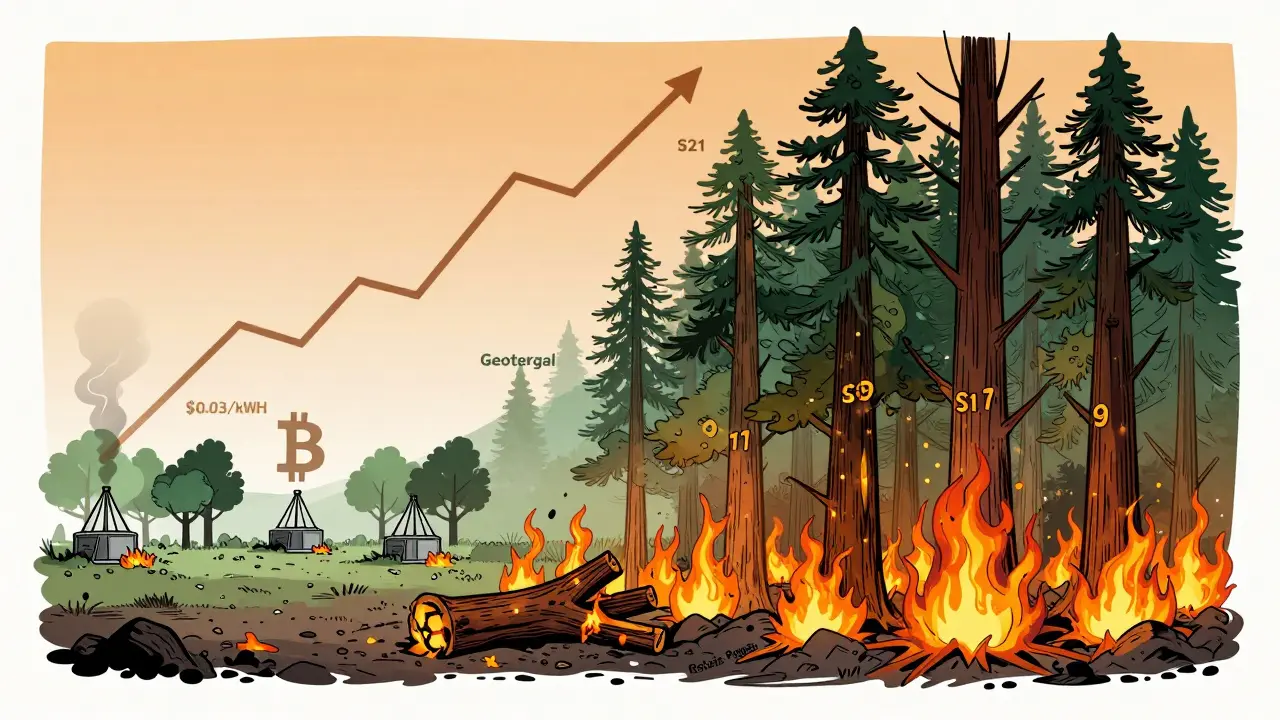
Think of it like a forest fire. The weak trees burn. The strong ones grow taller. After each halving, Bitcoin’s network becomes more secure because only the most efficient operators remain. Less centralization risk. More resilience.
The Hidden Cost: Energy and Location
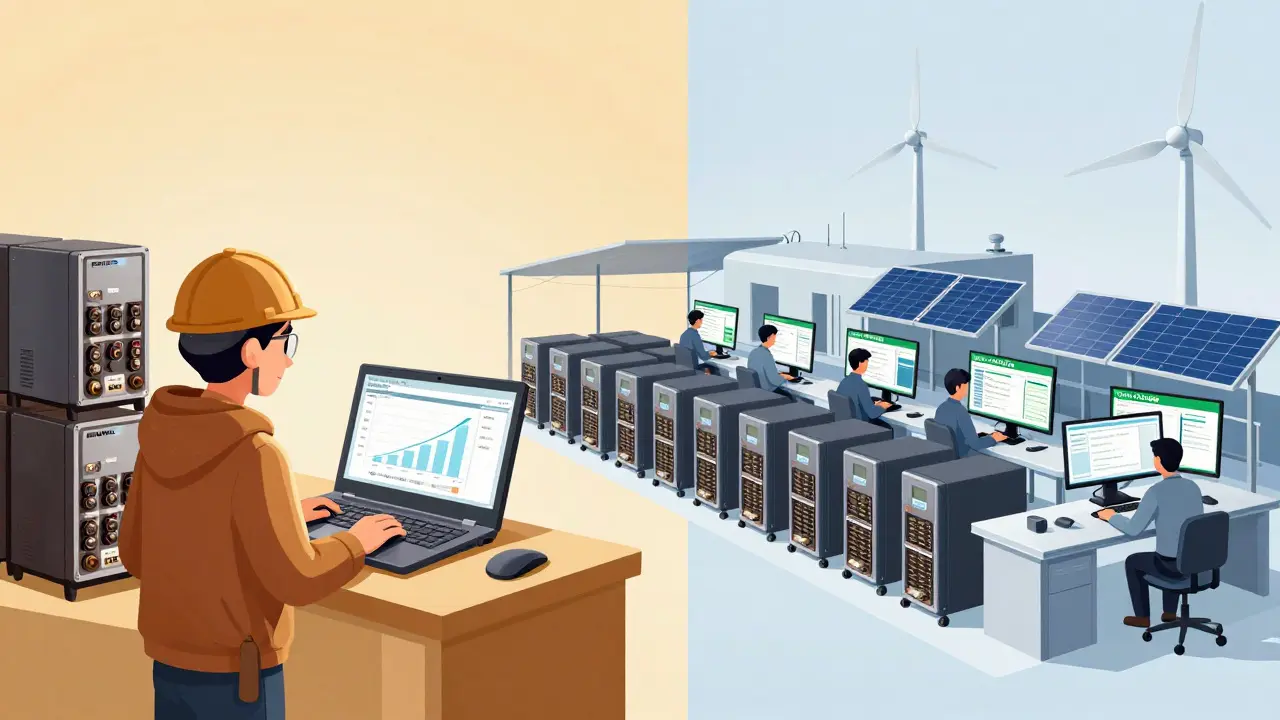
Electricity isn’t just a line item-it’s the lifeblood. Miners in Texas, Georgia, and Kazakhstan used to thrive because of cheap coal and gas. But after 2024, the game changed.The new winners? Those using stranded energy-wind farms in North Dakota that spill power at night, hydro plants in Canada with surplus capacity, or geothermal in Iceland. These sources aren’t just cheap-they’re often subsidized or free during off-peak hours. Some miners now run rigs in repurposed data centers next to solar farms, using curtailed energy that would’ve otherwise been wasted.
Miners who still rely on retail electricity? They’re extinct. Even $0.06/kWh is now a death sentence unless you’re running the latest 50+ TH/s ASICs. The average miner in 2023 could survive on $0.05/kWh. Now? You need $0.04 or less. And that’s not negotiable.
Hardware Upgrades: The Only Way Forward
You can’t outlast a halving with old gear. The S19 Pro from 2021 delivered 110 TH/s at 3,250W. The S21 from 2024 delivers 200 TH/s at 3,250W. That’s an 80% efficiency jump. No magic. Just physics.Miners who upgraded before April 2024 saw their daily revenue stay flat-even though the block reward halved. Why? Because they mined twice as much per watt. That’s the only way to survive: do more with less.
But upgrading costs. A single S21 runs $4,500. A 100-machine farm? $450,000. That’s why only companies with access to capital or investors can make the leap. Small miners? They either sell their rigs to bigger operators or exit entirely.
Some turned to cloud mining. Companies like Hashflare and NiceHash now offer rental hashrate. You pay a monthly fee, get your Bitcoin, and avoid the noise of cooling fans and broken power supplies. It’s not ideal-but for many, it’s the only option left.
Price Recovery: The Waiting Game
Halvings don’t automatically make Bitcoin go up. But they do change the supply equation. Less new supply entering the market. More demand from ETFs, institutions, and retail buyers. That’s the theory.After the 2020 halving, Bitcoin took 12 months to recover to pre-halving levels. In 2024, it took just 4 months. Why? Spot Bitcoin ETFs. BlackRock, Fidelity, and Ark launched them in January 2024. Suddenly, institutional buyers were pouring billions into Bitcoin-regardless of miner sentiment.
By August 2024, Bitcoin hit $72,000. That lifted everyone. But the miners who didn’t survive? They were already gone. The ones who made it? They doubled their output and locked in profits.
What Comes Next: The 2028 Halving
The next halving is scheduled for 2028. By then, over 98% of all Bitcoin will be mined. Only 1.35 million coins remain. That means every new block will be harder to mine. The network difficulty will keep rising. The margin for error will shrink further.Analysts predict that by 2028, only miners with electricity under $0.03/kWh and next-gen ASICs will survive. That’s not a prediction-it’s a requirement. We’re moving toward an industrial mining landscape. Think Amazon warehouses full of rigs, powered by solar arrays and wind farms, run by teams of engineers-not hobbyists.
Some say this is bad for decentralization. Maybe. But Bitcoin’s security depends on miners having skin in the game. If 10,000 small miners go offline and 10 big ones take over, the network is still secure. It’s just less noisy.
How to Prepare (If You’re Still Mining)
If you’re still running a rig, here’s your checklist:- Check your power cost. If it’s above $0.05/kWh, you’re already in danger.
- Know your ASIC model. Anything older than the S19 is obsolete. S21 or M50? You’re still in the game.
- Calculate your daily profit. Use a mining calculator. Plug in your hash rate, power draw, and electricity cost. If it’s negative, shut down.
- Build a cash buffer. Keep at least 6 months of operating expenses in Bitcoin or USD. You won’t get paid for 90 days after a shutdown.
- Explore energy partnerships. Can you connect to a solar farm? A hydro plant? A stranded gas well? That’s your lifeline.
There’s no coming back from a halving if you’re unprepared. The market doesn’t care about your story. It cares about your watts per terahash.
Why This Matters Beyond Miners
You don’t have to mine Bitcoin to care about miner capitulation. Every time a miner shuts down, the network becomes more secure. Fewer players mean less risk of collusion. More efficient miners mean less waste. And as block rewards shrink, transaction fees become more important-pushing Bitcoin toward being a settlement layer, not a payment network.Halvings are the reason Bitcoin has lasted 15 years. It’s not the tech. It’s the incentive structure. Miners are the backbone. And every four years, the system filters out the weak. What’s left? A stronger, leaner, more resilient network.
What happens to Bitcoin’s price after a halving?
Historically, Bitcoin’s price rises 6-18 months after a halving due to reduced supply and increased demand. After the 2024 halving, it hit $72,000 by August-faster than in 2020-thanks to spot ETFs bringing in institutional money. But price isn’t guaranteed. If demand doesn’t rise, miners can stay unprofitable for longer.
Can I still mine Bitcoin profitably in 2025?
Only if you have modern ASICs (like the S21 or M50), electricity under $0.04/kWh, and a stable power contract. Home mining on retail power is dead. Industrial-scale operations with renewable energy are the only ones surviving long-term.
Why do miners shut down instead of waiting for prices to rise?
Because they can’t afford to wait. Electricity and maintenance bills keep coming. If you’re losing $500 a day and have no cash reserve, you go bankrupt in 30 days. Waiting for Bitcoin to rebound doesn’t pay your rent. Selling your rigs for parts or to a larger miner is often the only way to recoup some value.
What’s the difference between a miner and a mining pool?
A miner owns the hardware and runs the rigs. A mining pool is a group of miners who combine their hash power to increase their chance of earning a block reward, then split the payout. Most small miners join pools because solo mining is nearly impossible now due to high network difficulty.
Are cloud mining services worth it?
They’re better than running your own rig on expensive power-but only if you choose a reputable provider. Many cloud mining companies are scams. Look for transparent contracts, real hardware locations, and third-party audits. Even then, you’re paying a markup. You’ll earn less than if you mined yourself with cheap power.
Shawn Roberts
Bro this is the beauty of Bitcoin 🚀 Hard money doesn't care about your rent bill. If you can't adapt, get out of the game. The network just got stronger. 🤘
Jake West
Wow another crypto bro treatise on how the little guy gets crushed. Tell me again how your $450k S21 farm is somehow more ethical than a guy running an S19 on his garage. You’re not a miner. You’re a corporate asset.
Emily L
I saw a guy on Reddit sell his S17s for $200 each. He said he used the money to buy a used Tesla. Good for him. I’m just glad I’m not paying $0.08/kWh like some of these clowns.
Kevin Gilchrist
The real story? Miners are just the canaries in the coal mine. When the electricity grid starts pricing out miners, it’s because the whole system is rigged. They’re not letting us win. The banks own the grid. The banks own the ASICs. The banks own the narrative. Wake up.
Mandy McDonald Hodge
i just started mining with a used s19 in my basement and my power bill went up $40 a month... but i got 0.002 btc this week?? i feel like a wizard 🧙♀️✨
Jordan Fowles
The halving isn't a price predictor. It's a survival filter. The network doesn't care if you're emotional about it. It only cares about watts per terahash. That's the cold truth. Everything else is noise.
Bianca Martins
My cousin runs a small farm in Georgia on a solar + battery setup. He pays $0.025/kWh and runs 50 M50s. He made more in Q3 2024 than he did all of 2023. It's not about size. It's about optimization.
surendra meena
I TOLD YOU ALL THIS WOULD HAPPEN!!! The elites planned this!!! The halving was engineered to force small miners out so they can monopolize the network!!! They're coming for your wallets next!!!
Adam Hull
The romanticization of the "independent miner" is a myth. The reality is that Bitcoin’s security has always depended on institutional-scale operations. The 2024 purge was inevitable. The only surprise is that it took this long for retail to accept it.
Prateek Chitransh
Funny how everyone acts like this is new. We’ve seen this cycle since 2012. The only thing that changes is the color of the ASICs. The math? Still the same. The emotional drama? Always louder.
Abhisekh Chakraborty
I just sold my last 2 S17s. I cried. Not because I lost money. But because I lost the dream. I thought I was part of something revolutionary. Turns out I was just a disposable node.
Jordan Fowles
That’s the real cost. Not the electricity. Not the hardware. It’s the emotional investment. People don’t just mine Bitcoin. They mythologize it. When the market strips that away, it leaves a hollow space. That’s harder to recover from than any balance sheet.
Monty Burn
The fact that people still think mining is a path to wealth shows how little they understand economics. Mining is a cost center. It’s not an investment. It’s a utility. You don’t get rich running a water treatment plant either
Jackson Storm
If you’re still on retail power you’re not mining. You’re gambling. And if you don’t know your power cost per TH, you’re not even playing the game. Check your numbers. Then act. Don’t just complain.
Steve Williams
In Nigeria, we have no choice but to use expensive power. But we still mine. We use solar panels. We trade energy with neighbors. We adapt. Bitcoin doesn't require perfect conditions. It requires persistence.
Joydeep Malati Das
The industrialization of Bitcoin mining is not a bug. It is a feature. Decentralization does not require a thousand small operators. It requires a thousand independent actors with aligned incentives. Scale does not equate to centralization.
Johnny Delirious
The narrative that miners are the backbone of Bitcoin is misleading. The backbone is the protocol. Miners are the muscle. And like any muscle, it adapts to demand. The halving was not a crisis. It was a recalibration.
Haritha Kusal
i think its so cool how people are finding ways to use wasted energy for mining like solar and wind lol i wish i could do that but my apartment has no space 😅
Kenneth Mclaren
You think this is about power costs? No. This is about the Fed printing money. Miners are being forced out so they can control the narrative and push CBDCs. The halving is just the cover. The real agenda is digital slavery.
Andrew Prince
The fundamental flaw in the prevailing narrative is the conflation of efficiency with decentralization. The notion that a reduction in the number of operational miners equates to increased network security is a fallacy. Security is derived from distributed participation, not from the computational density of a few oligopolistic entities. The homogenization of hardware, coupled with geographic concentration, introduces systemic risk. The very architecture that Bitcoin was designed to circumvent is being reconstituted under the banner of optimization.