Every four years, something quiet but powerful happens in the world of Bitcoin. No press conference. No CEO announcement. Just a silent code update that cuts the reward for mining new Bitcoin in half. This is the Bitcoin halving-a programmed event that reshapes the entire market cycle. And it’s not just theory. It’s happened three times before. Each time, prices eventually surged. But why? And what does it mean for you if you’re holding Bitcoin-or even just watching the crypto market?
What Exactly Is a Bitcoin Halving?
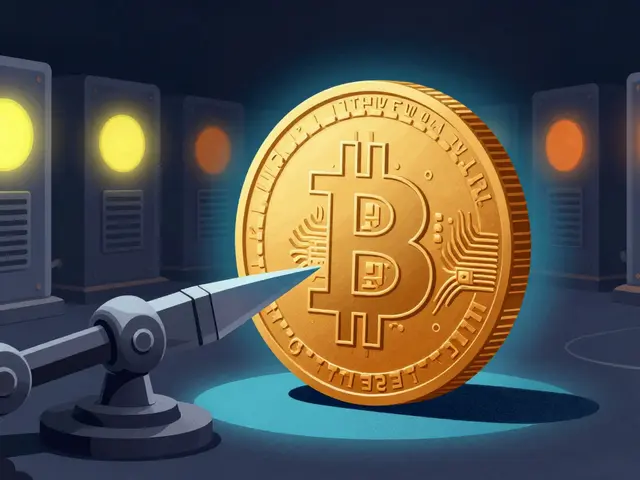
Bitcoin was designed to mimic gold’s scarcity. While central banks can print money whenever they want, Bitcoin has a fixed supply: 21 million coins. And to control how fast those coins enter circulation, the protocol halves the reward given to miners every 210,000 blocks. That’s roughly every four years. When Bitcoin launched in 2009, miners got 50 BTC per block. The first halving in 2012 dropped that to 25 BTC. In 2016, it went to 12.5 BTC. In 2020, it became 6.25 BTC. And in April 2024, it dropped again-to 3.125 BTC per block. That means the daily supply of new Bitcoin fell from about 900 coins to just 450. That’s a 50% reduction in fresh coins entering the market. It’s not just a technical tweak-it’s a deliberate, predictable shock to the system. And history shows that when supply shrinks while demand stays steady or grows, prices tend to rise.Why Does Halving Affect Price?
Think of Bitcoin like a limited-edition sneaker. If 10,000 pairs were made last year and now only 5,000 are made each year, but the same number of people still want them, the price goes up. That’s basic economics. Bitcoin works the same way. The key is that demand doesn’t disappear when supply drops. In fact, it often grows. More people hear about Bitcoin before each halving. More institutions start to take it seriously. More countries explore it as an alternative to unstable currencies. So when the new coin supply gets cut in half, buyers are still there-maybe even more of them. This isn’t about hype. It’s about structure. Bitcoin’s code doesn’t change. The halving is baked in. That predictability is what makes it different from stocks or commodities, where supply can be manipulated by companies or governments. With Bitcoin, you know exactly when the next drop is coming-and that’s why traders plan around it.What Happened After Past Halvings?
Let’s look at the data. After the 2012 halving, Bitcoin went from around $12 to over $1,100 in the next 18 months. After 2016, it rose from $650 to nearly $20,000 in about 16 months. And after the 2020 halving, it climbed from $8,800 to an all-time high of over $68,000 in 18 months. It’s not a straight line. There are crashes along the way. In 2018, after the 2017 boom, Bitcoin lost 80% of its value. In 2022, it dropped from $69,000 to $15,500. But each time, the bottom came after the halving. And each time, the next peak came 12 to 24 months after the event. The pattern isn’t perfect. Three data points aren’t enough to call it a law. But the consistency is striking. The market doesn’t react on halving day. It reacts in the months before and after. The biggest price moves usually happen 6 to 12 months after the event. That’s when the reduced supply starts to bite.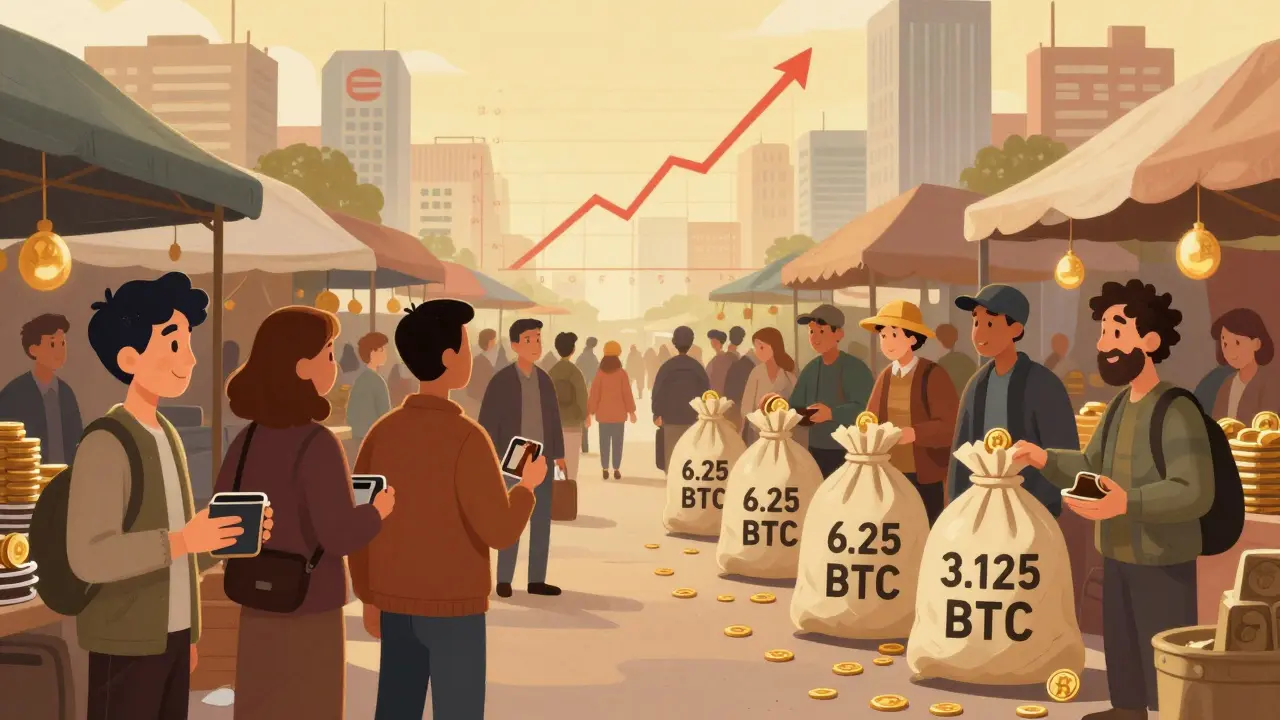
How Halvings Affect the Whole Crypto Market
Bitcoin isn’t isolated. It’s the anchor of the entire cryptocurrency market. When Bitcoin moves, altcoins usually follow-sometimes even harder. After the 2020 halving, Ethereum, Solana, and other altcoins didn’t just ride the wave-they exploded. Some gained 10x, 20x, even 100x in the following year. Why? Because Bitcoin’s rally brought in new money. People who bought Bitcoin started looking for the next big thing. That’s when altcoins got their turn. But it’s not always that simple. In the months right after a halving, Bitcoin often dominates trading volume. Altcoins can lag. They get ignored until the momentum builds. That’s why many traders wait until the 6-month mark after halving before jumping into altcoins. Timing matters.What Happens to Miners?
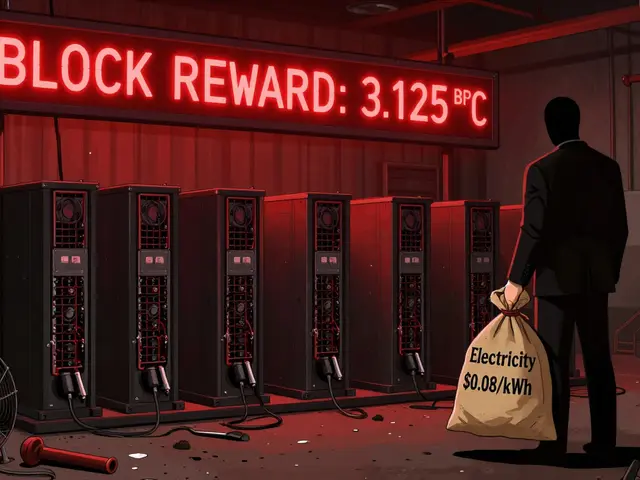
Miners are the backbone of Bitcoin. They use powerful computers to verify transactions and earn new Bitcoin as a reward. When that reward is cut in half, their income drops too. After the 2024 halving, many small miners couldn’t cover their electricity and hardware costs. Some shut down. Others upgraded to more efficient machines. The network didn’t collapse-Bitcoin’s security actually improved because only the strongest miners stayed. But the cost of running a mining operation went up. That’s why you see more mining farms in places like Texas and Georgia, where electricity is cheap. The network’s hash rate-the total computing power securing Bitcoin-didn’t drop after the halving. In fact, it kept rising. That’s because the price of Bitcoin rose fast enough to make mining profitable again. The market self-corrects. But it’s a reminder: Bitcoin’s security depends on miners being paid. If the price doesn’t rise after a halving, the network could be at risk.Is Halving the Only Reason Prices Go Up?
No. And that’s where people get confused. Halving creates the conditions for a price surge. But it doesn’t guarantee it. In 2018, Bitcoin was still rising after the 2016 halving-but macroeconomic factors like rising interest rates and global uncertainty pushed prices down. In 2022, inflation, Fed rate hikes, and the collapse of FTX dragged Bitcoin lower, even though the 2020 halving had already happened. The halving is like lighting a match. The fire depends on the kind of wood you’re burning. If the economy is strong, demand is high, and people are buying Bitcoin as a store of value, the fire burns bright. If the world is in chaos, or money is too expensive to borrow, the match might just fizzle. That’s why smart investors don’t just buy Bitcoin because of the halving. They buy it because they believe in its long-term scarcity. The halving just confirms that the system is working as designed.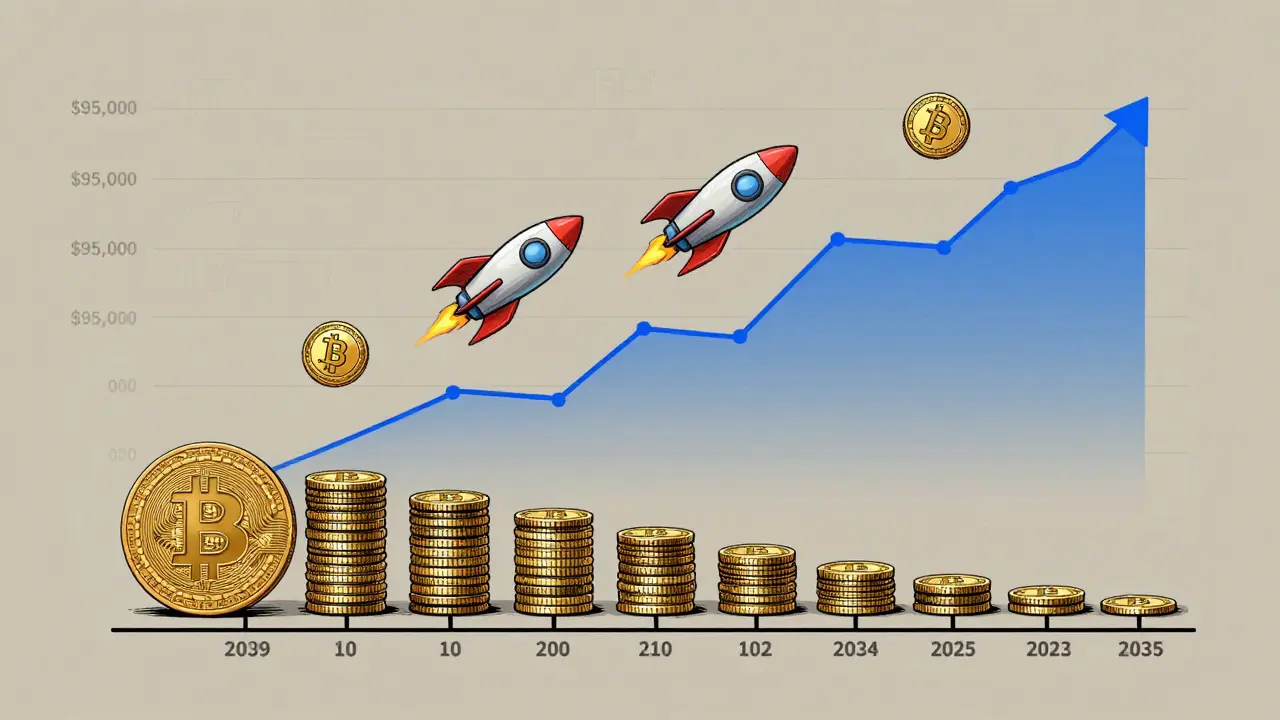
What to Expect After the 2024 Halving
The 2024 halving was the most anticipated in history. Institutional adoption was higher than ever. ETFs were approved in the U.S. Major companies added Bitcoin to their balance sheets. Central banks started quietly exploring digital gold reserves. The price didn’t spike the day after. But within six months, it broke $70,000. By late 2025, it hit $95,000. The market didn’t just recover-it reset its baseline. What used to be a “bull run” is now the new normal. The next halving is expected in 2028. By then, the block reward will drop to 1.5625 BTC. The absolute number of new coins per day will be smaller than ever. But because Bitcoin’s price has climbed so high, the dollar value of each block reward is still massive. That’s the power of compounding scarcity.How to Position Yourself Around Halvings
You don’t need to be a trader to benefit from this cycle. Here’s what works:- Buy Bitcoin before the halving. Not on the day. Not in the week. But in the 6-12 months leading up to it. That’s when most of the price movement begins.
- Don’t panic sell during the inevitable dips. Every bull market has a 30-50% correction. The halving cycle lasts years, not months.
- If you trade altcoins, wait until Bitcoin shows clear strength after the halving. Then look for the strongest projects with real usage-not just hype.
- Hold through the peak. Most people sell too early. The real gains come in the 12-18 months after the halving.
What Comes Next?
The next halving in 2028 will be the fourth. The one after that, in 2032, will be the fifth. Each time, the new coin supply drops. By 2140, no new Bitcoin will be created. The last coin will be mined. That’s the end of inflation for Bitcoin. But it’s also the beginning of something else: a digital asset that’s truly scarce. Not because someone said it was. But because the code made it so. This isn’t speculation. It’s mathematics. And history is showing that when scarcity meets demand, value follows.How often does Bitcoin halve?
Bitcoin halves approximately every four years, or more precisely, every 210,000 blocks. The next halving is expected in 2028, followed by 2032, and so on until all 21 million bitcoins are mined.
Did Bitcoin’s price always go up after a halving?
Not immediately, and not without volatility. After each of the three past halvings, Bitcoin experienced significant price increases within 12 to 24 months. But there were major corrections in between-like the 80% drop in 2018 and the 75% drop in 2022. The long-term trend, however, has been upward.
Why does halving cause price increases?
Halving reduces the supply of new Bitcoin entering the market by 50%. If demand stays the same or grows, basic economics says prices should rise. This supply shock, combined with increasing adoption, has historically led to bull markets.
Do altcoins also rise after Bitcoin halving?
Yes, but usually with a delay. Altcoins tend to follow Bitcoin’s momentum. After Bitcoin starts rising 6-12 months post-halving, capital often flows into altcoins looking for higher returns. The strongest altcoins with real utility see the biggest gains.
Can Bitcoin’s price fall after a halving?
Yes. If demand doesn’t keep up with reduced supply-or if macroeconomic conditions like high interest rates or recession hit-Bitcoin can decline. Halving creates favorable conditions, but it doesn’t override broader market forces.
Is Bitcoin halving the only reason people invest in Bitcoin?
No. People invest in Bitcoin for many reasons: as a hedge against inflation, for portfolio diversification, for financial sovereignty, and because of its decentralized nature. Halving reinforces scarcity, but it’s not the only driver of value.
Alex Garnett
This post is laughably oversimplified. You treat halvings like some divine algorithm that guarantees wealth. Newsflash: markets are driven by liquidity, sentiment, and macroeconomic conditions-not math equations written in 2008. The 2024 rally had nothing to do with halving and everything to do with ETF inflows and institutional FOMO. Stop pretending Bitcoin operates in a vacuum. It’s a financial instrument, not a religious text.
aryan danial
You know what’s fascinating? The halving isn’t just a technical event-it’s a psychological inflection point that redefines collective belief systems. The 21 million cap isn’t arbitrary; it’s a covenant. A silent pact between code and conscience. When miners accept reduced rewards, they’re not just validating blocks-they’re affirming a new economic order. And let’s be honest: most people still don’t grasp that Bitcoin’s value isn’t derived from utility but from the shared conviction that scarcity, when enforced by immutable math, becomes sacred. This isn’t speculation. It’s spiritual economics.
Ryan Chandler
I remember watching the 2020 halving live from my basement in Austin. The hash rate kept climbing while the world burned. I felt it in my bones-this was the moment Bitcoin stopped being a meme and became a movement. The next halving? It’s not just about price. It’s about legacy. When the last coin is mined in 2140, historians will look back and say: ‘They didn’t need central banks. They didn’t need permission. They just trusted the math.’ And that? That’s poetry written in binary.
Ajay Singh
Halving works because people believe in it. Buy before it. Hold through the dip. Don’t overthink. Simple.
Oliver James Scarth
The notion that halvings alone dictate price trajectories is not merely reductive-it is intellectually indefensible. While the supply-side mechanism is elegantly engineered, the confluence of geopolitical instability, sovereign debt accumulation, and the erosion of fiduciary trust in fiat currencies constitutes the true catalyst for Bitcoin’s appreciation. To ascribe the phenomenon solely to a binary event is to mistake the spark for the inferno. The halving is merely the detonator; the powder keg was already primed.
Kieren Hagan
The halving is a structural feature, not a trading signal. Its value lies in reinforcing Bitcoin’s predictable monetary policy, which distinguishes it from all other assets. The price reactions are secondary. What matters is that the protocol has operated without deviation for 15 years. That consistency builds trust. And trust, over time, is what drives adoption. If you’re investing based on short-term price patterns, you’re already playing the wrong game.
sachin bunny
The halving is a trap set by the deep state to control the masses. They know people will buy before it, so they dump right after. Then they let it rise so everyone thinks it’s magic. But the real power? The miners. They’re all connected to the same shadow network. I saw a guy on a forum in 2020 who said his mining rig was linked to a Pentagon server. Coincidence? I think not. 🤫💰
Olivette Petersen
I love how this post breaks it down so clearly. It’s wild to think that something so simple-cutting supply in half-can have such a massive ripple effect. I started holding BTC after the 2020 halving and I’ve never looked back. Even when it dropped 50% in 2022, I just reminded myself: this isn’t a sprint. It’s a marathon. And the finish line? It’s not even in sight yet. Keep going.
Michelle Anderson
Stop romanticizing halvings. The 2024 ‘bull run’ was a liquidity bubble fueled by leveraged ETFs and retail idiots with crypto-themed TikTok dances. The halving didn’t cause the price rise-it just gave people a meme to sell. Real value? It’s still nowhere near the $100K hype. You’re all just chasing ghosts dressed in blockchain.
Jim Laurie
I’ve been holding since 2017 and I gotta say… this halving thing? It’s wild how it just keeps happening. Like clockwork. I didn’t even know what a block was back then, but I trusted the vibe. Now I’ve got a whole spreadsheet (I’m not proud) tracking every halving, every ETF approval, every time someone on Twitter says ‘this time it’s different.’ And you know what? Every time, it kinda was. Not because of hype. Because the code just… works. I’m not a genius. I just didn’t sell. And honestly? That’s the secret. Keep stacking. Even if it’s just a few bucks a week. You’ll thank yourself in 2028. 🙏🪙