Imagine logging into your favorite cryptocurrency exchange to withdraw funds, only to find the site gone. Your assets are frozen. The domain is seized by law enforcement. This isn't a hypothetical nightmare for users in sanctioned regions; it is the reality that unfolded in March 2025 when the U.S. Secret Service dismantled Garantex, one of Russia's largest crypto platforms. For millions of users relying on digital assets to bypass traditional banking restrictions, this event marked a turning point. It exposed the fragility of centralized exchanges operating in gray areas and triggered a rapid, chaotic evolution in how sanctioned entities attempt to maintain financial access.
The story of Garantex, a Russian-operated cryptocurrency exchange designated by the U.S. Treasury's Office of Foreign Assets Control (OFAC) begins long before its fall. Founded by Sergey Mendelev and Aleksandr Mira Serda, Garantex became a critical infrastructure piece for those seeking to move money outside the reach of Western sanctions. However, its utility came with severe risks. By August 2025, the U.S. government had escalated its approach from simple monitoring to aggressive dismantling, targeting not just the platform but its leadership, successor entities, and the underlying token ecosystems they relied upon.
The Fall of Garantex: A Case Study in Enforcement
To understand the current landscape of Russian crypto sanctions, we must look at the specific mechanics of Garantex's collapse. On March 6, 2025, an international operation led by the U.S. Secret Service resulted in the seizure of three Garantex domains and the confiscation of servers. More critically, authorities froze over $26 million in cryptocurrency, primarily USDT (Tether). This action was not random; it was the result of sophisticated blockchain analytics provided by firms like Elliptic, which helped overcome Garantex's wallet obfuscation techniques.
The human cost was immediate. Co-founder Aleksej Besciokov was arrested while vacationing in India. But the legal hammer fell harder months later. On August 14, 2025, OFAC re-designated Garantex under Executive Order 13694, alleging the exchange had processed over $100 million in transactions linked to illicit activities since 2019. This designation wasn't just about past crimes; it was a strategic move to block any remaining assets and cut off future interactions with the U.S. financial system. The U.S. Department of State simultaneously announced rewards totaling up to $6 million for information leading to the arrest of Garantex leaders, including a $5 million bounty for Aleksandr Mira Serda.
The Rise of Grinex: Successor Entities and Evasion Tactics
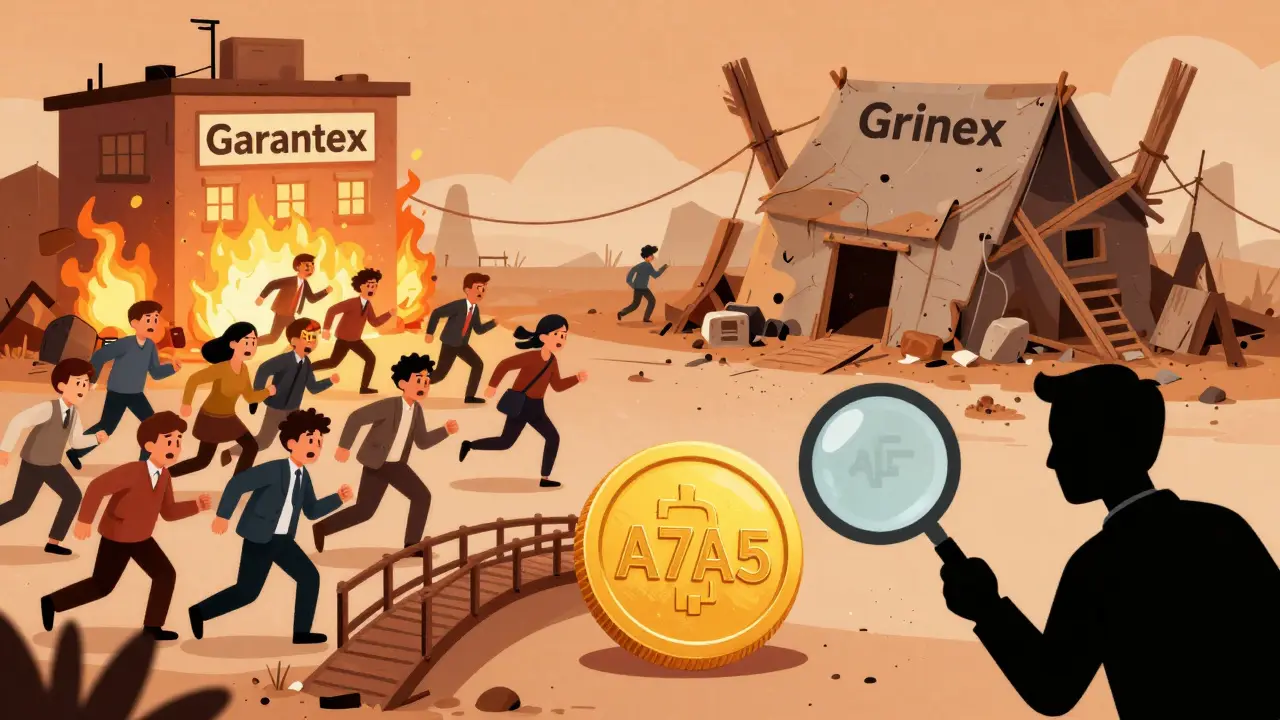
When a major exchange falls, its users don't simply disappear. They migrate. In response to the March 2025 disruptions, Garantex employees immediately created Grinex, a successor exchange designed explicitly to circumvent sanctions. Grinex’s own promotional materials openly acknowledged its origin, stating it was formed in response to the sanctions and asset freezes that affected Garantex. This transparency might seem reckless, but it highlights a desperate need for continuity among its user base.
Grinex allowed former Garantex customers to regain access to their accounts using a new mechanism: the A7A5 token. This ruble-backed digital asset, issued by a Kyrgyzstani firm, served as a bridge currency. Users could deposit A7A5 to unlock their previously frozen assets. However, this adaptation did not go unnoticed. OFAC designated Grinex alongside Garantex in August 2025, citing that Grinex was owned or controlled by Garantex. This legal maneuver demonstrates a key trend in modern sanctions enforcement: authorities are no longer satisfied with targeting primary entities; they are aggressively pursuing successor organizations and associated networks.
| Entity | Status | Key Action/Designation Date | Primary Role |
|---|---|---|---|
| Garantex Europe OU | Sanctioned | April 5, 2022 (Initial); Aug 14, 2025 (Re-designation) | Major Russian crypto exchange |
| Grinex | Sanctioned | August 14, 2025 | Successor exchange for Garantex users |
| Aleksandr Mira Serda | Targeted Individual | August 14, 2025 | Co-founder/CCO of Garantex |
| Sergey Mendelev | Targeted Individual | August 14, 2025 | Co-founder of Garantex |
The A7 Network and the Scale of Illicit Flows
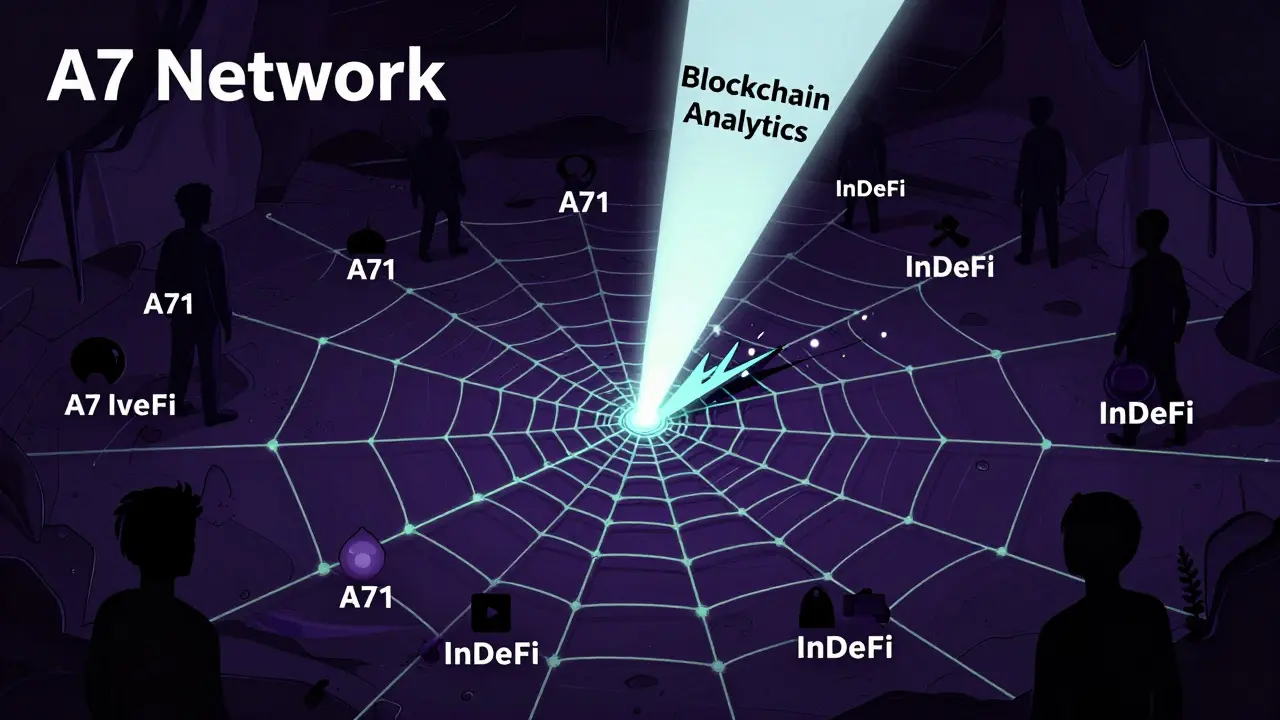
Beneath the surface of these high-profile designations lies a vast, interconnected network known as the "A7" group. This network includes companies such as A7, A71, A7 Agent, Old Vector, Independent Decentralized Finance Smartbank and Ecosystem (InDeFi Bank), and Exved. According to analysis by Elliptic, a leading blockchain analytics firm, these entities have received approximately $8 billion in cryptocurrency transactions since early 2024. This figure is likely a conservative lower bound, as additional unidentified wallets probably exist within the ecosystem.
The A7 leaks, which became public in mid-2025, were a significant blow to this network. These leaks disclosed information allowing cryptocurrency wallets to be linked directly to A7 companies. Evidence suggests that infrastructure changes observed in August 2025-including unusual activity with A7A5 stablecoin wallets-were responses to a security breach that potentially compromised cryptographic keys. This vulnerability underscores a critical weakness in sanctions evasion strategies: reliance on complex, opaque structures often leads to operational insecurity.
A7A5 Stablecoin: The Ruble-Backed Alternative
One of the most innovative aspects of the Russian sanctions evasion playbook is the development of alternative stablecoins. Historically, Russian users favored Tether's USDT for its price stability against the volatile Ruble and its broad payment utility. However, USDT's centralized nature became a liability. Tether, based in the Bahamas but subject to U.S. pressure, has the ability to freeze wallets. When Garantex was forced offline in March 2025, many users found their USDT holdings inaccessible.
This vulnerability prompted the creation of A7A5, a stablecoin designed as a more resilient alternative. Backed by the Ruble and issued by a Kyrgyzstani entity, A7A5 gained prominence among users seeking to bypass sanctions after domestic banks were cut off from SWIFT. Unlike USDT, A7A5 was intended to offer greater resistance to external freezing mechanisms. However, the cat-and-mouse game continues. In August 2025, Elliptic announced product updates adding support for screening A7A5 transactions on both TRON and Ethereum blockchains. This integration means that compliance teams and law enforcement can now track A7A5 flows with the same precision as USDT, neutralizing much of its advantage.
Implications for Users and Compliance Professionals
For individuals in sanctioned jurisdictions, the implications are stark. The systematic targeting of platforms like Garantex and Grinex creates increasingly complex challenges in accessing exchange services. Traditional platforms are being dismantled, and successor platforms are quickly identified and sanctioned. The emergence of new tokens like A7A5 offers temporary workarounds, but these solutions are inherently unstable and risky. Users face the constant threat of asset freezes, account bans, and potential legal repercussions if they interact with sanctioned entities.
For compliance professionals and financial institutions, the August 2025 actions represent a strategic escalation. The combination of OFAC sanctions, State Department reward offers, and private sector blockchain analytics forms a multi-pronged approach to disrupting Russian cryptocurrency operations. This shift requires enhanced due diligence. Institutions must monitor not only known sanctioned entities but also their potential successors and affiliated networks. The use of blockchain analytics tools is no longer optional; it is essential for detecting illicit flows involving tokens like A7A5 and identifying connections to the A7 network.
The Geopolitical Context: Sanctions as Leverage
The timing of these sanctions is not coincidental. They reflect broader geopolitical developments. In August 2025, President Trump stated he was prepared to impose further economic sanctions against Russia if Vladimir Putin failed to agree to a ceasefire in the war in Ukraine. The targeting of cryptocurrency infrastructure serves as a potent tool in this diplomatic leverage. By disrupting Russia's ability to conduct international transactions via crypto, the U.S. aims to increase economic pressure on the Kremlin.
This context highlights the dual role of cryptocurrency in modern conflicts. On one hand, it offers a lifeline for populations cut off from traditional finance. On the other, it provides a conduit for sanctions evasion and illicit financing. The U.S. strategy clearly prioritizes the latter concern, viewing crypto infrastructure as a critical vulnerability in the sanctions regime that must be sealed.
Conclusion: An Evolving Landscape
The saga of Garantex, Grinex, and the A7 network illustrates the dynamic nature of cryptocurrency sanctions enforcement. What began as targeted actions against individual exchanges has evolved into a comprehensive campaign against entire ecosystems. The scale of illicit flows-$8 billion through the A7 network alone-underscores the significance of this battlefield. While sanctioned entities demonstrate resilience through rapid adaptation, their vulnerabilities remain evident. Security breaches, regulatory crackdowns, and technological countermeasures continue to erode their effectiveness.
For users, the message is clear: navigating this landscape requires extreme caution. Reliance on sanctioned platforms carries substantial risk. For regulators and compliance officers, the challenge is ongoing. As evaders develop new tokens and structures, enforcement agencies must continuously adapt their tools and strategies. The battle over cryptocurrency access in sanctioned regions is far from over, but the methods of engagement are becoming increasingly sophisticated and relentless.
What happened to Garantex in 2025?
In March 2025, the U.S. Secret Service seized Garantex domains and servers, freezing over $26 million in crypto. In August 2025, OFAC re-designated Garantex under EO 13694, citing its role in facilitating over $100 million in illicit transactions since 2019. Key executives were also sanctioned.
Is Grinex a safe alternative to Garantex?
No. Grinex was designated by OFAC on August 14, 2025, as a successor entity owned or controlled by Garantex. Using Grinex exposes users to significant legal and financial risks, including asset freezes and potential complicity in sanctions evasion.
What is the A7A5 token?
A7A5 is a ruble-backed stablecoin issued by a Kyrgyzstani firm, part of the A7 network. It was created to help users bypass sanctions and regain access to funds after Garantex was disrupted. However, it is now monitored by blockchain analytics firms like Elliptic.
How much money flows through the A7 network?
According to Elliptic's analysis, companies linked to the A7 network have received approximately $8 billion in cryptocurrency transactions since early 2024. This figure is considered a conservative estimate.
Who are the key figures sanctioned in the Garantex case?
Key sanctioned individuals include Sergey Mendelev (co-founder), Aleksandr Mira Serda (co-founder and CCO), Pavel Karavatsky (co-owner), and Aleksej Besciokov (co-founder, arrested in India). The U.S. State Department offered up to $6 million in rewards for information leading to their arrest.
Write a comment