Remember the summer of 2021? You tried to swap $50 worth of tokens, and the network charged you $80 just for the privilege. It felt like paying a premium to stand in line at a crowded bank. Fast forward to October 2026, and that nightmare is largely a distant memory. Thanks to massive protocol upgrades, sending ETH now often costs less than your morning coffee. But here is the catch: while fees are down, the mechanics behind them have gotten more complex. If you don't understand how Ethereum gas fees work, you could still be overpaying or having transactions fail when you need them most.
You might think "gas" is just a fee for using the blockchain. That's true, but it's also a resource management tool. Think of gas as fuel for your car. The distance you drive (complexity of the transaction) determines how much fuel you burn. The price per gallon (gas price) changes based on demand. In this guide, we'll break down exactly what you're paying for, why prices fluctuate, and how to stop leaving money on the table every time you click "send."
What Exactly Is Gas?
At its core, Gas is the unit that measures the computational effort required to execute specific operations on the Ethereum network. Every action-from sending a simple payment to deploying a complex smart contract-requires validators to do work. They use their computer processing power and storage to verify and record these actions. Since validators aren't working for free, they get paid in ETH. This payment is the gas fee.
Why does Ethereum charge for this instead of letting everyone transact for free? It’s a defense mechanism. Without fees, anyone could spam the network with millions of tiny transactions, clogging up space and slowing everything down for everyone else. By putting a price tag on computation, Ethereum ensures that users value their block space. It keeps the network secure and efficient. If you try to run a heavy calculation, you pay more. If you send a simple transfer, you pay less. It’s a fair market system for digital resources.
The Math Behind Your Bill
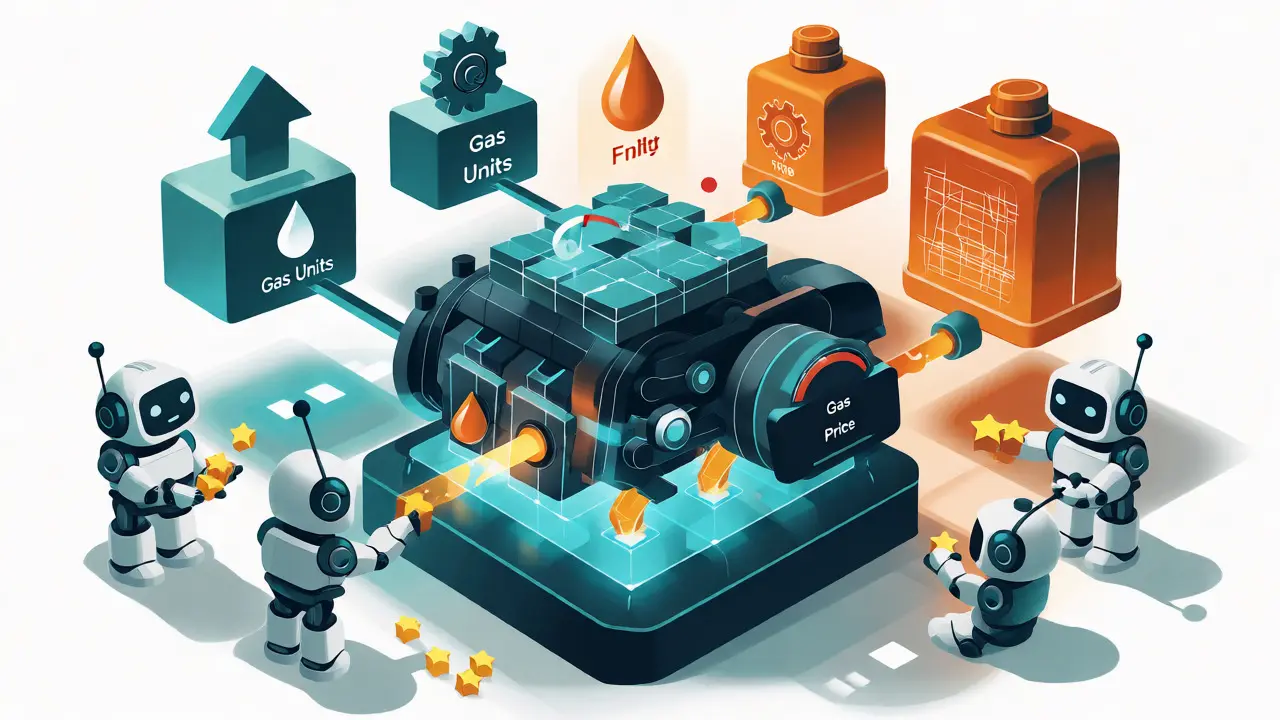
Calculating your total cost isn't magic; it's basic multiplication. The formula looks intimidating if you're new to crypto, but it breaks down into two parts:
- Gas Units (Limit): How much computational work your transaction needs.
- Gas Price: How much you are willing to pay per unit of work.
Your Total Fee = Gas Units × Gas Price.
Let's make this concrete. A standard ETH transfer always uses exactly 21,000 gas units. This number never changes because the operation is identical every time. However, swapping tokens on Uniswap might use 100,000 units, and minting an NFT could hit 50,000. The more steps involved, the higher the limit.
The second part, Gas Price, is measured in gwei. Don't let the name scare you. One gwei is one-billionth of an ETH (0.000000001 ETH). When you see a gas price of "10 gwei," it means you are paying 10 billionths of an ETH for each unit of work. Multiply that by your 21,000 units, and you get your total cost in ETH. Then, multiply by the current ETH dollar price, and you know what hits your wallet.
EIP-1559 Changed Everything
If you remember chaotic bidding wars for block space, blame the old system. Before August 2021, Ethereum used a first-price auction model. Users guessed what others were paying and bid slightly higher to jump the queue. This led to massive volatility and wasted money. Enter EIP-1559, a protocol upgrade that fundamentally reshaped how fees work.
Today, your fee consists of two distinct parts:
- Base Fee: This is the minimum amount required to process a transaction. It’s algorithmic, not guesswork. If blocks are full, the base fee rises. If blocks are empty, it drops. Crucially, this portion of the fee is burned-permanently removed from circulation. This creates deflationary pressure on ETH supply.
- Priority Fee (Tip): This goes directly to the validator who includes your transaction in their block. It’s optional but recommended. Think of it as tipping a waiter for faster service. During quiet times, a 1-2 gwei tip works fine. During NFT mints or market crashes, you might need to tip 50+ gwei to avoid being stuck in pending status for hours.
This split makes fees predictable. You no longer need to outguess thousands of other users. The network tells you the base fee, and you decide how much extra you want to pay for speed.
| Transaction Type | Average Gas Units | Complexity Factor |
|---|---|---|
| Simple ETH Transfer | 21,000 | Low |
| ERC-20 Token Transfer | ~65,000 | Medium |
| NFT Mint | ~50,000 - 100,000 | Variable |
| DEX Swap (Uniswap V3) | ~100,000 - 150,000 | High |
| Smart Contract Deployment | 500,000+ | Very High |
The Dencun Effect: Why Fees Are So Low Now
In early 2024, Ethereum implemented the Dencun upgrade, specifically introducing EIP-4844, also known as proto-danksharding. This was a game-changer for Layer 2 solutions like Arbitrum, Optimism, and Base. Before Dencun, L2s had to post all their data back to the main Ethereum chain (Layer 1), which was expensive. EIP-4844 introduced "blobs"-large chunks of data that are cheaper to store temporarily.
The result? Data availability costs dropped by roughly 90% for Layer 2 networks. While this primarily benefits L2 users, it has relieved congestion on the main Ethereum network too. With fewer high-volume apps clogging Layer 1, base fees on the mainnet have stabilized. As of late 2026, a standard transfer often costs between $0.50 and $1.50 depending on ETH's price, a far cry from the $50+ spikes we saw in previous cycles. For many users, moving funds via a Layer 2 rollup now costs pennies, making micro-transactions viable again.
How to Stop Overpaying
Most beginners set their gas limits too high "just in case." This wastes money. Wallets like MetaMask or Rainbow usually estimate gas automatically, but they can be conservative. Here is how to take control:
- Use Live Trackers: Don't rely solely on your wallet's default suggestion. Check sites like Etherscan's Gas Tracker or EtherNow. These tools show real-time data on average base fees and priority tips. If the network is quiet, you can lower your priority fee.
- Set Custom Limits Carefully: For simple transfers, stick to 21,000. For swaps, add a 10-15% buffer above the estimated gas limit. Why? Because if your limit is too low, the transaction fails, and you lose the gas fee anyway. If it's too high, you only pay for what you actually use, so a slight buffer is safe insurance against slippage or minor contract changes.
- Time Your Transactions: Congestion varies by time zone. Early mornings UTC often see lower activity than US business hours. If you aren't in a rush, wait for the green "low congestion" indicators on gas trackers.
A common pitfall is ignoring the priority fee during volatile markets. If ETH price swings rapidly, mempool competition heats up. If you leave the priority fee at default during a crash, your transaction might sit pending for hours. Increasing the tip by even 2-3 gwei can push you to the front of the line.

Common Myths and Misconceptions
There is a persistent myth that burning gas reduces validator rewards significantly. Validators only receive the priority fee, yes, but the base fee burn helps stabilize ETH's value, which indirectly supports the ecosystem they secure. Another misconception is that gas fees disappear on Layer 2s. They don't vanish; they are just aggregated and subsidized differently. You still pay a small fee on L2s, but it covers the cost of posting compressed data back to Layer 1.
Also, don't confuse gas fees with miner/validator profits alone. The system is designed to balance user experience with network security. If fees were zero, spam would return. If fees were fixed, they wouldn't reflect actual demand. The dynamic nature of gas pricing is a feature, not a bug.
Frequently Asked Questions
Why did my transaction fail even though I paid gas?
Transactions fail when the gas limit is set too low to complete the execution, or if the transaction conditions change before it gets mined (like a slippage error in a swap). You still lose the gas fee because validators did the work to attempt the transaction, even if it reverted.
Is there a way to predict future gas fees?
You can estimate near-term fees using historical data from explorers like Etherscan, but long-term prediction is difficult. Fees depend on unpredictable factors like network congestion, major project launches, and broader market sentiment. Tools use machine learning to offer short-term forecasts, but treat them as guidelines, not guarantees.
Do I pay gas fees on Layer 2 networks like Arbitrum?
Yes, but they are significantly lower than on Ethereum Mainnet. Layer 2 fees cover the cost of executing the transaction on the L2 and a portion of the cost to post batched data back to Layer 1. Post-Dencun, these fees are often under $0.10 for simple interactions.
What happens to the burned base fee?
The base fee is sent to address 0x000...0000, effectively removing it from the circulating supply of ETH. This reduction in supply can help support ETH's price during periods of high network usage, creating a deflationary effect.
Can I cancel a pending transaction?
Yes, by sending a new transaction with the same nonce (transaction counter) and a higher gas price. This replaces the original transaction. Alternatively, some wallets allow you to "speed up" or "cancel" directly, which automates this replacement process.

Write a comment