On a quiet Tuesday morning in January 2025, South Korea’s Financial Services Commission dropped a bombshell: Upbit, the country’s biggest cryptocurrency exchange, had failed to verify the identity of over 500,000 users. Not just a few mistakes. Not isolated glitches. A systemic collapse in Know Your Customer (KYC) controls that let people open accounts with blurred photos, fake IDs, and no documents at all. This wasn’t a minor slip-up. It was the largest crypto compliance failure ever recorded-and it changed everything.
What Exactly Went Wrong at Upbit?
Upbit handles nearly 80% of all cryptocurrency trading in South Korea. In 2024, it processed over $8 billion in trades every single day. That kind of volume demands ironclad security. But the Financial Intelligence Unit (FIU) found that Upbit’s verification system was barely functional.Investigators uncovered that in nearly 190,000 cases, users submitted South Korean driver’s licenses-but Upbit didn’t check the encrypted serial numbers. Those numbers are required by law. Without them, anyone could upload a photo of a license from the internet and get verified. In over 9 million cases, no ID was collected at all during account re-verification. Some users registered with photocopies of IDs, others with blurry selfies, and in dozens of cases, names didn’t even match the documents.
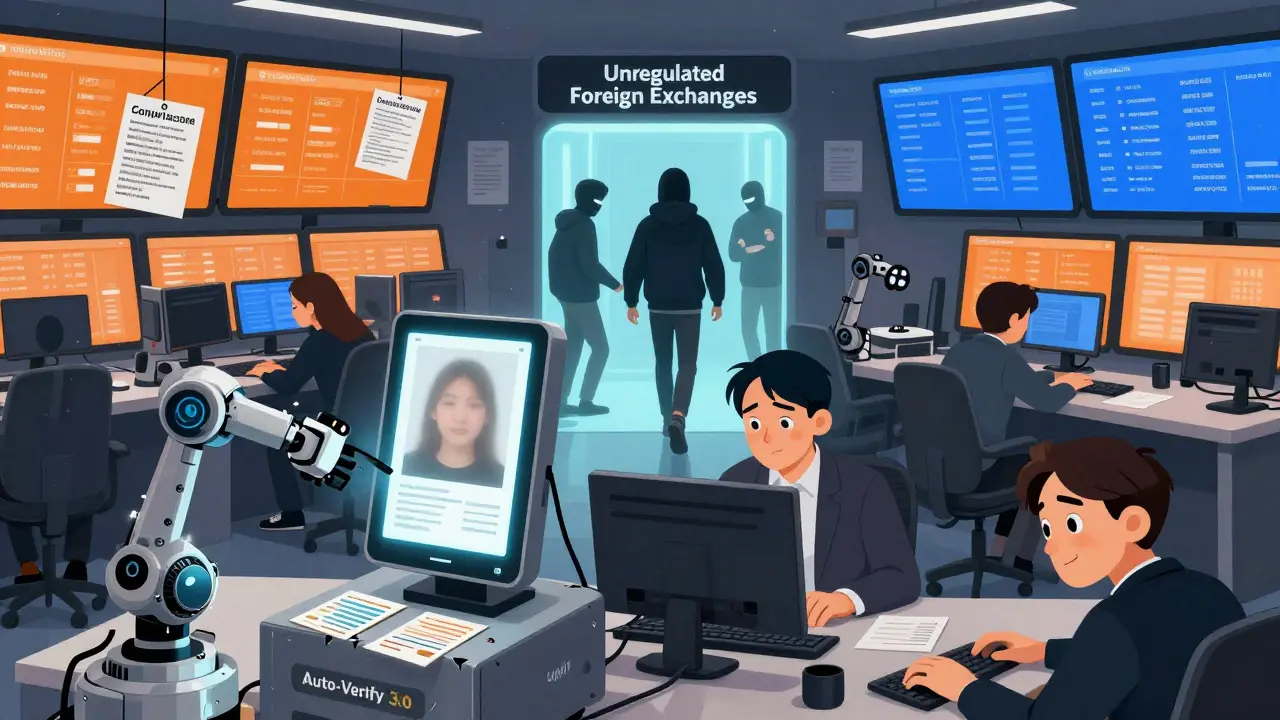
Worse, Upbit allowed roughly 45,000 transactions to flow between unregistered foreign exchanges. That’s a direct violation of South Korea’s Special Financial Transactions Act, which bans crypto platforms from acting as bridges to unregulated overseas services. These weren’t random errors. They were patterns. The same gaps appeared across departments, over years. Compliance wasn’t broken-it was ignored.
Why This Case Is Unprecedented
No crypto exchange in history has ever been caught with this many compliance violations. Binance paid $4.3 billion in 2023 to settle U.S. charges. But Binance’s case involved money laundering through third parties. Upbit’s problem was simpler-and more embarrassing. They didn’t even check if the person opening an account was real.The scale alone is staggering. Five hundred thousand violations means one in every four Upbit users might have been verified with fake or incomplete documents. That’s not just a risk-it’s an open door for criminals. Money launderers, fraudsters, and even sanctioned entities could have moved funds through Upbit without anyone noticing.
South Korea’s regulators didn’t just slap a fine. They proposed a six-month freeze on new user registrations. That’s rare. Most countries either shut down exchanges completely or let them pay and keep operating. This was a middle ground: Upbit could still serve existing customers, but it couldn’t grow. It forced the company to fix its system while under public scrutiny.
How Upbit’s System Failed So Badly
Upbit’s problem wasn’t just bad employees. It was a broken process. The company relied on automated tools that flagged documents as “verified” if they looked vaguely like IDs. No human checked the details. No system cross-referenced the serial numbers on driver’s licenses with the government database. No biometric checks. No liveness detection.Compare that to what banks do. When you open a bank account, the teller doesn’t just take a photo. They ask questions. They compare your face to the ID. They call the issuing authority to verify authenticity. Upbit skipped all of that. Why? Because it was cheaper. Faster. More profitable.
During its rapid growth from 2017 to 2023, Upbit prioritized user acquisition over compliance. Every new account meant more trading volume. More trading volume meant more fees. The company grew to be worth over $10 billion-but left its compliance team with half the staff it needed. By 2024, the system was creaking under its own weight.
What Happens Next?
Upbit’s parent company, Dunamu, didn’t accept the findings quietly. They filed a lawsuit challenging the suspension. That’s unusual. Most exchanges settle. But Dunamu believes the penalties are excessive-and they’re betting that the courts will side with them.As of January 20, 2025, the FSC hasn’t finalized the punishment. The deadline for Upbit’s official response passed. But regulators are still negotiating. The maximum fine? 100 million won per violation-that’s over $34 billion total. But no one expects that. The real number will be closer to $1 billion, likely split between fines, compliance upgrades, and mandatory audits.
What’s certain is that Upbit must now rebuild its entire KYC system from scratch. That means hiring hundreds of compliance staff, buying AI-based document verification tools, integrating with government ID databases, and running daily audits on every new account. It’ll cost tens of millions. And it’ll take months.
The Ripple Effect Across Asia
This isn’t just an Upbit problem. It’s a warning to every crypto exchange in Asia-and beyond.Japan, Singapore, and Hong Kong all have similar KYC rules. Now, regulators there are pulling up old files. Are their exchanges doing better? Or are they just as sloppy? In the weeks after the Upbit news broke, Singapore’s Monetary Authority ordered emergency audits on all licensed crypto platforms. Japan’s Financial Services Agency began reviewing historical onboarding logs from the last five years.
Even exchanges outside Asia are watching. If South Korea can go after its biggest player with this level of force, what’s stopping the U.S. SEC or the EU’s MiCA regulators from doing the same? Upbit’s case became the new benchmark. If your KYC system can’t survive a South Korean audit, it won’t survive anywhere.

How Traders Are Reacting
Korean crypto users didn’t panic. They switched.Within days of the news, Bithumb, Korbit, and Coinone saw a 40% spike in new sign-ups. International platforms like Kraken and Bybit also reported increased traffic from Korean users worried about fund safety. Reddit threads filled with questions: “Can I still withdraw my Bitcoin?” “Is my money locked up?” “Should I move to a foreign exchange?”
Many traders are now asking one question before choosing an exchange: “Has this platform passed a government KYC audit?” Not “What’s the trading fee?” Not “Which coins are listed?” But “Is this exchange actually compliant?” That’s a cultural shift. For years, Korean users cared about price and speed. Now, trust matters more.
What This Means for You
If you trade crypto, especially in countries with strong financial oversight, this case should scare you-because it should also inform you.Upbit’s failure wasn’t about technology. It was about priorities. They chose growth over safety. And when regulators came knocking, they had nothing to show.
Here’s what you should do now:
- If you use a major exchange, check if they’ve published a recent KYC audit report. Most won’t-but the ones that do are the ones you can trust.
- Don’t assume “big name” means “safe.” Upbit was the biggest. And it failed.
- Keep your funds in cold storage if you’re holding long-term. Exchanges can freeze, get fined, or shut down. Your private keys are your only real safety net.
- Watch for regulatory updates in your country. If your government starts demanding KYC audits, your exchange will have to change. That might mean longer sign-up times, stricter ID checks, or even temporary outages.
Upbit’s case didn’t kill crypto. It cleaned it up. And that’s a good thing-even if it hurt in the short term.
How many KYC violations did Upbit have?
South Korea’s Financial Intelligence Unit identified over 500,000 KYC compliance violations at Upbit. These included unverified accounts, fake or blurred ID documents, and cases where no identification was collected at all during re-verification processes. Nearly 190,000 violations involved unverified South Korean driver’s licenses, and over 9 million cases lacked any official ID documentation.
What penalties is Upbit facing?
Upbit could face fines of up to 100 million Korean won ($68,600) per violation, which theoretically adds up to over $34 billion. However, regulators typically negotiate settlements. The most likely outcome is a fine in the hundreds of millions of dollars, combined with a six-month suspension of new user registrations and mandatory compliance upgrades. Dunamu, Upbit’s parent company, has filed a lawsuit to challenge the sanctions, so the final penalty is still pending.
Why did Upbit fail its KYC checks?
Upbit prioritized rapid user growth over compliance. Its automated system accepted low-quality ID uploads without verifying authenticity. It didn’t check encrypted serial numbers on South Korean driver’s licenses, skipped identity verification in millions of cases, and allowed transactions with unregistered foreign exchanges. There was no human oversight, no integration with government databases, and no regular internal audits. The system was designed to be fast and cheap-not secure.
Is Upbit still operating?
Yes, Upbit is still operating as of January 2026. The Financial Services Commission proposed a six-month ban on new user registrations, but existing users can still trade and withdraw funds. The final decision on sanctions is still under review after Dunamu filed a legal challenge. Upbit continues to work on rebuilding its KYC system under regulator supervision.
Should I move my crypto from Upbit?
If you’re concerned about regulatory risk, moving your assets to a self-custody wallet is the safest option. Exchanges, even large ones, can be frozen, fined, or forced to restrict services. Upbit’s situation shows that no platform is immune to regulatory action. If you’re trading actively, consider diversifying across multiple regulated exchanges. But never leave large amounts on any exchange long-term-your private keys are your only real security.
Are other Korean exchanges also at risk?
Yes. After the Upbit case, South Korea’s regulators launched reviews of all licensed crypto exchanges. Bithumb, Coinone, and Korbit are now under increased scrutiny. The FSC is auditing historical KYC records going back five years. Any exchange with weak verification systems is likely to face penalties. The message is clear: compliance is no longer optional-it’s mandatory.
What’s changed in crypto regulation since the Upbit case?
South Korea now treats crypto exchanges like banks. KYC isn’t a suggestion-it’s a legal requirement backed by criminal penalties. Exchanges must now use government-verified ID systems, conduct live biometric checks, and store audit trails for at least five years. Other countries, including Japan and Singapore, have followed suit. The global standard has shifted: if you can’t prove your users are real, you don’t get to operate.



steven sun
bro upbit just let anyone sign up with a screenshot of a drivers license?? lmao no wonder crypto is a dumpster fire. i could’ve opened an account with a photo of my cat and they’d say ‘verified’
Arielle Hernandez
The systemic failure of Upbit’s KYC infrastructure represents a catastrophic erosion of regulatory trust in one of Asia’s most critical financial gateways. The absence of encrypted serial number validation, biometric verification, and real-time government database integration constitutes a breach of fiduciary duty under South Korea’s Special Financial Transactions Act. This is not merely a technical lapse-it is a governance collapse that demands institutional recalibration, not merely financial penalties.
Mathew Finch
Oh wow, South Korea finally did something right. For once, a government didn’t just hand out fines and call it a day. They actually made a company fix its crap. Meanwhile in the US, Binance pays $4 billion and gets a pat on the back. Pathetic.
Roshmi Chatterjee
This is actually super scary. I use Upbit for small trades and never thought about how they verify people. If they missed half a million fake accounts, what’s stopping someone from laundering millions? I’m checking my exchange’s audit reports now.
Deepu Verma
Hey, don’t panic. This is actually a good wake-up call. The fact that regulators are forcing Upbit to rebuild from scratch means the whole industry is getting cleaner. It’s painful now, but long-term? This is how crypto grows up. We need this. Stay calm, stay smart.
MICHELLE REICHARD
Of course Upbit failed. They’re a Korean company. You think they care about compliance? They care about profit. And now they’re crying because someone finally checked their work. Meanwhile, real exchanges like Kraken have had biometric checks since 2019. It’s not hard. You just have to want to do it.
Bonnie Sands
Wait… this was all planned. The FSC knew about this for years. They let Upbit grow so they could crush it later and take control of the whole crypto market. This isn’t regulation-it’s a power grab. They’ll force everyone to use state-approved wallets next. You think your Bitcoin is safe? Think again.
Jennifer Duke
It’s fascinating how people still think ‘big exchange’ equals ‘safe.’ Upbit was the biggest in Korea. And look what happened. The lesson? Size doesn’t protect you-rigorous compliance does. If your exchange doesn’t publish its KYC audit logs, you’re playing Russian roulette with your assets.
Andy Marsland
Let’s be clear here: this isn’t just about Upbit. This is about the entire crypto industry’s refusal to mature. For years, we’ve been told that decentralization means no rules. But you can’t have a financial system that operates like a wild west carnival and then cry when the sheriff shows up. Upbit’s failure was inevitable. They treated compliance like a checkbox, not a cornerstone. And now, they’re paying the price-not just in fines, but in credibility. Every exchange that skipped proper identity verification is just one audit away from collapse. The regulators aren’t the enemy. The people who ignored them are.
Jeffrey Dufoe
Yeah, this is wild. I just moved my stuff to Kraken after reading this. Better safe than sorry. No point risking it over a few bucks in fees.
Jonny Lindva
Love that people are finally waking up. KYC isn’t sexy, but it’s what keeps your money from vanishing into some hacker’s wallet. Upbit messed up, but now they’re fixing it. That’s actually kind of cool. Progress, not perfection.
Jen Allanson
It is both regrettable and inevitable that a financial institution of such magnitude would prioritize velocity over veracity. The absence of human oversight in identity verification protocols constitutes a dereliction of fiduciary responsibility. The proposed sanctions, while severe, remain proportionate to the magnitude of systemic negligence. Regulatory accountability must be non-negotiable.
Dave Ellender
Interesting case. I’ve seen similar gaps in other Asian fintechs-usually because they’re scaling too fast. The real question is whether other exchanges are doing the same. I hope regulators are looking at Bithumb and Coinone too.
Adam Fularz
so upbit didn’t even check if the id was real? lmao. guess that’s why crypto is full of scams. they should’ve just shut it down. no second chances for lazy companies.
Adam Lewkovitz
Korea’s got balls. US regulators are asleep at the wheel. Binance gets a slap on the wrist and Upbit gets a six-month lockdown? That’s justice. If you’re gonna run a financial platform, you don’t get to cut corners just because it’s ‘crypto.’ This is banking, not a meme contest.
Barbara Rousseau-Osborn
They’re hiding something. Why would a company this big mess up THIS badly? Someone’s getting paid to ignore this. I bet the CEO’s brother runs a shell company that moved $200M through fake accounts. This isn’t incompetence-it’s corruption. And the FSC is letting them off easy.
Arnaud Landry
They’re not fixing it. They’re just pretending. I’ve seen this before-companies hire consultants, slap on a fancy dashboard, and call it ‘compliance.’ Meanwhile, the same backdoor loopholes still exist. They’ll get fined, do the bare minimum, and go right back to the same game. This is theater, not reform.
george haris
Man, I just started trading last year and had no idea how shaky this stuff was. Thanks for laying it out like this. I’m moving half my stuff to a cold wallet tonight. No more trusting exchanges with everything.
Mark Estareja
Upbit’s KYC failure is a textbook case of technical debt compounded by cultural negligence. The lack of liveness detection, serial number validation, and cross-referencing with national ID repositories indicates a fundamental misalignment between engineering priorities and regulatory risk frameworks. The 9M+ unverified re-verification events suggest a systemic breakdown in audit trails-likely exacerbated by incentive structures rewarding user acquisition over compliance velocity. This is not an isolated incident; it is the inevitable outcome of crypto’s ‘move fast and break things’ ethos applied to financial infrastructure.