You’ve probably heard of Dogecoin or Shiba Inu. Maybe you even dabbled in some Solana memes during the last bull run. But have you ever come across Forky? If you stumbled upon the ticker symbol FORKY on a trading screen or a social media post, you might be asking yourself: Is this the next big thing, or just another digital ghost town?
The short answer is that Forky is a cryptocurrency with a confusing identity crisis. It’s described as everything from a community-owned meme coin to a high-tech DeFi tool. The reality, however, is much simpler-and significantly less exciting. Forky is a micro-cap token with negligible value, contradictory technical specs, and almost no active users.
Who Actually Created Forky?
Trying to find the origin story of Forky is like trying to trace a rumor through a crowded room. According to data from major exchanges like MEXC and LBank, Forky started as a community-owned token on the Binance Smart Chain (BSC). It was originally launched on a platform called Four.meme. The narrative here is that the original creators abandoned the project, leaving it entirely up to the community.
But wait-there’s a twist. Documentation from CoinSwitch describes Forky as a Web3 coin built on the Solana blockchain. They highlight its use of Solana’s fast transactions and low fees. Then you have Coins.ph, which claims Forky is a specialized DeFi token designed for yield farming and staking. CoinGecko takes a different route, calling it a fun meme coin inspired by the character Forky from Toy Story 4.
Which one is true? Likely none of them, or at least not all at the same time. This confusion isn’t a marketing strategy; it’s a red flag. When a project can’t agree on its own blockchain or purpose, you need to proceed with extreme caution.
Is Forky on Bitcoin or Ethereum?
No. Most reliable sources place Forky on either Binance Smart Chain (BSC) or Solana. There is no evidence of a native Bitcoin or Ethereum implementation.
The Numbers Don’t Lie: Market Cap and Liquidity
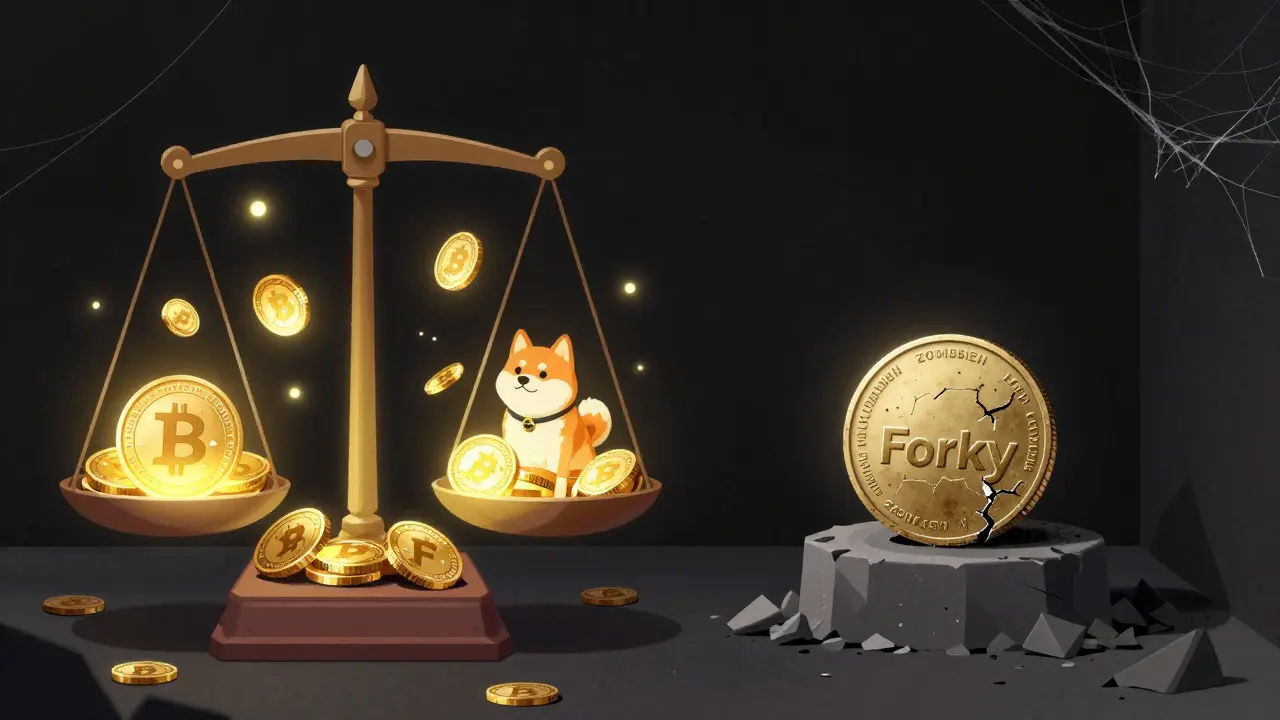
Let’s look at the hard data. As of late 2023, when most recent metrics were recorded, Forky’s market capitalization was roughly $4,677. To put that in perspective, that’s less than the cost of a decent gaming laptop. Its 24-hour trading volume was around $9. Yes, nine dollars.
This places Forky in the bottom 0.5% of all tracked cryptocurrencies. In crypto terms, this is often called a "zombie token." These are coins that still exist on paper but have no real economic activity. Delphi Digital defines zombie tokens as those with a market cap under $10,000 and daily volume under $100. Forky fits this description perfectly.
Why does liquidity matter? Because if you buy a token with zero liquidity, you can’t sell it. Imagine buying a house where there are no other buyers. You’re stuck. With Forky, the risk isn’t just losing money; it’s losing the ability to exit your position entirely.
| Token | Market Cap | 24h Volume | Status |
|---|---|---|---|
| Dogecoin (DOGE) | $12+ Billion | $500M+ | Active |
| Shiba Inu (SHIB) | $4+ Billion | $200M+ | Active |
| Forky (FORKY) | $4,677 | $9 | Inactive/Zombie |
BSC or Solana? The Technical Identity Crisis
If you want to buy Forky, you first need to know which wallet to use. Here is where things get messy. MEXC and LBank list Forky as a BEP-20 token on Binance Smart Chain. This means you would need a wallet like MetaMask or Trust Wallet configured for BSC. You’d also need BNB to pay for gas fees, which can range from $0.50 to several dollars depending on network congestion.
On the other hand, CoinSwitch lists a Solana contract address for Forky. If you follow their guide, you’d use Phantom or Sollet wallet. However, independent checks on the Solana Explorer show zero transactions for this specific token address in the past 90 days. That’s a dead end.
CoinPaprika notes that while the project claims to have "fork-related functionality," there is no verifiable code on GitHub. No whitepaper. No smart contract audit. Just empty promises. Dr. Elena Rodriguez from Blockchain Insights Group called tokens like this "the speculative extreme... where narrative outweighs substance." She’s right. Without code, there is no product.
User Experiences: Slippage and Gas Fees
What happens when you actually try to trade Forky? Real user reports paint a grim picture. On Reddit, a user named u/CryptoNewbie2023 shared their experience: they tried to buy $5 worth of Forky on PancakeSwap. The transaction failed three times due to slippage issues. Slippage occurs when the price changes between the time you click "buy" and when the transaction executes. In illiquid markets, slippage can be massive.
When the user finally succeeded, they couldn’t sell. Why? No liquidity. They lost their $5 plus $15 in gas fees. That’s a 300% loss on a $5 investment. Trustpilot reviews echo this sentiment, with users rating the project 1 out of 5 stars, citing it as a "scam project with no real team."
LiveCoinWatch’s sentiment analysis shows 92% negative community feedback. The most common complaint? "Abandoned project with no working use cases." This isn’t just bad luck; it’s a structural flaw in the token’s design.
Is Forky a Scam?
Legally speaking, it’s hard to prove a scam without intent. But practically? It behaves like one. Coins.ph claimed Forky offered yield farming APYs up to 1,200%. DeFiLlama, a trusted data aggregator, found zero liquidity pools associated with Forky. You can’t farm yields if there’s no pool to farm in. That claim was pure fiction.
Mark Benson, a technical reviewer for CoinTelegraph, dismissed Forky as a "textbook example of a memetic token with no technical foundation." He noted the complete absence of GitHub activity since inception. In the crypto world, code is king. No code means no trust.
Arcane Research gave Forky a 97% probability of becoming completely illiquid within six months. Given that the last contract interaction was in September 2023, that prediction has likely already come true.
How to Avoid Tokens Like Forky
So, how do you spot a zombie token before you lose money? Here are three simple rules:
- Check the Liquidity: If the 24-hour volume is under $1,000, walk away. You won’t be able to sell.
- Verify the Contract: Look for the official website and GitHub repo. If they don’t exist, or if the code hasn’t been updated in months, it’s a red flag.
- Ignore Hype, Check Data: Don’t believe Telegram groups or Twitter influencers. Use tools like CoinGecko, CoinMarketCap, and DeFiLlama to verify claims.
Forky serves as a cautionary tale. It reminds us that just because a token exists on an exchange doesn’t mean it has value. In fact, many exchanges list thousands of tokens that are effectively worthless. Always do your own research (DYOR), and remember: if it sounds too good to be true, it probably is.
Where can I buy Forky (FORKY)?
Forky has been listed on exchanges like MEXC and LBank, but due to extremely low liquidity, buying it may result in high slippage or failed transactions. Proceed with extreme caution.
Does Forky have a whitepaper?
No. Independent researchers have confirmed that there is no official whitepaper or technical documentation available for the Forky project.
Is Forky safe to invest in?
Most experts consider Forky high-risk due to its lack of utility, zero development activity, and negligible liquidity. It is generally recommended to avoid such "zombie tokens."
Why is Forky’s price so low?
The price is low because there is almost no demand. With a market cap of under $5,000, very few people are buying or selling, leading to extreme volatility and potential inability to sell.
What is the difference between Forky and other meme coins?
Unlike established meme coins like Dogecoin or Shiba Inu, Forky has no strong community, no clear roadmap, and virtually no trading volume. It lacks the cultural momentum that sustains larger meme coins.


Write a comment