You’ve probably seen a new coin pop up on your feed or a chat group promising to change how you handle your digital life. The name Vibing (VBG) is a cryptocurrency token built for a Web3.0 personal homepage platform sounds catchy. It claims to let you own and make money from your personal data. That’s a big promise in an era where privacy is a hot topic. But before you rush to buy, you need to know what this thing actually is. More importantly, you need to see if it works.
The short answer? Vibing is a concept with serious execution problems. While the idea of monetizing your digital footprint is cool, the reality of the VBG token is messy. We’re talking about conflicting price data, zero liquidity on major exchanges, and a lot of unanswered questions. This guide breaks down exactly what Vibing is, why the numbers don’t add up, and whether it’s worth your attention in 2026.
The Core Idea: What Is Vibing Supposed To Do?
To understand the token, you have to look at the platform behind it. Vibing aims to be a Web3.0 personal homepage. Think of it as a digital profile that lives on the blockchain instead of a social media server owned by a corporation. The pitch is simple: you generate data, you control it, and you can sell access to it if you want.
This falls under the umbrella of Decentralized Identity (DID) systems. In traditional tech, companies like Facebook or Google harvest your data for free. In the Vibing model, you hold the keys. The VBG token is supposed to be the fuel for this ecosystem. You’d use it to pay for storage, verify your identity, or transact when someone buys your data insights.
On paper, this aligns with the broader shift toward user-owned data. Projects like Ocean Protocol and Datawallet are trying to do similar things. However, Vibing positions itself specifically around the "personal homepage" angle. It wants to be your central hub for digital existence. The problem isn’t the idea; it’s the infrastructure supporting it.
Technical Specs: Where Does VBG Live?
If you’re looking to interact with Vibing, you need to know the technical ground rules. VBG operates as a BEP-20 token on the BNB Smart Chain. This means it’s not its own standalone blockchain like Bitcoin or Ethereum. It rides on top of Binance’s network.
Here are the hard facts you need to check before doing anything:
- Contract Address: 0x756176aff6b885eD0C21B1718c739bF8A371eF82 (Verified by LiveCoinWatch)
- Total Supply: 1,000,000,000 VBG (Fixed)
- Network: BNB Smart Chain (BSC)
- Token Type: BEP-20 (Standard utility token format)
Using BNB Smart Chain has pros and cons. The good news is transaction fees are usually low, and transfers are fast. The bad news is that BSC is crowded with thousands of tokens, many of which are scams or abandoned projects. Being on BSC doesn’t validate a project; it just makes it easier to launch one. You’ll need a compatible wallet like MetaMask or Trust Wallet configured for BSC to even hold these tokens.
The Data Mess: Why Prices Don’t Match
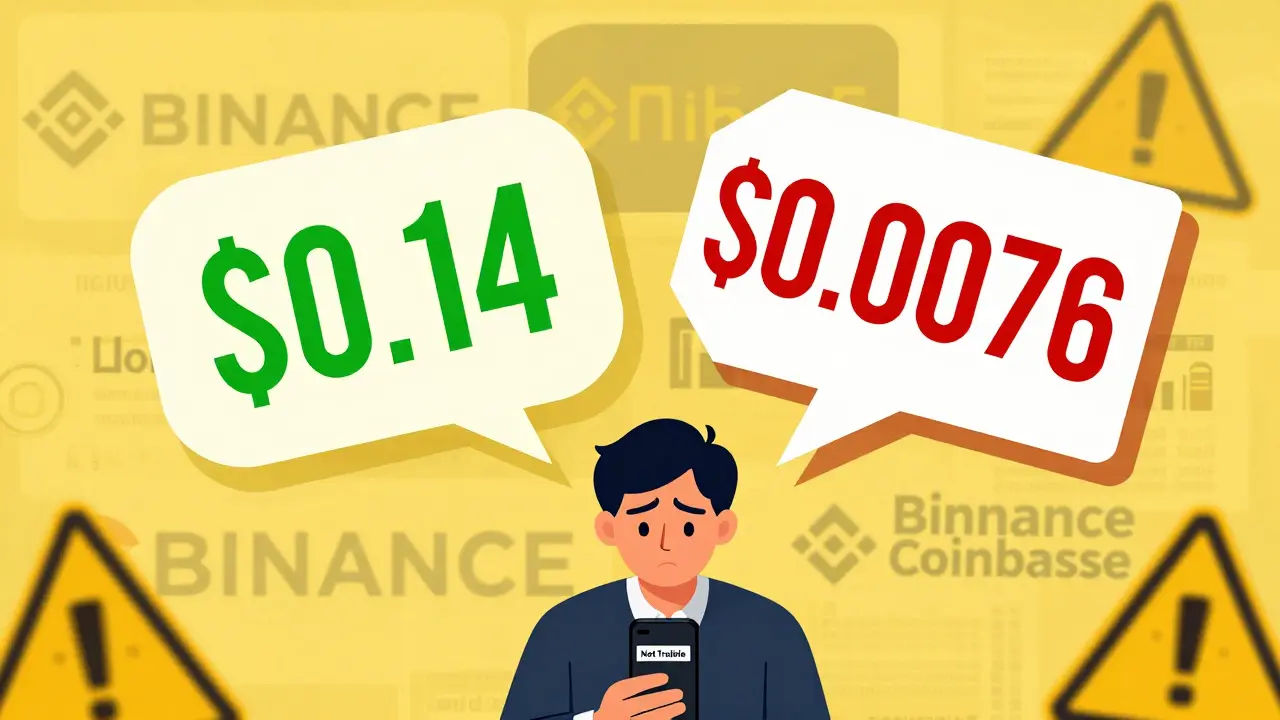
Here is where things get weird. If you check different crypto tracking sites for Vibing in early 2026, you’ll see completely different stories. This isn’t just normal market variance; it’s a sign of deeper issues.
| Metric | CoinMarketCap | CoinGecko | Coinbase/Binance |
|---|---|---|---|
| Price | $0.14 | $0.0076 | N/A / $0 |
| Circulating Supply | 143.08 Million | Varies | 0 |
| Market Cap | ~$20 Million | ~$491 Million (FDV) | $0 |
| Liquidity Status | Listed | Listed | Not Tradable |
Look at that table. CoinMarketCap says the price is around $0.14. Coinbase and Binance say there is no circulating supply and the market cap is zero. How can both be true? They can’t. This discrepancy suggests that the trading volume reported on some platforms might be artificial, or that the token is only being traded on obscure, unverified decentralized exchanges (DEXs) that aren’t feeding reliable data to major aggregators.
When a major exchange like Binance states “VBG is not tradable yet,” that is a massive red flag. It means you cannot easily buy or sell the token through safe, regulated channels. If you manage to find a pair on a small DEX, you face high slippage and the risk of getting stuck with tokens you can’t unload.
Risks and Red Flags: Should You Avoid VBG?
I’m not here to tell you what to do with your money, but I am here to highlight the risks so you don’t lose yours. Vibing currently exhibits several characteristics common to high-risk or failing crypto projects.
- Zero Liquidity on Major Exchanges: You can’t buy it on Coinbase or Binance. This limits who can participate and makes exiting your position difficult.
- Inconsistent Supply Data: A circulating supply of “0” vs “143 million” indicates poor auditing or potential manipulation of metrics to appear more valuable than they are.
- Lack of Development Activity: GitHub analysis shows no significant updates since late 2025. For a tech-heavy Web3 project, silence is dangerous.
- Community Sentiment: Reddit users report frustration over vanishing supply figures. Trustpilot has no verified reviews. The few positive comments come from official Telegram channels, which are often curated.
Compare this to established players in the data economy. SelfKey has tens of thousands of holders. Ocean Protocol has real enterprise partnerships. Vibing has neither. As of early 2026, there are no documented corporate partnerships for Vibing. Without real-world usage, the token has no intrinsic value anchor.
How to Check Vibing Yourself (Due Diligence Guide)
If you’re still curious, don’t just take my word for it. Here is how you can investigate any low-cap token like VBG yourself.
1. Verify the Contract Address
Never copy-paste an address from a random tweet. Go to BscScan (the block explorer for BNB Chain). Paste the contract address: 0x756176aff6b885eD0C21B1718c739bF8A371eF82. Check if the contract is verified. If it’s not verified, you can’t read the code to see if there are hidden functions that allow the developers to steal funds or halt trading.
2. Check Holder Distribution
On BscScan, look at the “Holders” tab. If the top 10 wallets hold more than 50% of the supply, the project is centralized. One person could dump all their tokens and crash the price to zero. For Vibing, reports suggest only ~191 unique holders, which is extremely low for a public token.
3. Test Liquidity on Uniswap/PancakeSwap
Connect your wallet to PancakeSwap. Search for VBG. Look at the liquidity pool size. If the pool is tiny (e.g., less than $10,000), you won’t be able to sell without crashing the price. Also, check if liquidity is “locked.” If it’s not locked, the creators can pull the rug (withdraw all the money) at any time.
4. Read the Whitepaper vs. Reality
Does the website show a working product? Vibing’s site describes a platform, but users report incomplete documentation. If you can’t actually use the service to monetize data, the token is just a speculative bet on a future that hasn’t arrived.
Future Outlook: Is There Any Hope?
Some analysts, like those at BeInCrypto, have offered optimistic predictions, suggesting VBG could hit $0.50 by 2027 if adoption takes off. These scenarios depend entirely on the Web3 personal homepage gaining traction. Right now, there is no evidence of that traction.
The broader trend of data ownership is real. People are tired of Big Tech spying on them. But Vibing needs to prove it can deliver a usable product. Until we see consistent development updates, clear liquidity on reputable exchanges, and transparent supply data, Vibing remains a high-risk speculation rather than a solid investment.
For most people, the safest play is to watch from the sidelines. Wait for the next update. Wait for a listing on a Tier-1 exchange. If Vibing disappears into obscurity, you haven’t lost anything. If you buy in now based on hype, you might lose everything.
Is Vibing (VBG) a scam?
There is no definitive proof that Vibing is a malicious scam designed to steal funds directly, but it exhibits many red flags associated with failed or manipulative projects. These include zero liquidity on major exchanges, conflicting market data, and a lack of verifiable development activity. Proceed with extreme caution.
Where can I buy Vibing (VBG) tokens?
As of early 2026, VBG is not available on major centralized exchanges like Coinbase or Binance. Trading reportedly occurs on small, unverified decentralized exchanges (DEXs) on the BNB Smart Chain. This carries high risk due to potential fraud and lack of liquidity.
What is the total supply of VBG?
The total fixed supply of Vibing is 1,000,000,000 (1 billion) tokens. However, the circulating supply is highly disputed, with some sources reporting 143 million and others reporting zero.
How does Vibing differ from other data tokens?
Vibing focuses on a "Web3.0 personal homepage" concept, aiming to give users a single blockchain-based profile for data management. Competitors like Ocean Protocol focus more on data marketplace infrastructure. Vibing currently lacks the enterprise adoption and liquidity of these competitors.
Is the Vibing platform actually working?
User feedback suggests the platform is incomplete. Documentation is scarce, and there are no widespread reports of users successfully monetizing data through the system. Most positive testimonials come from official community channels rather than independent verification.
Write a comment