You send a Bitcoin payment, hit 'send', and then... nothing happens. Or worse, it takes three hours. You check your wallet, and the status says 'pending'. Meanwhile, someone else sent a similar amount ten minutes ago, and it’s already confirmed. What gives? The answer isn't magic; it's economics. Specifically, it's a free-market auction for space on the blockchain.
Unlike credit cards or bank transfers where fees are often hidden or flat-rate, Bitcoin transaction fees are dynamic, user-set, and based entirely on data size, not money value. Understanding this mechanism is the difference between paying pennies and overpaying by dollars every time you move funds.
The Core Concept: Paying for Space, Not Value
The biggest misconception about Bitcoin fees is that they relate to how much Bitcoin you are sending. They don't. If you send 10 BTC to a friend, and I send 0.001 BTC to my cousin, and both our transactions use the exact same amount of digital 'ink' (data), we pay the exact same fee.
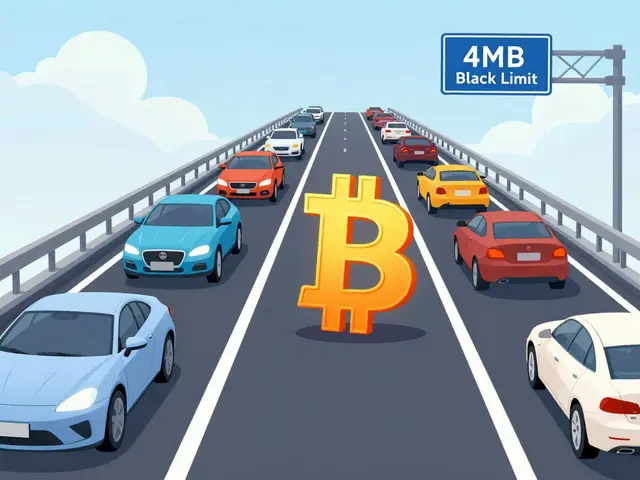
Think of the Bitcoin blockchain like a highway with a limited number of lanes. Each block mined is a bus that can carry only so many passengers (transactions). The bus has a maximum capacity of 4 megabytes of data. When the highway is empty, anyone can hop on for cheap. When traffic jams occur, people start offering bribes (higher fees) to the bus driver (the miner) to let them in first.
This system relies on the concept of satoshis per virtual byte (sats/vByte). A satoshi is the smallest unit of Bitcoin-one hundred-millionth of a single coin. Your wallet calculates the fee by multiplying the current market rate (sats/vByte) by the size of your transaction in bytes.
| Component | Value |
|---|---|
| Current Network Rate | 5 sats/vByte |
| Your Transaction Size | 200 vBytes |
| Total Fee | 1,000 satoshis (0.00001 BTC) |
In this example, whether you are moving $1 or $1,000,000 worth of Bitcoin, the cost to process that specific data packet is 1,000 satoshis. This creates a unique economic environment where small payments are just as efficient as large ones, provided the data structure remains simple.
Why Does My Transaction Take Up Space? The UTXO Model
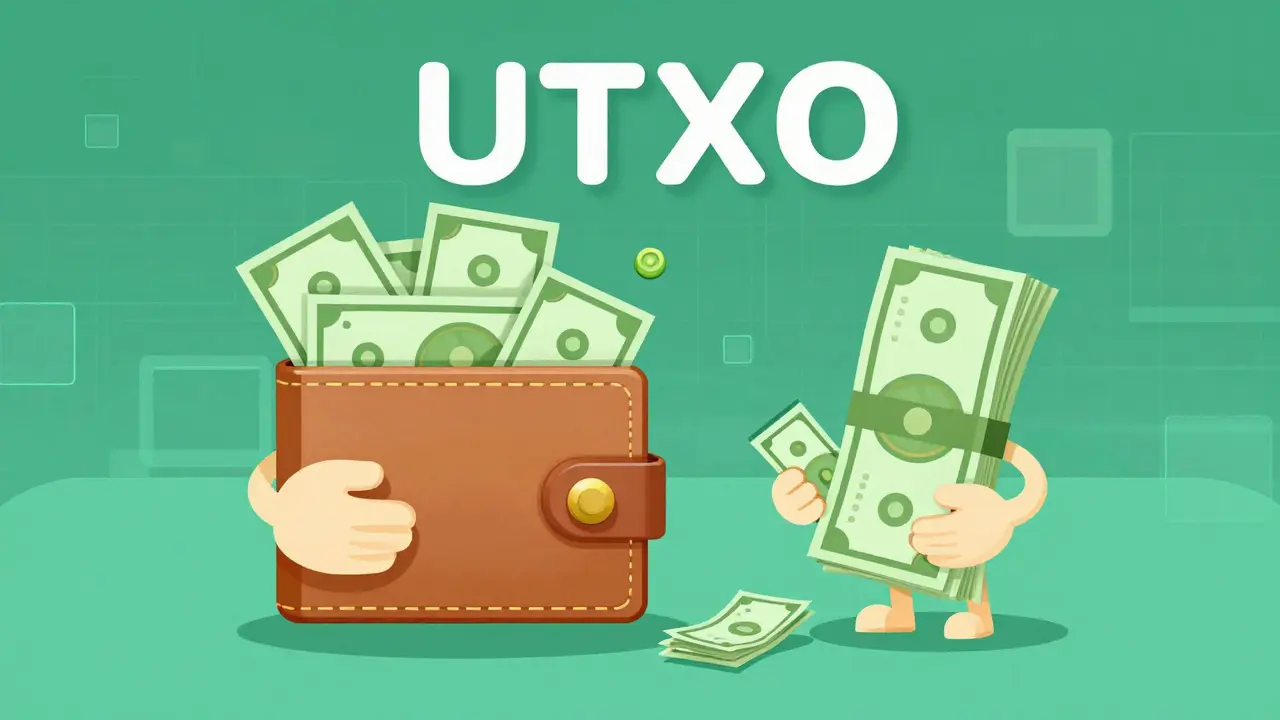
If fees depend on data size, what determines the size? It comes down to how Bitcoin tracks ownership. Unlike a bank account that has a balance, Bitcoin uses the UTXO model (Unspent Transaction Output).
Imagine Bitcoin like physical cash. You don't have a 'balance'; you have a wallet full of bills. Some are $20s, some are $1s. To spend $30, you hand over one $20 bill and one $10 bill. In Bitcoin terms, those bills are UTXOs. Every time you receive Bitcoin, you get new UTXOs. Every time you spend, you consume existing UTXOs and create new ones.
Here is the catch: each UTXO you use as an input adds data to your transaction. If you have accumulated hundreds of tiny dust-sized UTXOs from various sources, spending them all at once requires listing every single one in the transaction data. This makes the transaction larger. Larger transactions cost more in fees because they take up more room in the 4MB block limit.
This is why experienced users practice UTXO consolidation. By grouping many small inputs into fewer, larger outputs, they reduce the future data footprint of their spending, lowering long-term fees. Conversely, receiving many small payments without consolidating them bloats your wallet's 'baggage,' leading to higher costs later.
The Mempool: Where Transactions Wait Their Turn
When you broadcast a transaction, it doesn't go straight into a block. It goes into the mempool (memory pool). This is a waiting room held in the memory of Bitcoin nodes across the world. It contains every unconfirmed transaction currently competing for inclusion in the next block.
The mempool is transparent. You can view it on any block explorer website. During quiet times, the mempool might hold just a few dozen transactions. During peak congestion-often caused by market volatility or major network events-it can swell to gigabytes of pending data.
Miners act as rational economic agents. They want to maximize their revenue per block. Since block space is scarce, they sort the mempool by fee density. They pick the transactions that offer the highest sats/vByte first. If you set your fee too low, your transaction sits at the bottom of the pile. As blocks fill up with high-fee transactions, your low-fee transaction gets pushed further back. Eventually, if it waits too long, it may expire from the mempool entirely, requiring you to rebroadcast it with a higher fee.
Network Congestion and Dynamic Pricing
Bitcoin fees are not static; they fluctuate in real-time based on supply and demand. This is pure market mechanics.
- Low Demand: Few people are transacting. Blocks have plenty of empty space. Miners will accept very low fees to keep the network active. Users can set conservative rates and still get confirmed within minutes.
- High Demand: Many users are sending funds simultaneously. The mempool fills up. Users who need fast confirmation compete by raising their fee rates. Miners select the highest bidders.
This dynamic pricing serves a critical security function. It prevents spam attacks. If fees were zero or fixed, a malicious actor could flood the network with millions of fake transactions to clog the system. Because each byte costs money, attacking the network becomes economically prohibitive. The fee market self-regulates: as congestion rises, prices rise, which discourages non-urgent transactions until space opens up again.
On-Chain vs. Off-Chain: The Lightning Network Alternative
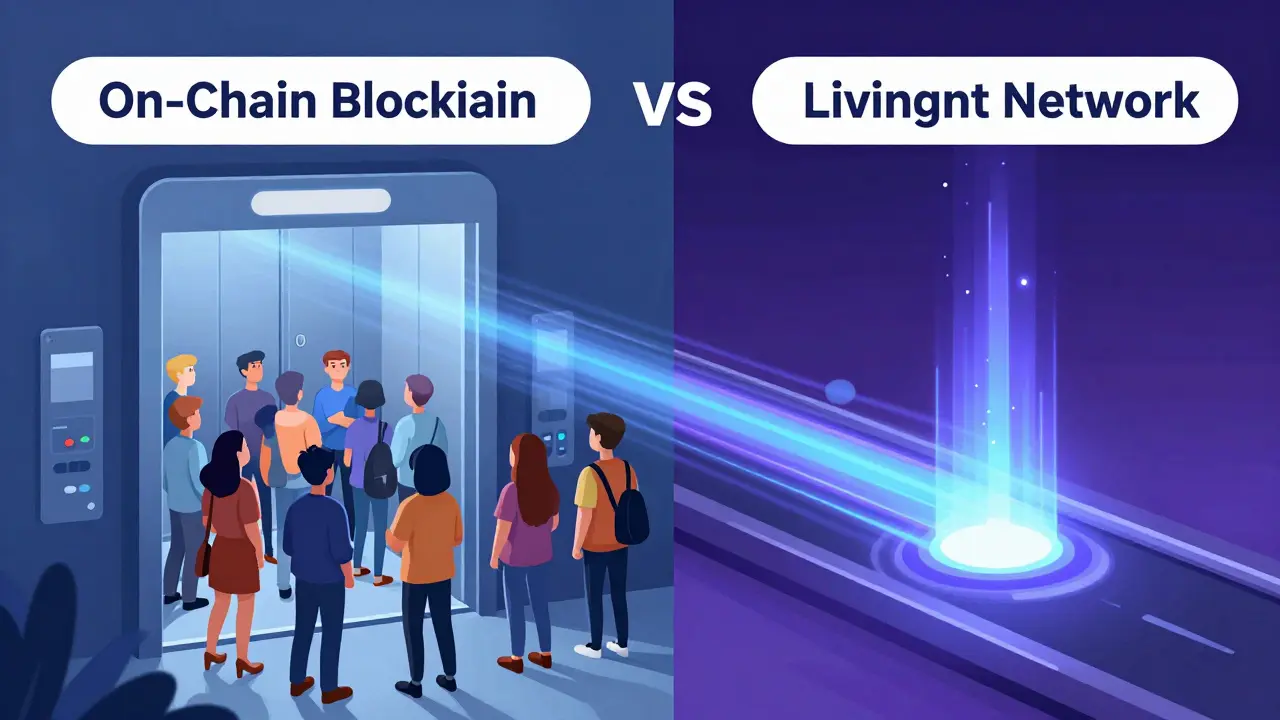
For everyday purchases like buying coffee, paying on-chain Bitcoin fees can be inefficient, especially during congestion. This is where the Lightning Network comes in. It is a second-layer protocol built on top of Bitcoin designed for speed and low cost.
Lightning moves transactions off the main blockchain. Instead of broadcasting every payment to the entire network, two parties open a channel, exchange multiple instant payments privately, and only settle the final net amount on the main Bitcoin blockchain when they close the channel.
Lightning fees work differently. They typically consist of:
- A base fee: A tiny flat rate per transaction (often fractions of a satoshi).
- A liquidity fee: A small percentage of the amount transferred, paid to the node operators routing the payment.
These fees are set by individual node operators, creating a diverse marketplace. While on-chain fees depend on global block space scarcity, Lightning fees depend on the specific path chosen through the network. For micropayments, Lightning fees are often negligible compared to even the lowest on-chain rates.
Exchange Fees vs. Network Fees: Don't Confuse Them
If you buy Bitcoin on a centralized exchange like Coinbase or Binance, you see a 'fee' charged. Be careful: this is usually a service fee, not a Bitcoin network fee.
Exchanges charge for their platform services, customer support, and regulatory compliance. These are often tiered percentages of your trade volume. However, when you withdraw Bitcoin from an exchange to your personal wallet, the exchange will add a separate network fee. Exchanges often batch thousands of withdrawals into one giant multi-output transaction to save on costs, but they pass a portion of that cost to you. Always distinguish between the platform's markup and the actual blockchain fee required to secure your transfer.
Optimizing Your Bitcoin Fees
You don't have to guess your way through fees. Here are practical strategies to manage costs:
- Check the Mempool: Before sending, look at a mempool visualizer. If it's green/red crowded, expect higher fees. If it's light, you can lower your rate.
- Use Wallet Estimates: Most modern wallets provide 'Slow', 'Medium', and 'Fast' options. 'Slow' might take 6+ confirmations but saves money. 'Fast' aims for the next block.
- Consolidate Dust: Periodically merge small UTXOs into larger ones to keep your transaction footprint small.
- Time Your Transactions: Bitcoin usage follows global patterns. Fees often dip during weekends or late-night hours in major financial hubs.
- Consider RBF: Replace-By-Fee (RBF) allows you to bump up the fee of a stuck transaction after you've sent it, without starting over. Ensure your wallet supports this feature.
FAQ
Can I change the fee after sending a Bitcoin transaction?
Yes, but only if your wallet supports Replace-By-Fee (RBF) or Child-Pays-For-Parent (CPFP). RBF lets you broadcast a new version of the same transaction with a higher fee. CPFP involves sending a new transaction that spends the output of the stuck transaction, attaching a high fee to incentivize miners to confirm both.
Why do Bitcoin fees vary so much day to day?
Fees vary based on network congestion. When many users try to send transactions at once, the mempool fills up. Miners prioritize high-fee transactions, driving up the average rate needed for quick confirmation. When activity drops, fees fall as competition for block space decreases.
Does sending more Bitcoin cost more in fees?
No. Bitcoin fees are based on the data size of the transaction in bytes, not the monetary value. Sending 100 BTC costs the same as sending 0.01 BTC if the transaction structure (number of inputs and outputs) is identical.
What happens if I pay too low a fee?
Your transaction will sit in the mempool longer than usual. If the fee is significantly below the market rate, miners may ignore it entirely. Eventually, the transaction may expire from the mempool, and you will need to rebroadcast it with a higher fee.
Are Lightning Network fees cheaper than on-chain fees?
Generally, yes. Lightning Network fees are typically fractions of a cent, making them ideal for small, frequent payments. On-chain fees can range from cents to dollars depending on congestion, making them less suitable for micro-transactions.


Kat Barr
Oh my gosh!! This is such a helpful breakdown!!! 😍 I always get so confused when my transactions just sit there in limbo for hours!!! It’s wild to think it’s basically an auction system!!! 🤯 Thanks for explaining the UTXO thing, that makes total sense now!!! 💖
Logan Edmison
the mempool is like a purgatory of digital intent... we wait and we hope and we pay tribute to the miners who decide our fate. it is the great equalizer or perhaps the great divider depending on your wallet balance. i often wonder if the blockchain is truly free or just expensive freedom.
Michelle Walker
You're missing the point entirely. The article oversimplifies the security model. Fees aren't just about space; they're about proof-of-work validation costs which are rising due to hashrate increases. Your 'highway' analogy is flawed because highways don't have variable lane capacities based on bribes. Educate yourself before commenting.
Shay Thomson
Wow, just wow! The way this ecosystem balances itself is absolutely breathtaking! 🌟 It’s not just code, it’s a living, breathing economic organism! I feel like I’m witnessing history every time I check the mempool! Let’s all be kind to each other while we wait for confirmations! ✨
DJ Maleko
So you’re telling me I can’t just send money without paying a toll? 🤔 That sounds like a scam to me. Who are these miners again? And why do they get to charge us? Seems like a violation of basic financial freedom. I want my data back! 😡
Erika Pozzetto
It is indeed fascinating how the Unspent Transaction Output model necessitates such intricate fee structures, which ultimately serve to protect the integrity of the decentralized ledger against malicious spam attacks, thereby ensuring that only those with genuine economic incentive can utilize the network resources effectively and efficiently in a manner that preserves the long-term viability of the protocol.
Russ Fincham
The technical explanation is sound but the tone is too casual for such a critical infrastructure topic. We need to treat Bitcoin fees with the seriousness they deserve as they represent the cost of security. Casual users will inevitably lose funds due to misunderstanding these dynamics. Formal education is required.
Linda Hilliard
Sigh. Another guide written by people who clearly don't understand the nuances of SegWit vs Legacy addresses. If you're still using P2PKH inputs, you're voluntarily increasing your vByte footprint and paying more than necessary. Do better. :/
Winston Lacewing
This whole system is morally bankrupt! 🙄 Charging people for moving their own money is theft! The miners are just bandits holding the network hostage! We need a revolution! 💥 Why should I pay to be safe? It’s outrageous! 😡
Kristine Lawson
I must disagree with the premise that this is 'simple.' It is anything but simple. The complexity of RBF and CPFP mechanisms is deliberately obscured here. Furthermore, the reliance on market forces for essential settlement layers is inherently unstable and unethical. One should not have to gamble on confirmation times.
Jessie Smith
ah yes the satoshi ballet where we dance around the block limit hoping to squeeze in before the miners pick the juicy ones. its a beautiful tragedy really. most folks dont realize they are feeding the beast with every tx. the elite know how to consolidate dust but the plebs just throw coins at the wall.
Drew M
Let me tell you something about Lightning! ⚡️ It’s the future, baby! On-chain is for whales, off-chain is for the rest of us! Don’t be stuck in the past! Get on the train! 🚂✨
Deep Rahman
When we look at the concept of value transfer through the lens of digital scarcity we begin to understand that the fee is not merely a cost but a reflection of the collective demand for immutability and trustlessness which are rare commodities in our modern world and thus command a price that fluctuates with the tides of human activity and technological adoption.
Melissa Beckwith
I have studied the mempool dynamics extensively over the past decade and can attest that the correlation between market volatility and fee spikes is statistically significant yet often misunderstood by retail investors who fail to anticipate these periods of congestion leading to unnecessary financial loss and frustration which could be mitigated by proper education and planning ahead of time.
Josephine Finlayson
That is a very thoughtful perspective! It is important to remember that patience is a virtue when dealing with blockchain technology! Let us support each other in learning these new systems! You are doing a great job asking questions! 😊
Tuan Nguyen
The average user lacks the sophistication to manage UTXOs properly. This leads to bloated wallets and inefficient transactions. It is a design flaw in the UX layer that perpetuates ignorance. Only those with technical acumen can optimize their fee expenditure effectively. The rest are merely consumers of a service they do not comprehend.
Hazel Fruitman
i mean its kinda unfair that some people just have more money to burn on fees right? its like a class divide on the blockchain. rich guys get fast confirmations poor guys wait forever. its not cool man. we should all just use lightning or something idk.
Autumn Story
Oh no! Don't worry too much about it! 😅 It's totally normal to feel overwhelmed at first! Just take a deep breath! 💕 Maybe try sending a small test transaction next time? You've got this! 🌈
Mark Tuason
It is prudent to consider the environmental and economic implications of high fee markets. Perhaps regulatory oversight could ensure fair access to block space for all participants regardless of wealth. A balanced approach would benefit society as a whole.