Spot trading crypto isn’t about guessing the future. It’s about buying and selling digital assets right now-at today’s price. If you’ve ever bought Bitcoin on Coinbase or swapped Ethereum for Solana on Kraken, you’ve already done spot trading. No futures. No leverage. No complex contracts. Just you, your money, and the actual coins in your wallet. That’s the core of it.
Unlike derivatives, where you’re betting on price moves without owning the asset, spot trading means you take ownership. When you buy 0.05 BTC, you own that Bitcoin. You can hold it, send it, or sell it later. This makes spot trading the most straightforward way into crypto. And for most people, it’s the only way they should start.
Choose the Right Exchange
Not all exchanges are built the same. Some are built for beginners, others for pros. If you’re new, go with a regulated platform like Coinbase a U.S.-based cryptocurrency exchange that offers spot trading with strong security and user-friendly tools, Gemini a New York-based exchange regulated by the NYDFS, known for transparency and institutional-grade security, or Kraken a long-standing exchange with deep liquidity and support for over 200 cryptocurrencies. These platforms have been around for years, comply with U.S. regulations, and keep most user funds offline.
Avoid sketchy exchanges with names you’ve never heard of. If it doesn’t clearly state where it’s registered, or if it promises 10x returns, walk away. Look for these basics:
- Trading volume over $1 billion daily
- Clear documentation on asset storage (cold wallets, insurance)
- Two-factor authentication (2FA) as a default option
- Support for USD deposits via bank transfer or ACH
High volume means tighter spreads and faster trades. Low volume? You might get stuck waiting for someone to buy what you’re selling.
Set Up Your Account Right
Signing up isn’t just about clicking "Create Account." You’ll need to verify your identity. In the U.S., that means your Social Security number, a government-issued ID, and sometimes a selfie. This isn’t bureaucracy-it’s protection. It stops fraud, money laundering, and account takeovers.
After verification, link your bank account. Most exchanges support ACH transfers, which take 1-3 business days. Some offer instant deposits via debit card, but those often come with higher fees. Don’t rush this step. Use a bank you trust, and never use a joint account unless you’re sure your co-owner knows what you’re doing.
Once your funds arrive, you can start buying. Type in the ticker: BTC for Bitcoin, ETH for Ethereum, SOL for Solana. You don’t need to buy a whole coin. You can buy $10 worth of Bitcoin. That’s how spot trading works-you trade fractions.
Learn to Read the Charts
You don’t need to be an economist to trade crypto, but you do need to understand what the charts are telling you. Forget astrology. This is data.
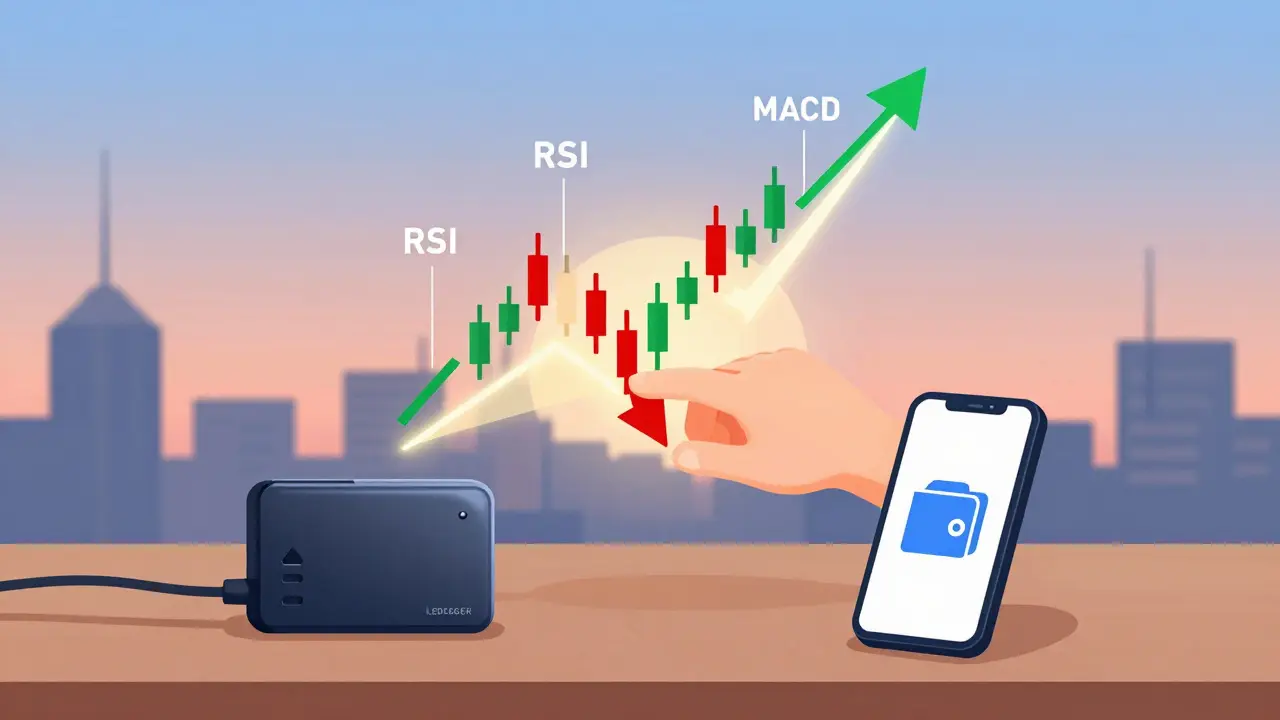
Start with candlestick charts. Each candle shows price movement over a set time-like 15 minutes, 1 hour, or 1 day. A green candle means the price closed higher than it opened. Red means it closed lower. Long wicks? That’s indecision. A long green body? Strong buying pressure.
Use three indicators to filter noise:
- RSI (Relative Strength Index) A momentum oscillator that measures speed and change of price movements, typically ranging from 0 to 100: Above 70? Overbought. Below 30? Oversold. Not a sell or buy signal by itself, but a warning.
- Moving Average (MA) A line that shows the average price of an asset over a specific period, smoothing out price data to identify trends: The 50-day and 200-day MAs are gold standards. When the short-term MA crosses above the long-term one, it’s a potential uptrend signal.
- MACD (Moving Average Convergence Divergence) A trend-following momentum indicator that shows the relationship between two moving averages of a cryptocurrency’s price: Watch for the MACD line crossing above the signal line-that’s often a buy signal.
Don’t overload your chart. Three indicators max. Too many lines make you second-guess every move.
Time Frames Matter
Are you trading for a quick profit? Or holding for weeks? Your time frame changes everything.
Short-term traders (day traders) use 15-minute and 1-hour charts. They look for small price swings, often making 5-10 trades a day. It’s intense. You need to stare at screens. Most burn out.
Swing traders use 4-hour and daily charts. They hold positions for 2-7 days, riding trends. This fits better with a job or life outside trading. You check prices once or twice a day. Less stress. More sleep.
Round numbers matter. Bitcoin at $85,000? $90,000? $100,000? These aren’t random. Thousands of traders place orders at these levels. That creates natural support and resistance zones. Watch what happens when price hits $90,000. Does it bounce? Or break through? That tells you who’s in control.
Manage Your Risk Like a Pro
The biggest mistake new traders make? Betting too much.
Rule #1: Never risk more than 1-2% of your total trading capital on a single trade. If you have $10,000, that’s $100-$200 max per trade. Why? Because crypto can drop 20% in an hour. One bad trade shouldn’t wreck you.
Use stop-loss orders. Set them when you buy. If Bitcoin drops 8% from your entry, the order sells it automatically. No panic. No emotion.
Set take-profit levels too. Don’t just hold hoping it goes to $100K. Decide ahead of time: "If it hits $88,000, I sell half." Lock in gains. Let the rest ride.
Emotions kill traders. Fear makes you sell low. Greed makes you hold too long. Write down your plan before every trade. Stick to it.
Where Do You Store Your Crypto?
When you buy crypto on an exchange, it’s usually stored in a hot wallet an online cryptocurrency wallet connected to the internet, offering convenience but higher vulnerability to hacking. Convenient? Yes. Safe? Not for long-term holding.
For anything over $500, move it to a cold wallet a hardware device that stores cryptocurrency offline, providing enhanced security against online threats. Think Ledger or Trezor. These are physical devices, like a USB drive, that keep your private keys offline. No internet = no hack.
Exchanges get hacked. Even big ones. In 2022, one major exchange lost $300 million because a hacker got in through a third-party vendor. Don’t leave your life savings on an exchange. Move it. Even if it’s a pain to send a transaction.

Long-Term Strategies That Actually Work
You don’t have to trade every day. In fact, most people who try to day trade crypto lose money. The real winners? They buy and hold.
Dollar-Cost Averaging (DCA) a strategy of investing a fixed amount of money into a cryptocurrency at regular intervals, regardless of price is the quiet hero of crypto wealth building. Buy $100 of Bitcoin every week. No matter if it’s $70K or $120K. You buy more when it’s cheap, less when it’s expensive. Over time, you average down your cost. It removes emotion. It works.
Some people also invest in crypto ETFs exchange-traded funds that track the performance of a basket of cryptocurrencies or crypto-related assets or stocks like Coinbase (COIN) a publicly traded cryptocurrency exchange company that provides spot trading services and holds significant Bitcoin reserves. These give you exposure without holding actual crypto. Good for retirement accounts. Not for active traders.
Why Spot Trading Is Different
Stock markets close at 4 p.m. Crypto never sleeps. Prices move at 3 a.m. on a Sunday. A tweet from Elon Musk can spike Dogecoin 30% in ten minutes. That’s freedom. But it’s also danger.
You can’t rely on news cycles like you do with stocks. Crypto moves on memes, whale wallets, and regulatory rumors. You need to be alert. But you don’t need to be glued to your phone. Set price alerts. Check in once a day. Let the market do its thing.
Volatility is your friend if you’re prepared. It’s your enemy if you’re not. Spot trading gives you control. You own the asset. You decide when to buy. You decide when to sell. No middleman. No expiration date. Just you and the blockchain.
What to Avoid
- Chasing pumps. If something spikes 50% in an hour, it’s likely to dump just as fast.
- Trading on tips from Reddit or TikTok. Most are bots or shills.
- Using leverage. You’re not ready. Not yet.
- Ignoring taxes. The IRS treats crypto as property. Every trade is a taxable event.
Keep records. Use a tool like Koinly or CoinTracker. They auto-import your trades and calculate your gains. Don’t wait until April.
Spot trading isn’t a get-rich-quick scheme. It’s a skill. Like cooking. Or driving. You learn by doing. Start small. Learn the charts. Protect your money. And never trade with money you can’t afford to lose.
Is spot trading crypto safe?
Spot trading itself is safe if you use regulated exchanges and protect your assets with cold wallets. The risk comes from poor habits-like using unregulated platforms, not using stop-losses, or trading with money you can’t afford to lose. The technology is secure. The people? Not always.
Do I need to pay taxes on spot crypto trades?
Yes. Every time you sell, trade, or spend crypto, it’s a taxable event in the U.S. If you bought Bitcoin at $50,000 and sold it at $60,000, you owe tax on the $10,000 gain. Use tax software like Koinly to track trades. The IRS is actively auditing crypto users.
Can I make money spot trading crypto as a beginner?
You can, but it’s unlikely if you’re trying to time the market. Most beginners lose money chasing pumps. The best path is dollar-cost averaging into Bitcoin or Ethereum over months or years. That’s how most long-term holders build wealth-not by trading daily.
What’s the difference between spot trading and futures trading?
Spot trading means you buy and own the actual cryptocurrency. Futures trading means you’re betting on the future price without owning the asset. Futures use leverage, which can amplify gains-or wipe out your account. Spot trading is simpler, safer, and better for beginners.
How much money do I need to start spot trading crypto?
You can start with as little as $10. Most exchanges let you buy fractions of Bitcoin or Ethereum. But to make meaningful gains, you need at least $500-$1,000. That gives you room to diversify, use stop-losses, and absorb small losses without panic.

Eva Gupta
Just wanted to say I started with $20 on Kraken last year and DCA’d into BTC every week. No fancy charts, no indicators-just consistency. Now I’ve got enough to cover my rent for a month. Crypto isn’t about timing the market. It’s about showing up.
Also, hi from India! 🙌
Jeffrey Dean
They say ‘own the asset’ like that’s some moral victory. You don’t own anything. The blockchain doesn’t care if you ‘hold’ it. The exchange still controls the keys. The government still taxes you. The banks still monitor your ACH. You’re not free-you’re just a better-labeled slave.
Wake up. This isn’t decentralization. It’s rebranded Wall Street with more emojis.
Megan Lutz
Spot trading is the only way to start because it forces you to learn the fundamentals before you gamble with leverage. Derivatives aren’t ‘advanced’-they’re addiction disguised as sophistication.
And yes, RSI at 70 doesn’t mean ‘sell.’ It means ‘ask why buyers are exhausted.’ That’s the difference between trading and gambling.
Jane Darrah
I read this whole thing and I’m just… wow. Like, I thought I was the only one who gets that cold wallets aren’t ‘for nerds’-they’re for people who don’t want to cry at 3 a.m. because a hacker drained their Coinbase account.
Also, I bought $50 of ETH on a whim in 2021 and forgot about it. Now it’s worth more than my car. I didn’t trade. I just… didn’t panic. That’s the real strategy.
Also, why does everyone act like ‘dollar-cost averaging’ is some secret ritual? It’s just… buying stuff regularly. Like groceries. Why is this so hard to grasp?
Ian Thomas
Let me ask you something: if spot trading is so simple, why do 90% of beginners lose money? Because the system isn’t broken-it’s designed to extract. The exchanges make money on volume, not on your gains.
They don’t care if you’re rich. They care if you’re active.
So yes, DCA works. But it works because you’re ignoring the noise. Not because the market is fair.
Nash Tree Service
It is imperative to underscore the ontological fallacy inherent in the notion of ‘owning’ cryptocurrency. One does not ‘own’ a digital token; one possesses a cryptographic key that permits access to a distributed ledger state.
Ownership, in the classical sense, implies dominion over a physical object. A blockchain, however, is a consensus mechanism. It is not yours. It is agreed upon.
Therefore, the premise of this article-that you ‘own Bitcoin’-is, strictly speaking, a semantic misstatement. I recommend revising it.
Leah Dallaire
They say ‘use a cold wallet.’ But who’s to say the Ledger factory isn’t compromised? Or that the firmware isn’t backdoored? Or that the CEO isn’t secretly cooperating with the Fed?
I don’t trust hardware. I don’t trust software. I don’t trust people.
I just hold cash. And gold. And a shotgun.
Emily Pegg
OMG I’m so glad someone finally said this!! I’ve been telling my friends for months that you shouldn’t use joint accounts for crypto!! My ex tried to steal my ETH after we broke up and I had to hire a lawyer 😭😭😭
Also, taxes are a nightmare. I used Koinly and it saved me from an audit. You’re not alone!! 💕
Jamie Hoyle
LMAO ‘don’t use leverage’ like that’s the golden rule. Bro, if you’re not using 10x, you’re not even playing. Spot trading is for people who like watching paint dry.
Real traders are out here shorting Solana on a moon tweet and laughing all the way to the bank. You think $10K is a ‘meaningful’ amount? Try $100K in margin. Then we’ll talk.
Jesse VanDerPol
Charts are useless. I’ve been trading for 7 years. I look at one thing: how many people are talking about it on Twitter. If it’s quiet, I buy. If it’s screaming, I sell.
That’s it.
Denise Folituu
I used to be a day trader. Then I lost $12,000 in one week because I ignored my stop-loss. I cried for three days. I didn’t leave the house. My cat left me. That’s when I started DCA. Now I sleep. I eat. I go to yoga.
Don’t be like me. Be smarter.
Also, why do people still use Coinbase? It’s so clunky. Try Bitstamp. It’s way better. I swear.
Bryanna Barnett
ok but like… who even uses ACH anymore? it takes 3 days?? why not just use a debit card? i know it’s more fees but i need my btc NOW. also, why is everyone so scared of taxes? just pay em. its not that hard. like, its not like you’re robbing a bank. its crypto. chill.
Ethan Grace
They say ‘volatility is your friend.’
What if your friend is a serial killer?
What if your friend shows up at 3 a.m. screaming, ‘THEY’RE COMING FOR YOU!’ and then steals your wallet?
Spot trading isn’t safe. It’s just… quieter than the alternative.
Nancy Jewer
From a portfolio optimization standpoint, spot trading offers maximal alignment with the principle of asset-liability matching, particularly when paired with a DCA framework that mitigates sequence-of-returns risk. The absence of leverage eliminates counterparty exposure, thereby enhancing systemic resilience. Moreover, the non-digital custody of assets via hardware wallets introduces a robust layer of operational security that aligns with best practices in institutional risk management.
That said, the emotional bandwidth required to remain disciplined during drawdowns is often underestimated.
Basil Bacor
u shudnt b tradin crypto at all. its a scam. the whole thing. the blockchain? fake. the coins? just code. the people who made it? rich. the people who follow it? dumb.
go get a job. buy a house. stop wasting time on this.
Brian T
Why are we still talking about exchanges? No one cares. The real issue is that crypto isn’t money. It’s a meme with a ledger.
And we’re all just arguing over which meme to buy.
Just… stop.
Megan Lutz
Someone said DCA is ‘just buying groceries.’ That’s the most accurate thing I’ve read all week.
It’s not about timing. It’s about habit.
And habits are what separate the people who build wealth from the people who chase it.
Keep showing up. Even when it’s boring. Especially when it’s boring.