There’s no such thing as a legitimate crypto exchange called Multi.io. Not because it’s new or niche - but because it doesn’t exist as a real platform. If you’ve seen ads promising low fees, 100x leverage, or hundreds of coins to trade on Multi.io, you’re being targeted by a scam. This isn’t a review of a flawed exchange. It’s a warning.
Why Multi.io Doesn’t Belong in Any Crypto Exchange List
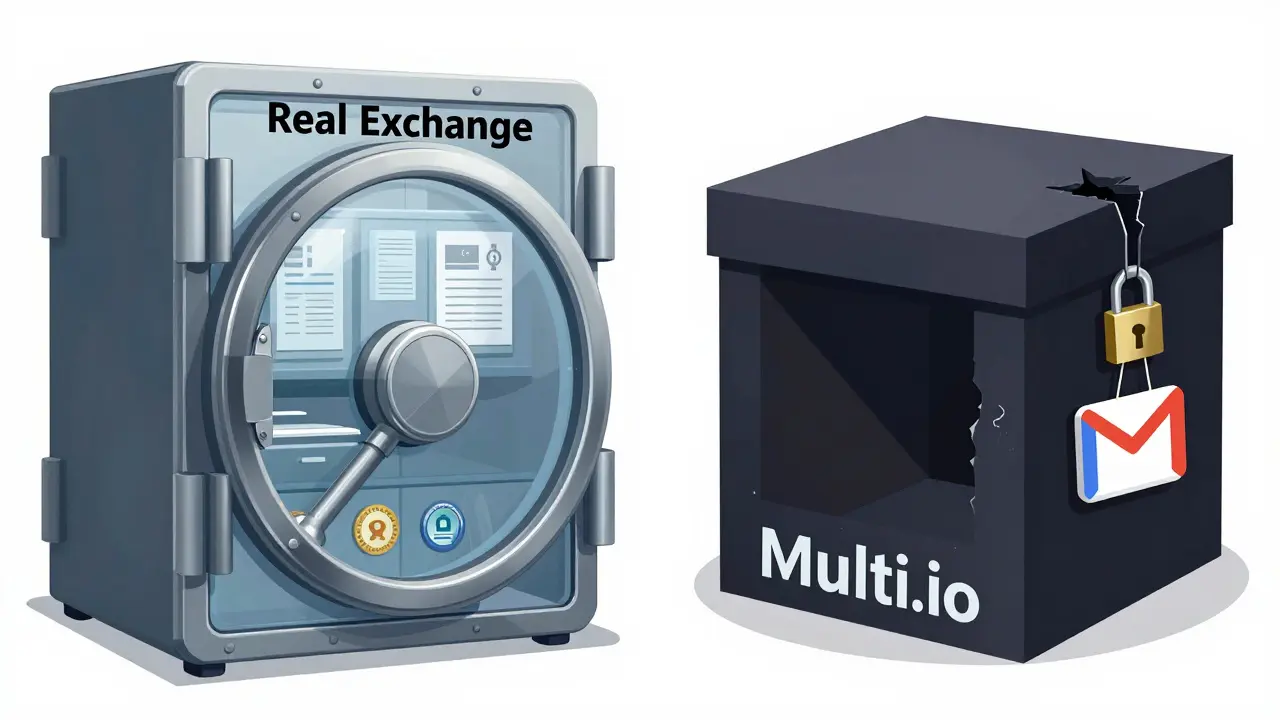
Every major crypto exchange has a public footprint. They’re listed on CoinMarketCap, CoinGecko, and reviewed by trusted outlets like NerdWallet, Coincub, and Koinly. They publish company details, regulatory licenses, security audits, and transparent fee structures. Multi.io has none of that. Look at the real players: Binance, Coinbase, Kraken, Gate.io, KuCoin. They all have public records. Binance has been hacked before - and publicly disclosed how they covered losses. Gate.io had a 2019 breach and openly shared that they compensated users. Kraken holds a New York BitLicense. Coinbase is registered with the SEC. These aren’t bragging rights - they’re baseline requirements for any platform handling real money. Multi.io? Zero transparency. No corporate address. No regulatory registration. No security whitepaper. No GitHub activity. No user reviews on Trustpilot, Reddit, or Bitcointalk. If it were real, even a little bit, someone would’ve talked about it. But no one has. Not because it’s quiet - because it’s fake.How Scammers Mimic Real Exchanges
The name Multi.io isn’t random. It’s designed to confuse. Look at Gate.io - a real, well-known exchange with over 1,000 cryptocurrencies and 100x leverage. The domain names are similar: Gate.io vs. Multi.io. One letter, one word - barely noticeable when you’re scrolling fast on your phone. That’s not an accident. It’s a tactic used by fraudsters to catch people who type the wrong address. Scam exchanges use the same tricks:- Promising impossible returns: “Earn 5% daily on your BTC!”
- Using fake testimonials with stock photos
- Mimicking real UI designs from Binance or Coinbase
- Claiming “low fees” without showing actual fee schedules
- Pressuring you to deposit quickly: “Limited time offer!”
What Real Exchanges Do That Multi.io Doesn’t
Here’s what you can expect from any trustworthy exchange:- Clear company info: Legal name, registered address, CEO. Coinbase is Coinbase Global Inc. Kraken is Payward Inc. Multi.io? No info.
- Regulatory compliance: Licenses from FINCEN, FCA, ASIC, NYDFS. Multi.io has none.
- Security details: 95% of assets in cold storage, multi-sig wallets, insurance policies. Crypto.com insures $250M in assets. Multi.io? Silent.
- Fee transparency: Maker/taker fees listed clearly. Gate.io charges 0.025% / 0.075%. Multi.io? No numbers. Ever.
- User verification: KYC/AML processes with tiered account levels. Multi.io skips this - because if they verified you, they’d have to answer questions.
- Public track record: Audit reports, hack disclosures, customer support logs. Multi.io has zero history.
Where to Find Real Crypto Exchanges
Don’t waste time on ghosts. Stick to platforms with proven records:- For beginners: Coinbase - simple UI, FDIC-insured USD holdings, easy fiat on/off ramps.
- For traders: Binance - lowest fees, 100+ trading pairs, advanced charting tools.
- For security-focused users: Kraken - regulated in the U.S., strong cold storage, transparent audits.
- For altcoin traders: Gate.io - 1,000+ coins, 100x leverage, active community.
- For mobile users: Crypto.com - polished iOS/Android apps, rewards program, debit card integration.
What Happens If You Deposit on Multi.io?
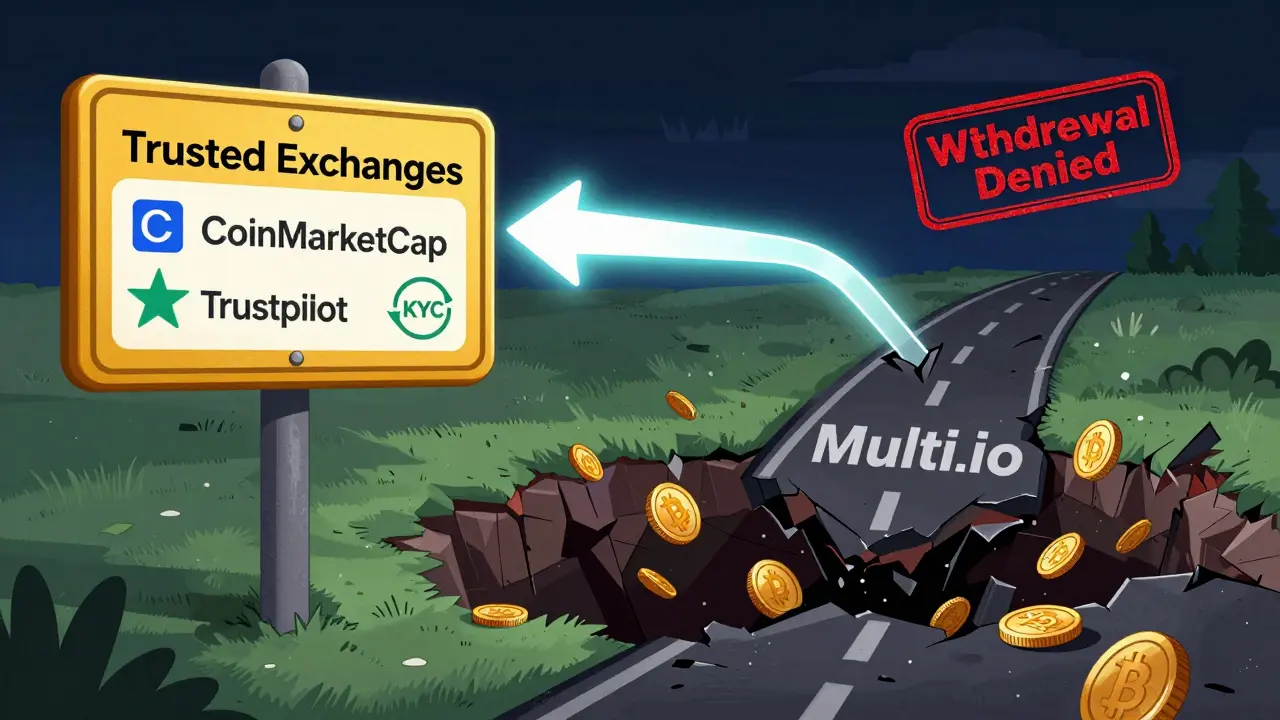
Here’s the truth: you won’t be able to withdraw. Scam exchanges don’t want you to cash out. They want you to deposit - and then vanish. Once you send crypto to their wallet, it’s gone. No reversal. No customer service. No legal recourse. These platforms operate offshore, often using servers in countries with no crypto regulations. If you send $1,000, you’re not investing - you’re donating. Even if you somehow get your coins out, the platform will likely:- Change its domain overnight (Multi.io → MultiExchange.io → MultiTrade.net)
- Disappear from Google search results
- Shut down their social media accounts
- Stop responding to all messages
How to Spot a Fake Crypto Exchange
Use this checklist before you even think about signing up:- Search the company name on the California DFPI Crypto Scam Tracker. If it’s there - walk away.
- Check CoinMarketCap or CoinGecko. If it’s not listed, it’s not real.
- Look for a legal entity. Google “[Exchange Name] + company registration.” If you get nothing, it’s fake.
- Verify the domain. Does it use .com, .io, .org? Real exchanges use official domains. Scams use weird ones like .xyz or .live.
- Check for reviews on Trustpilot, Reddit (r/CryptoCurrency), or BitcoinTalk. If there are zero reviews - or only glowing ones with no details - it’s a red flag.
- Test their support. Send a simple question: “What’s your fee structure for ETH/USDT trades?” If they reply with fluff or no answer - exit.
What to Do If You Already Sent Money to Multi.io
If you’ve already deposited funds:- Stop immediately. Don’t send more. Don’t fall for “recovery scams” promising to get your money back for a fee.
- Document everything. Screenshots of deposits, emails, chat logs.
- Report it. File a complaint with the California DFPI or your country’s financial regulator.
- Warn others. Post on Reddit, Twitter, or crypto forums. Your warning could stop someone else from losing money.
Final Verdict
Multi.io isn’t a crypto exchange. It’s a trap. It’s built to look real, but it has no substance, no oversight, no history, and no future. There’s no legitimate reason for it to exist. The absence of information isn’t an oversight - it’s the biggest red flag of all. Stick to platforms with names you’ve heard before. Use only exchanges that answer your questions clearly. If something feels off - it is.Is Multi.io a real crypto exchange?
No, Multi.io is not a real crypto exchange. It has no corporate registration, no regulatory license, no transparent fee structure, and no verifiable security measures. All major crypto review sites and scam trackers, including the California DFPI and TechForing, show no evidence of its legitimacy. It is a known scam platform designed to mimic real exchanges like Gate.io.
Why can’t I find Multi.io on CoinMarketCap or CoinGecko?
Because it doesn’t meet the basic requirements to be listed. CoinMarketCap and CoinGecko only include exchanges that provide verified data: trading volume, security audits, corporate details, and compliance records. Multi.io provides none of this. Its absence from these platforms is a clear sign it’s not legitimate.
Can I trust Multi.io if it has a mobile app?
No. Scammers create fake mobile apps that look professional to trick users. These apps are often cloned from real exchanges like Binance or Kraken. Even if the app downloads and runs, it’s not connected to a real trading system. Any funds you deposit will go directly to the scammers’ wallets - and you won’t be able to withdraw them.
What should I do if I deposited crypto on Multi.io?
Stop using the platform immediately. Do not send more funds. Document all transactions, screenshots, and communications. Report the scam to your country’s financial regulator and file a complaint with the California DFPI Crypto Scam Tracker. There is no guaranteed way to recover lost funds - prevention is your only protection.
Are there any legitimate exchanges similar to Multi.io?
Yes - but they’re not called Multi.io. Gate.io is a legitimate exchange that offers similar features: 1,000+ cryptocurrencies, 100x leverage, and low fees. If you’re looking for a platform with those traits, use Gate.io, Binance, or KuCoin instead. Never confuse similar-sounding names - scammers rely on that confusion to steal money.


Marie Vernon
Just wanted to say thank you for laying this out so clearly. I’ve seen so many people fall for these fake exchanges, especially new folks just getting into crypto. It’s scary how convincing these scams look - same UI, same jargon, same fake testimonials. I’ve even had friends ask me if Multi.io was legit after seeing ads on Instagram. I sent them this post and they’re now double-checking every platform before depositing. We need more of this kind of awareness.
Stay safe out there, everyone.
- Marie
Ross McLeod
Let’s be honest - the fact that anyone still believes in something called Multi.io is a symptom of a much larger problem. The crypto space has become a breeding ground for cognitive dissonance. People aren’t just ignoring red flags; they’re actively rationalizing them away because they want to believe in the fantasy of easy money. The name ‘Multi.io’? It’s not even clever. It’s lazy. It’s the digital equivalent of a knockoff Rolex with a slightly misspelled logo. And yet, people send ETH to it like it’s a charity donation.
The real tragedy isn’t the scam - it’s the ecosystem that lets it thrive. No regulation? Fine. But when people refuse to do basic due diligence - checking CoinMarketCap, verifying domain ownership, looking up corporate registration - then we’re not dealing with victims. We’re dealing with participants in a collective delusion.
And don’t get me started on those ‘recovery services’ that come after. Those are scams layered on top of scams. It’s like being robbed, then hiring a guy with a fake badge to get your stuff back - for another $5K.
Bottom line: if you’re not researching like a forensic accountant before you deposit, you deserve to lose it.
rajan gupta
OMG 😭 this is literally the most emotional thing I’ve read all week
Imagine sending your life savings to a ghost website 🕯️💔
I cried when I read about the domain changing overnight - like, who does that?! It’s not a business, it’s a haunting.
My cousin lost 12 ETH to something just like this. He still talks about it. We don’t talk anymore. I tried to help. He said I ‘don’t understand his vision.’
crypto is a religion now. and scams are the false prophets.
🙏💔🔥
Billy Karna
There’s a reason why legitimate exchanges invest heavily in public trust - because trust is their only asset. You don’t build a billion-dollar company in crypto by having the best tech. You build it by having verifiable history.
Take Kraken: they got hacked in 2019. Instead of hiding it, they published the full incident report, showed exactly how much was stolen, how they covered it, and what they changed in their infrastructure. That’s not PR - that’s accountability.
Multi.io? Zero history. Zero transparency. Zero accountability. Not because they’re new. Not because they’re small. Because they’re not real.
Here’s a simple rule I use: if you can’t find a company registration number on a .gov domain (like ASIC in Australia or FINCEN in the US), it’s not legitimate. Period.
And don’t fall for the ‘but it has a mobile app!’ excuse. I’ve seen apps that look like Coinbase but were built with Flutter and hosted on a free server from 2017. The backend? A Google Sheet with a webhook. That’s not a platform - that’s a PowerPoint slide with a wallet address.
Check the domain. Check the registration. Check the reviews. If any of those are missing - walk away. No exceptions.
Cheri Farnsworth
This is a public service announcement of the highest order. Thank you for the clarity and precision. The absence of information is not an oversight. It is a declaration. And we must treat it as such.
Gene Inoue
Wow. Someone actually wrote a 3000-word essay on a fake website. Congrats. You’ve turned a scam into a TED Talk.
Here’s the truth: nobody cares about Multi.io. It’s not a threat. It’s a footnote. The real problem is that people still believe in crypto exchanges at all. You think Kraken’s ‘secure’? They got hacked in 2019. Coinbase? They’re registered with the SEC - which means they can be shut down tomorrow if the government says so. And Gate.io? They’re based in China. You think they’re not playing both sides?
You’re not protecting yourself from Multi.io. You’re protecting yourself from your own greed.
Just use a hardware wallet and HODL. Stop trading. Stop trusting platforms. Stop pretending this is finance. It’s a casino with worse odds and no cops.
Ricky Fairlamb
Let me correct the record - this is not merely a warning. It is a forensic exposé of systemic deception in the digital financial ecosystem.
Multi.io is not a scam - it is a *symptom*. A symptom of regulatory vacuum, algorithmic exploitation, and the commodification of trust in post-web2 economies. The domain name ‘Multi.io’ is not accidental. It is a *linguistic weapon* - exploiting phonetic similarity to Gate.io to trigger cognitive autopilot in users with low financial literacy.
The fact that CoinMarketCap does not list it is not a failure of data collection - it is a *moral imperative*. Platforms that lack corporate registration, regulatory compliance, and audit transparency must be *systemically excluded* - not merely ignored.
And yet, the community continues to normalize this. People say ‘I just want to try it.’ No. You are not ‘trying.’ You are volunteering for extraction.
This is not about crypto. It is about epistemology. If you cannot verify the source of truth in a financial transaction, you are not an investor - you are a data point in a predator’s model.
Arlene Miles
You know what? I’ve been in this space for over a decade. I’ve seen ponzi schemes, exit scams, rug pulls - you name it.
But this post? This is the kind of thing that saves lives.
I’ve had so many young people come to me asking if they should ‘put a little in’ to Multi.io. I always say the same thing: ‘If you have to ask, the answer is no.’
And I don’t say that to be harsh. I say it because I remember when I lost my first 0.5 BTC to a fake exchange back in 2014. I was 19. I thought I was being smart. I wasn’t. I was just desperate.
You don’t need to be a genius to avoid scams. You just need to be skeptical. And patient. And willing to walk away.
If you’re reading this and you’re thinking ‘maybe it’s real’ - stop. Breathe. Go check CoinGecko. Go look up the domain registrar. Go read the comments on Bitcointalk. You’ll see. It’s not there. And that’s not an accident.
You’re not late. You’re not behind. You’re not missing out.
You’re safe.
And that’s worth more than any 100x leverage ever could.
Jessica Beadle
Multi.io exhibits all the hallmarks of a non-registered, non-compliant, non-audited, non-transparent, non-verifiable, non-licensed, non-regulated, non-authenticated, non-documented, non-verified, non-traceable, non-identifiable, non-accountable, non-legal, non-physical, non-corporate, non-entity - which, by any reasonable standard of financial infrastructure, constitutes a non-exchange. The absence of any of these attributes is sufficient to disqualify a platform. The absence of all is not merely indicative - it is conclusive. The burden of proof lies with the claimant. Multi.io has not met the burden. Ergo, it does not exist as a functional financial instrument. Case closed.
Tony Weaver
Look - I get it. You’re trying to help. But this whole thing reads like a corporate whitepaper written by someone who’s never actually lost money.
Real talk? I’ve used sketchy exchanges. I’ve lost money. I’ve gotten lucky. I’ve had my wallet drained. I’ve had my email phished. I’ve had fake apps on my phone.
And guess what? None of it mattered. Because crypto isn’t about safety. It’s about risk. And if you’re going to play, you need to accept that some of it’s going to vanish.
Multi.io? It’s not special. It’s just another one. The fact that you’re treating it like a national emergency is the real problem. You’re feeding the narrative that crypto is fragile - when it’s actually one of the most resilient systems ever built.
Stop scaring people. Start teaching them how to lose gracefully.
Because the next scam? It won’t be called Multi.io. It’ll be called ‘CryptoPay Pro’ - and you’ll write another 2000-word essay about it.
And it’ll still happen.
Because people want to believe.
Not because they’re dumb.
Because they’re human.
Patty Atima
This is so helpful. Saved for future reference. Thanks!
Lucy de Gruchy
Let’s not pretend this is about Multi.io.
This is about the fact that CoinMarketCap and CoinGecko are privately owned, unregulated entities with no accountability. They decide what’s ‘real’ - and they’re not immune to influence.
What if Gate.io is also a front? What if Kraken’s ‘audit’ was paid for? What if the SEC is complicit? The entire system is built on trust - and trust is the most easily manipulated asset in history.
Multi.io might be fake. But so is the entire infrastructure that says it is.
Don’t trust the list. Don’t trust the reviews. Don’t trust the ‘verified’ badges.
Trust your own research.
And even then - you’re still gambling.